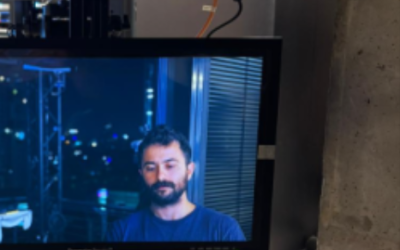
The Fixer at the Edge of History
There is a particular kind of silence that descends in the seconds after a story breaks that changes everything. Not the silence of calm. The silence of people collectively holding their breath.
I know that silence well now.
Since October 7, I have been living a double life. By day, I help families move their lives to Israel. Furniture, appliances, and the physical weight of a decision to make Aliyah. By night, and sometimes through the night and well into the following afternoon, I have been working as a fixer for the foreign press corps that descended on this country in the wake of the massacre and never quite left.
The work began periodically. A contact here, a short gig there. I helped crews from Canada, many European countries, Brazil, etc. The fixer’s role sounds logistical on paper: arranging interviews, navigating checkpoints, translating between languages, and, more importantly, between worldviews. In practice, it is something closer to being the invisible co-author of history’s first draft. You are the person who knows which road to take, which source will actually pick up, which detail will make the story land for an audience that has never been to this country and cannot quite picture it.
I was good at it. But I always wanted the big stage.
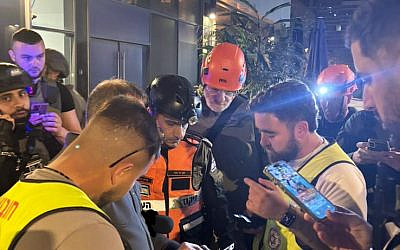 On the night of October 13, the day Israel declared its own version of Victory Day and the last of the hostages came home, I found myself at a bar somewhere between relief and disbelief, surrounded by journalists and other fixers. We had all lived inside this story for so long that we had forgotten what celebrating felt like. That night, through a haze of drinks and delayed emotion, I met a producer. One of those figures in the television news world who seems to know everyone and has been everywhere. She had worked for Big new agency. She understood the game at its highest level.
We stayed in touch. Months passed. Then the war with Iran escalated, and my phone rang.
She offered to connect me to the big name. I said yes before she finished the sentence. I was mid-shift at Kef International at the time, helping coordinate a shipment for a family making Aliyah. I finished the call, set down the phone, and quietly understood that some opportunities do not come back around.
Working with them was immediately, viscerally different from anything I had known before.
Every other outlet I had worked with operated on something like an artisanal model: a journalist, a camera, my car, and a meeting in a hotel lobby at dawn. They arrived like a different species of enterprise entirely. Each team comprised a cameraman, a journalist, a producer, a security advisor, and me. There was an actual bureau, a permanent office, with the institutional gravity that implies. It was the first outlet I had encountered that had a real physical presence in Israel, not just a reporter parachuting in and parachuting out.
The professionalism was total. The talent, across the board, was exceptional.
The nature of a long-range missile war has its own rhythms and its own limitations as television. Much of our work involved driving to impact sites, standing in the rubble, and explaining to audiences on the other side of the world what a cluster munition actually is and what it does to a neighborhood. It is necessary journalism. But it lacks the intimacy of the October 7 stories, the survivor testimony, the impossible personal narratives that had originally drawn me to this work. There is a rawness to those stories that the geography of long-range bombardment cannot replicate.
Then came the night that made all of that feel beside the point.
We were wrapping a late shift, closing down the operation around one in the morning, when the journalist I was working with received a call. Something had happened. We could not leave. An hour passed. Then another. On Telegram and X, the feeds began moving with the kind of velocity that signals something real, not the usual churn of rumors but a cascading flood of fragmentary reports, urgent and unverified and multiplying by the minute.
Then came a call from a senior government contact.
Something terrible had occurred.
For perhaps two minutes, the entire team went still. Phones face down. Eyes up. We took a breath together before the machinery of journalism had to kick back in. There is a version of this work that is purely professional, that processes events and produces copy and moves on. This was not that version.
What followed was one of the longest nights of my professional life. A U.S. F-15E Strike Eagle had been shot down. The pilot had already been rescued. But the Weapon Systems Officer, the WSO, was still missing. For hours, we worked through the dark, reading every feed, cross-referencing every source, verifying and re-verifying everything that moved across our screens while the outcome remained genuinely unknown.
We finally wrapped at eleven-thirty the following morning.
The WSO was found. Rescued. The kind of ending that, had it appeared in a screenplay, you might call implausible. I suspect it will be exactly that within a summer or two.
Over two months with them, I rotated through three different journalist and producer pairings. What I had not anticipated was how much the work changes depending on who you are doing it with. Television journalism is often dismissed as a conveyor belt: find the story, shoot it, broadcast it, move on. In practice, the personality and instincts of the journalist shape everything. What questions get asked? Which silences get held?
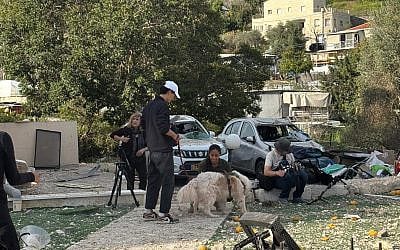 Which stories get told at all, and which ones get quietly left behind.
I had been warned repeatedly that TV news is chaos, high-strung talent, impossible demands, ego running at industrial scale. My experience was the opposite. The teams I worked with were disciplined, genuinely curious, and committed to getting it right. Each one brought a different color to the work. A different way of reading a room, a source, a moment.
I am still at Kef International. Families are still calling. The port is still running. People are still choosing Israel, which continues to say something about this country that no headline quite captures.
But something has shifted in how I understand what I am doing here.
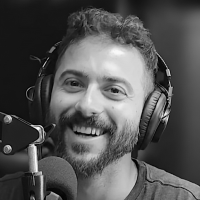
Before October 7, I thought I knew what it meant to live inside a story. I grew up in Jerusalem, spent years translating between the Israeli world and the Anglo one, and built a podcast trying to explain this place to people who could not quite see it from the outside. I thought that proximity was the same as understanding.
It is not. There is a difference between understanding a story and being present in the room when history cracks open, when the phones go face-down, and the silence falls, and everyone holds their breath together, not knowing yet how it ends.
That is what I have been doing since October 7.
I would not trade it for anything.