
The Flag of Humanity
“If they ask me derisively, what is this flag? … a flag is something symbolic and national and with a flag one leads people anywhere one wants, even to the Promised Land. People live and die for a flag…”
These were the words of Theodor Herzl in a letter to Baron Maurice de Hirsch in 1895, explaining why a flag would be so significant to his dream of a future Zionist state. It was not simply cloth on a stick. It was a symbolic embodiment of the values and hopes of a nation.
Flags have a special place in Jewish history. In this week’s parashah, the Jews prepare to travel through the desert. God tells Moshe that they are not to travel in a haphazard fashion but rather with a structured formation. Each person will camp with their tribe. The tribes will be joined in groups of three, forming four super-camps, each led by one tribe. Each of these four camps had a flag:
God spoke to Moshe and Aharon, saying: Each person from the Children of Israel shall camp by his flag, by the signs of their patriarchal house; surrounding the Tent of Meeting shall they camp. (Bamidbar 2:1-2)
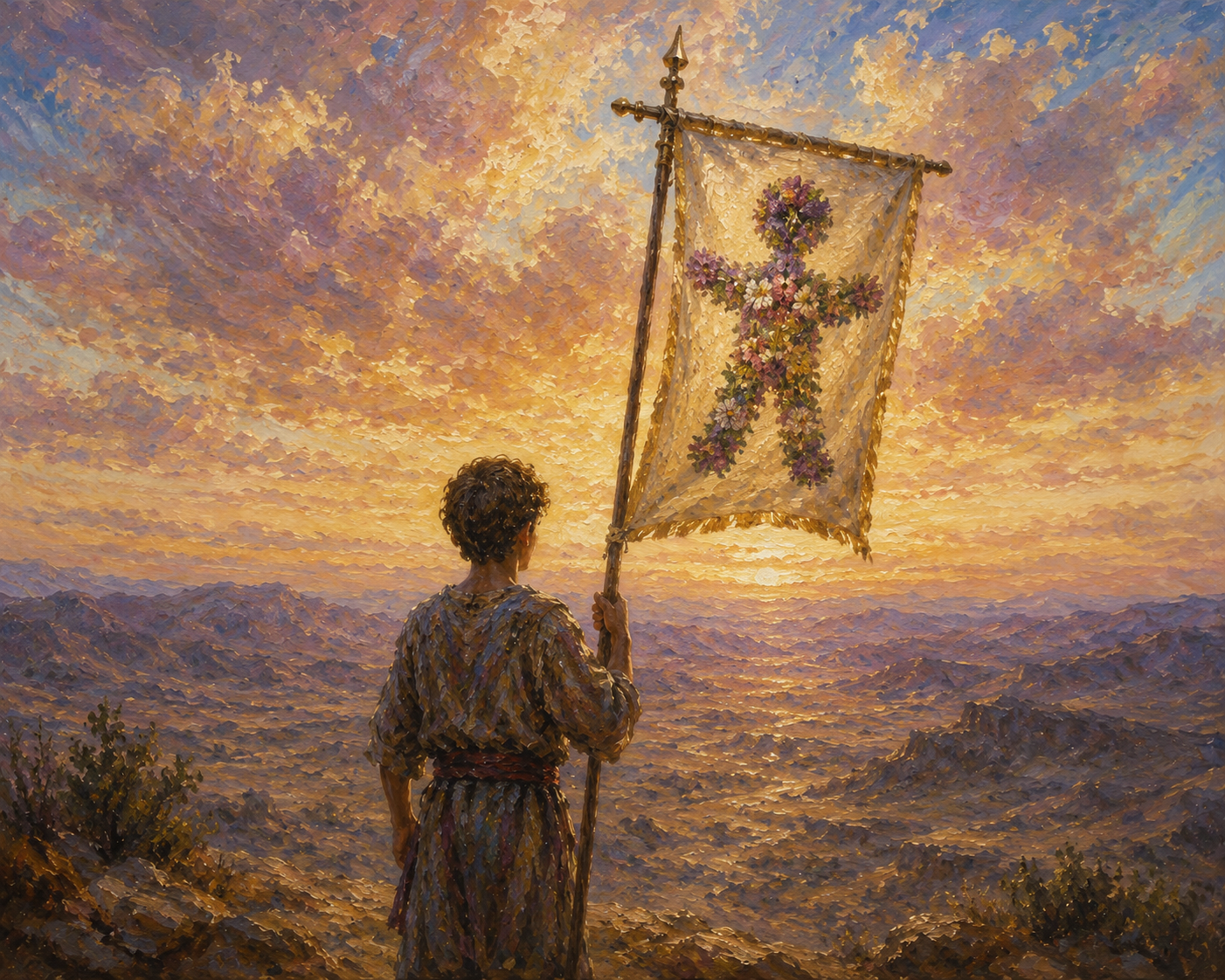
There are various midrashic accounts that detail what the flags looked like. The common theme is that each bore the colours of the three tribes of that camp. Ibn Ezra (ibid) quotes the tradition that the flag of the camp of Yehuda featured a lion. The Camp of Ephraim’s flag carried an ox while the Camp of Dan had an eagle. Fascinatingly, on the flag of the camp of Reuven was a picture of a person. This he claims, was a reference to the dudaim (a human-shaped plant) that centuries earlier Reuven had gifted his mother (details to follow).
The symbolism here is mostly clear: Yehuda’s lion represents its ancestor’s leadership and its future kingship. Ephraim, the son of Yoseph, is represented like his father, by an ox. This is a symbol of power, and probably also an agrarian reference to the food security that Yoseph provided for his family in Egypt. Dan, the camp that functioned as the rearguard is represented by an eagle: symbolic of its sheltering and daunting presence. It is the symbolism of the flag of Reuven that requires explanation. Throughout human history, there have been many symbol-bearing flags. It is exceptionally rare for a flag to carry the human form. Even given the reference to the episode of the dudaim, why is such an insignificant story given such prominent symbolism?
Let us delve into the story of the dudaim, a short tale of what seems like a mundane, petty dispute but in fact, is microcosmic of life in Yaakov’s household:
Once, at the time of the wheat harvest, Reuven went and found some dudaim in the field and brought them to his mother Leah. Rachel said to Leah, “Please give me some of your son’s dudaim.” But she said to her, “Was it not enough for you to take away my husband that you would also take my son’s dudaim?” Rachel replied, “Therefore, he shall lie with you tonight, in return for your son’s dudaim.” (Bereishit 30:14-15).
The commentators make great efforts to explain what “dudaim” are; it is a word that does not appear elsewhere in the Torah. Many explain that they were some kind of herb. Ramban explains that they were leaves or fruit with a pleasant smell. Ibn Ezra adds that the dudaim had the shape of a small person. This gives us a small clue, but we still need more:
Yaakov, Rachel, and Leah found themselves in an exceptionally complicated marriage. Yaakov had always wanted to marry Rachel but was tricked into marrying Leah. In the end, he married both. The difficulties of this marriage are laid bare in two of the most tragic pesukim in the Torah:
וַיָּבֹא֙ גַּ֣ם אֶל־רָחֵ֔ל וַיֶּאֱהַ֥ב גַּֽם־אֶת־רָחֵ֖ל מִלֵּאָ֑ה וַיַּעֲבֹ֣ד עִמּ֔וֹ ע֖וֹד שֶֽׁבַע־שָׁנִ֥ים אֲחֵרֽוֹת: וַיַּ֤רְא ה’ כִּֽי־שְׂנוּאָ֣ה לֵאָ֔ה וַיִּפְתַּ֖ח אֶת־רַחְמָ֑הּ וְרָחֵ֖ל עֲקָרָֽה: (בראשית כט:ל-לא)
And He (Yaakov) came (in marriage) to Rachel also; and he loved Rachel more than Leah. And he served him (Lavan) another seven years. And God saw that Leah was hated and he opened her womb, yet Rachel was barren. (Bereishit 29:30-31)
These pesukim are deliberately worded in a contradictory manner. The second pasuk says that Leah was hated, yet the first passuk does not say that Yaakov hated Leah. On the contrary, it is implied that he did indeed love her, he just loved Rachel more. Leah wasn’t hated, but she felt hated. Love viewed through a relative prism can sometimes feel like hate. The Torah tells us something striking. Even though it was only her experience, God saw Leah’s pain. He blessed her with a child.
Leah wasn’t the only person who suffered. Yaakov was torn between a wife he never wanted but wouldn’t leave, and a wife which he always wanted but would never be truly alone with. Leah could not be blamed for wanting love but would always feel unloved. Rachel had allowed her sister to marry her husband but had to watch her become the only mother of his children. Good marriages have enough love for two people. For no fault of their own, these three people were made to share, none would have the amount of love they deserved.
Yet there is a fourth person in this story, one that gets overlooked. Watching all of this, is the young firstborn child: Reuven. He grew up in this family, he saw his mother’s pain. He couldn’t fix it, but wanted to ease it. He wanted her to feel loved. Fueled by the pure love of a child, he went out to the field to find something for her. Some flowers perhaps. Or perhaps something more: if dudaim were indeed the shape of a person, maybe young Reuven specifically brought these back. To show her love, he gave her another little person for her to love, and to remember who she was loved by.
This explains the strong reactions from both Rachel and Leah. Each yearned for what the other had. Rachel saw the love Reuven showed towards his mother, and she longed for it. O’ to feel the love of a child! Leah defended herself fiercely: This one form of undiluted pure love that I have – how could you take it from me?!
Reuven was human. He saw his mother’s pain and he cared about it. This act does not get a lot of airtime in the Torah, but it is awarded a gesture worth more than a thousand words. On the flag of Reuven was a person. He cared for people. He had what only humans can have: humanity.
Reuven may not have had the bravery of a lion, the power of an ox, or the fearlessness of an eagle, but he would forever be the tribe that flew the flag of humanity.