
The Flawed Idea behind: ‘I Love Israel, BUT…’
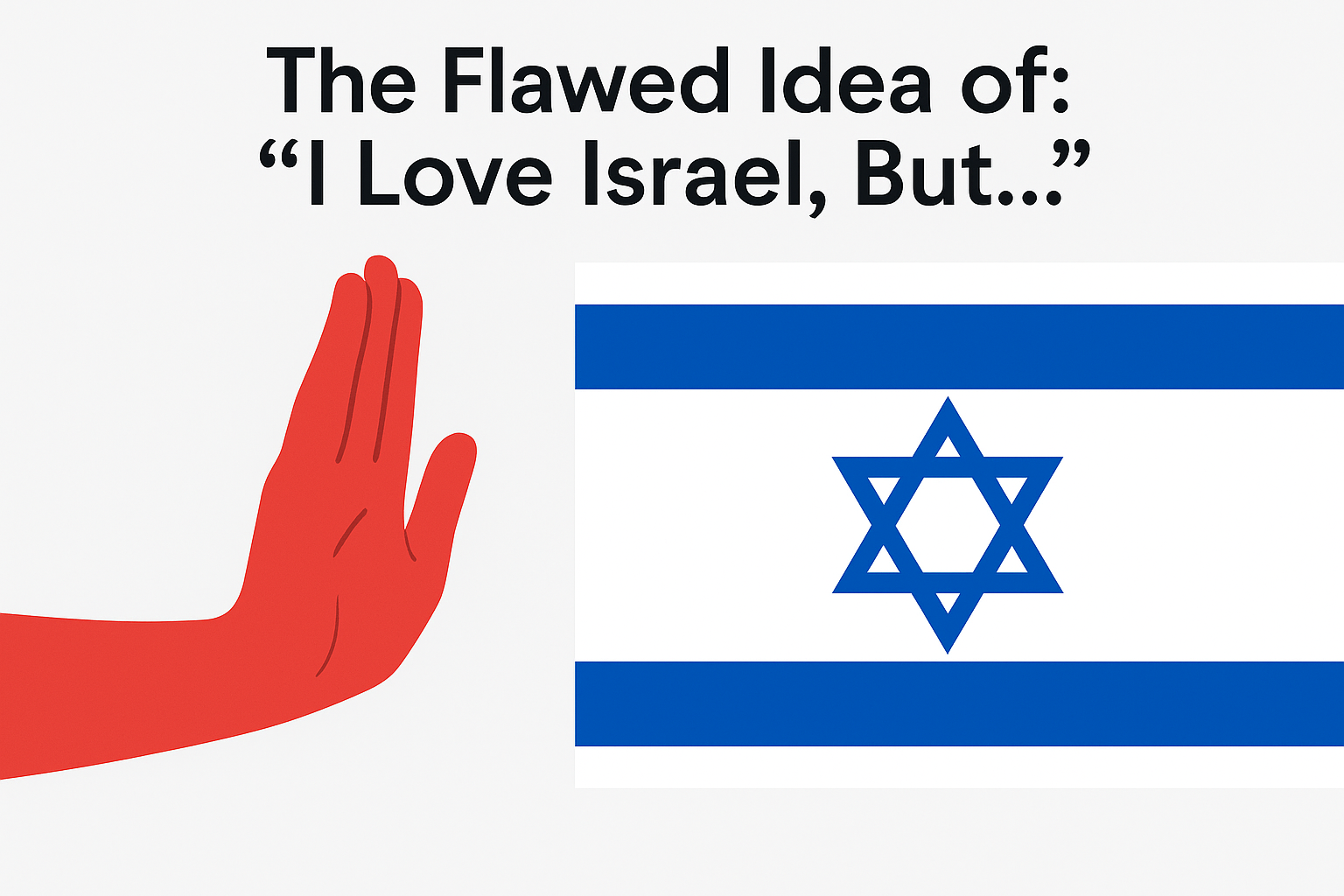
One of the “blessings” of modern day Jewish Life is the ability to be able to listen to the words of many of my colleagues in far away places. More often than not I am inspired by their wisdom and their insight and I find it refreshing to be able to have the pulse of what others are saying and thinking. However, more often than ever before, I listen to colleagues begin their High Holy Day sermons with the same tortured sentence: “I love Israel, but…” And every time I hear it, something inside me turns.
Why must a rabbi, a spiritual heir to Abraham, who stood before God to defend the innocent, feel compelled to preface moral concern with an apology for loving his or her own people?
This formula has become ritualized: a declaration of affection for Israel immediately followed by a lament for Gaza. The implication is unmistakable, that unless we distance ourselves from Israel’s pain, our compassion for others will be questioned. That unless we balance our defense of Jewish life with public contrition, we are somehow morally suspect. It is a corruption of conscience, a sign that even our pulpits are absorbing the rhetoric of those who seek to erase moral clarity.
I know the humanitarian crisis in Gaza is real. I know there is suffering. But I also know that Hamas chose it, that they built their empire of tunnels beneath hospitals and schools, and that their war is not for land but for annihilation. I have seen the videos, the charred rooms, the hostages’ faces. I have met families who buried their children for the crime of being Jewish. And yet we are told that to grieve for them without qualification is somehow callous.
Something is broken when moral symmetry replaces moral truth.
There is no “but” after “I love Israel.”
There is no equivalence between a nation fighting to survive and a terror cult that hides behind its own civilians.
And there is no holiness in confusing the two.
When rabbis, my own colleagues, speak as if Israel’s self-defense requires penance, they unintentionally lend moral cover to Hamas’s strategy. Every time we declare that we “love Israel but,” we grant legitimacy to the lie that Israel’s very existence is conditional, that Jewish survival must always be balanced by someone else’s narrative of victimhood.
It is painful to write this. Many who speak that way do so from compassion. They truly wish for the suffering of innocents to end. I share that wish. But compassion divorced from context becomes cruelty. When compassion forgets who started this war, it turns into complicity. The Torah commands us to choose life not to apologize for defending it.
The deeper question is how we reached this place, how the moral disorientation of our enemies seeped into our own sermons. Perhaps it is the relentless language of “both sides.” Perhaps it is fear… Fear of losing congregants, donors, or social standing. Perhaps it is exhaustion, the desire to appear “balanced” in a world that punishes moral certainty. But prophetic Judaism was never meant to be balanced. The prophets did not say, “I love Israel but.” They said, “Return, Israel.” They cried out against injustice while standing inside their people, not above them.
We must recover that posture. We must learn again to speak from covenant, not from caution. Our moral voice is strongest when it is rooted in loyalty. Loyalty to our people’s survival and to the divine image that makes every human life sacred. To pretend those loyalties are in conflict is to accept the framing of those who would see Israel destroyed and Judaism reduced to apology.
On Yom Kippur we beat our chests for our sins. But loving Israel is not one of them. It is time to stop treating Jewish self-preservation as something to atone for. Israel does not need rabbis who are embarrassed by its struggle to exist. It needs rabbis who can stand at the bimah and say, without hesitation, that defending life is not a sin, that fighting terror is not cruelty, and that Jewish sovereignty is not a moral flaw to be balanced against the suffering our enemies orchestrate.
We can pray for all innocents. We can ache for peace. But we must not surrender moral clarity to fashionable compassion. The prophets of Israel never confused the victim with the aggressor. They never mistook restraint for righteousness when evil advanced. They never began their sermons with “but.”
This year, just like I do every year, I chose to begin mine differently. I began by saying that I love Israel — period. Because love that needs to justify itself is no longer love. And a Judaism that forgets who it is cannot be the conscience of humanity.
Our calling, as rabbis and as Jews, is not to be morally fashionable. It is to be morally faithful to truth, to life, to covenant. If we reclaim that, then maybe next year, from pulpits across the world, we will hear no more tortured prefaces, only the proud, unqualified words: I love Israel.