


The Forgotten Voyage to Palestine aboard the Josiah Wedgwood
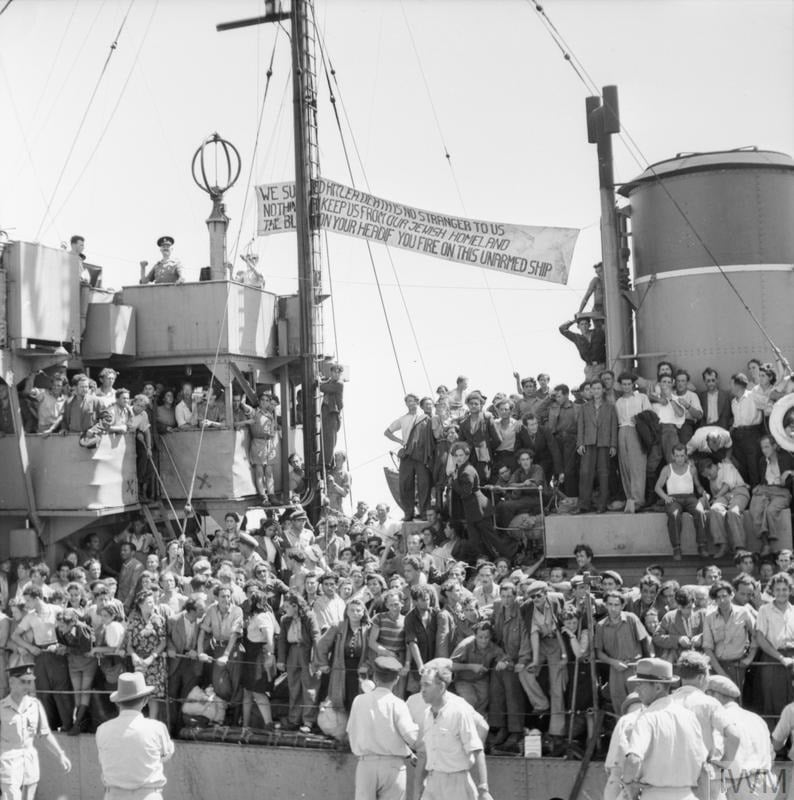
Mediterranean Sea, June 1946 The voyage of the Josiah Wedgwood
They had survived Hitler. Now, within reach of the shores of Palestine, 1,257 Jewish refugees faced another formidable obstacle: the British Royal Navy
In June 1946, four British destroyers surrounded a converted Canadian warship carrying 1,257 Jewish refugees to Palestine. For the passengers crowded aboard, the journey had begun with a promise of freedom. Most had emerged from the wreckage of Europe, their families murdered, their homes destroyed, their former lives shattered. Now, a year after the liberation of the camps, the Royal Navy stood between them and the shores of a land where they hoped to rebuild their lives.
Among the passengers was Regina Semmel, a young Polish woman who would become my mother-in-law, Rifka. She had survived five labor camps, a salt mine, Auschwitz, and Oskar Schindler’s factory at Brünnlitz. Almost her entire family had perished, but her brother Zvi had left Poland for Palestine before the war. She hoped to find him there.
But reaching him would entail another journey with an uncertain outcome.
For Jewish survivors across Europe, liberation had freed them from the Nazis, but left them facing an uncertain future, with nowhere to call home. Their families were gone, their communities destroyed, their homes appropriated. Many remained in displaced-persons camps, waiting for somewhere to take them in. In British-ruled Palestine, the White Paper of 1939 severely restricted Jewish immigration, and those restrictions continued after the war. With legal routes largely closed, survivors turned to the sea. Aliyah Bet, a clandestine operation, became the de facto facilitator for the illegal migration of Jewish refugees to Palestine. Its organizers acquired ships, assembled crews, transported refugees across borders, and arranged departures from European ports. One of those vessels was the Josiah Wedgwood.
And so began one of the extraordinary postwar chapters that has largely faded from public memory: Aliyah Bet, the clandestine effort to bring Jews into Palestine in defiance of British immigration policy.
The Josiah Wedgwood began its career as HMCS Beauharnois, a Canadian warship that escorted convoys across the North Atlantic during the Second World War. After the war, a front company secretly purchased the ship for clandestine immigration and registered it as Colon; aboard, it was known as the Wedgwood, named for British parliamentarian Colonel Josiah Wedgwood, a stalwart Zionist supporter. The Wedgwood was no sleek passenger liner; she was a former warship, hastily adapted for a mission she was ill-suited for. Furthermore, she was a vessel bearing the name of a British champion of Jewish immigration that would now attempt to evade the British blockade! The irony.
Commanding it was Captain Jerry Lichtman, an experienced American Jewish seaman. The crew included American and Canadian volunteers, some of whom had served during the war. After helping fight one battle, they signed on to carry its survivors to a new life.
Before they could begin the crossing, however, the survivors had to find a way to get out of Italy, where they were sequestered in DP camps, waiting for clandestine vessels to take them to their new home.
Near Savona, Italy, preparations were underway to bring the refugees aboard the Wedgwood when British officials learned of the planned departure. The Italian carabinieri were immediately instructed to prevent the ship from leaving the harbor. To divert their attention, Yehuda Arazi, who directed the clandestine operation in Italy, helped orchestrate a disturbance with the local authorities.
The gambit worked. Amid the commotion, the gangplanks were lowered, and Rifka and the other refugees were rushed aboard. Then someone hacked through the mooring ropes, untethering the ship from the bollards. The carabinieri, caught flat-footed, watched in disbelief as the Wedgwood, with its 1,257 passengers, slipped out of the bay and set sail on its daring mission; on June 19, 1946, it entered the Mediterranean, and the race began: reach Palestine before the Royal Navy could stop her.
On board were refugees from across Eastern Europe—Poland, Romania, Hungary, Czechoslovakia and Yugoslavia. They had endured ghettos, forced labor, concentration camps and death marches; among them were children and pregnant women. Providing food, shelter, and care for so many would be a formidable challenge.
Accompanying them were Palyamniks, members of the Palmach’s maritime unit. Working day and night, they distributed food, tended to the ill, and, when necessary, imposed discipline, for which they were often rewarded with shouts of “Kapo!” A reminder of the unhealed scars the survivors carried. Even in the middle of the Mediterranean, the ghosts of the camps were never far away.
Whenever a reconnaissance plane appeared overhead searching for them, the crew hurried passengers below deck so there would be no visible evidence of its human cargo.
They crowded into the holds, where the heat was suffocating, and the stagnant air made conditions even more insufferable. With only nine toilets and three urinals, the passageways were permanently congested with long lines as passengers waited to relieve themselves while the tempestuous ocean pitched and heaved, lashing the ship from stem to stern.
To add to their misery, ventilation had failed in some holds, including the hospital, forcing patients, among them pregnant women, to be evacuated to the belly of the ship. Only five nurses remained on duty; the others were too seasick to work. Hundreds of ma’apilim (clandestine immigrants) became violently ill from the relentless pitching of the ship, while the stench of human waste from overflowing toilets, sluicing down the passageways, made conditions nightmarish. For many, the situation in the hold evoked familiar feelings they’d experienced in the concentration camps.
From the bridge, a Palyamnik radioed Arazi in Italy about the chaos below. Aliyah Bet had never transported this many refugees. Previous ships had carried at most two to three hundred young, fit passengers who could withstand confinement below deck.
Recognizing the situation had reached a crisis point, Arazi sent a telegram to Parliamentarian Harold Laski, a passionate supporter of a Jewish homeland:
This telegram was sent to you by a thousand two hundred and ninety (passengers) who sailed illegally…to Eretz Israel. You are requested to advise the British government there is no way to stop us, even by force of arms although we are unarmed.
SIGNED: Committee of the Ship’s Passengers
Meanwhile, Captain Lichtman pushed the Wedgwood to 13 knots, racing toward Haifa in hopes of slipping in undetected.
On June 23, British command received intelligence of her approach and deployed a flotilla of destroyers.
The following day, the BBC reported that a ship carrying a thousand refugees was being intercepted.
On June 26, with the Wedgwood about 200 kilometers from Haifa, a British-marked plane appeared on the horizon and headed straight for the vessel.
“An airplane has just spotted us,” a disappointed Palyamnik radioed headquarters in Jerusalem.
Three hours later, the British destroyer Venus appeared and signaled:
What ship?
Colon, the Wedgwood signaled back.
The Venus immediately reported to British intelligence:
Vessel is a corvette. No guns. Packed with people. Name Colon…will not give destination.
Back in Jerusalem, headquarters radioed to the Wedgwood:
Raise the Israeli flag and a placard reading “Colonel Josiah Wedgwood,” and continue toward Haifa. If the men on the destroyers do not board, drop anchor at a distance of ten miles from Haifa and shut down engines. Don’t reply to questions. It’s better if they steer or tow the ship.
Three ma’apilim climbed the mast, lowered the Panamanian flag, and hoisted three Israeli flags in its place.
As the Wedgwood passed Cyprus, the Royal Navy dispatched two destroyers to intercept her while the Venus kept pace, trailing half a mile behind.
With the world watching, the Palyamniks, determined to make a final bid to outrun the faster destroyers, urged Captain Lichtman to push the vessel to 16 knots.
Within the hour, the Wedgwood entered territorial waters.
The Venus immediately surged ahead at 19 knots and overtook her.
Half an hour later, the Venus and the two destroyers closed in, surrounded the Wedgwood, and forced her to slow.
Over a loudhailer, the Venus warned:
Stop your ship instantly
In defiance, the ma’apilim unfurled a banner across the bridge:
We survived Hitler. Death is no stranger to us. Nothing will keep us from our Jewish homeland. The blood is on your head if you fire upon this unarmed ship.
Disregarding the command, Captain Lichtman reduced the ship’s speed to 8 knots and continued toward Haifa, flanked by the flotilla.
In fact, the Palyamniks’ attempt to outrun the blockade was pure saber-rattling, since the Wedgwood would inevitably be seized now that she was in territorial waters.
In any event, their plight drew international condemnation, creating a public relations nightmare for the British. The Wedgwood’s secret journey had made front-page news.
At 19:12, the Venus warned:
We will fire if you do not stop
At 19:19, the Venus radioed Jerusalem:
Venus in position to drop depth charges if the ship does not respond to gunfire.
At 20:22, the Venus fired a warning shot across the Wedgwood’s bow.
At 20:26, the Venus fired a second shot, followed by a third.
Even then, the refugees and those commanding the ship sought ways to avoid surrendering the vessel and its passengers to British control.
For hours, the Wedgwood drifted.
Meanwhile, some passengers tried to reach shore in lifeboats, rappelling down ropes thrown over the ship’s sides. But the British destroyers placed themselves between the vessel and the coast, blocking their attempts.
Then, in a dramatic act of defiance, the ma’apilim gathered on deck and began singing Hatikvah. Their voices rose, growing louder and more resolute as they sang it over and over again. Within earshot, the British ceased firing, while the survivors continued to sing.
It would be a cry from the heart, heard across the world, their voices swelling into a thunderous chorus echoing across the Mediterranean. Before them, rising from the shore, the majestic Mount Carmel. Surrounding them, the aqua-blue Mediterranean, their amphitheater.
The song gave voice to the longing that had brought them there: to be a free people in their own land. On deck they stood, a tempest of humanity, their lives shattered, singing within sight of the country they hoped would receive them with open arms.
On June 27, after a 14-hour standoff, British forces boarded the Wedgwood and took control. Under British escort, the battered ship finally limped into Haifa’s harbor.
They had reached Palestine, but they were not free yet. British authorities immediately transferred them to the Atlit detention camp, where they remained for approximately two weeks before being released.
For Regina, this marked the beginning of a life in which she would change her name to Rifka. Decades later, she would entrust me with her storied three years as a slave laborer and the voyage that had brought her to those shores. My Name Is Not Rifka charts our relationship and her extraordinary journey to freedom.
In 1948, the country commissioned the Wedgwood to serve the navy as HaShomer (K-18). Like the ma’apilim, the ship became part of a larger story embodying the pioneering spirit that helped lay the foundation of a nation that would one day be called Israel.
And the song they sang within sight of Mount Carmel became their country’s national anthem.