Courtyards and Characters: Wandering Through Jerusalem’s Living Stories
The Fourth Quarter
What two Armenian shopkeepers in Jerusalem taught me about tradition, technology and my own professional challenge
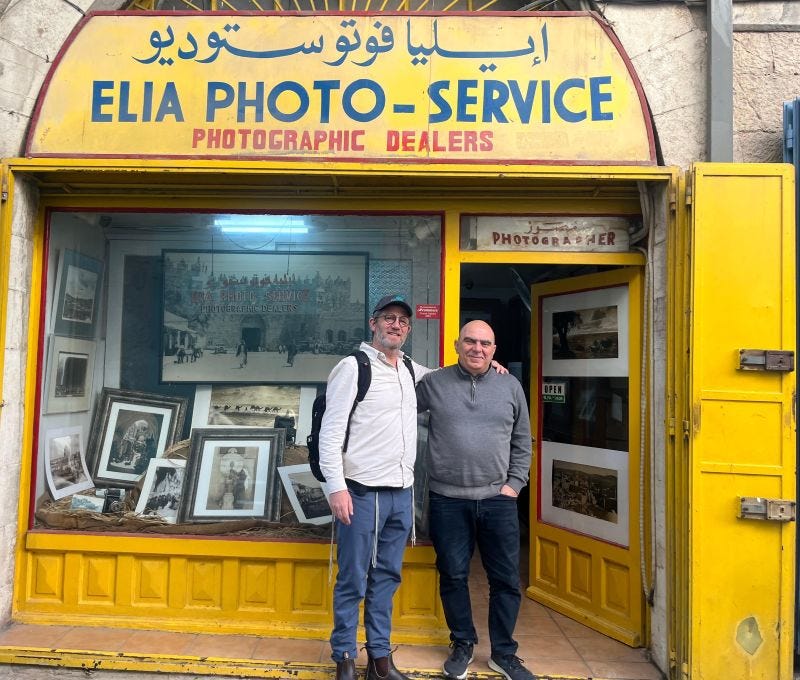
The author with Elia Kahvedjian in front of his shop.
Jerusalem trivia for 500:
The Old City has four quarters. Three of them make perfect sense: Jewish, Christian, Muslim.
Who possesses the fourth?
The answer, which tends to surprise people, is: the Armenians.
The Armenians? Who even are the Armenians? And how did this tiny minority manage to secure an entire quarter in a place where every stone is argued over, claimed, reclaimed, and fought for?
That question propelled me to investigate this for an upcoming episode of The Jerusalem Files. I’ll deal with the history and politics of it there. But before doing that, I want to tell a different story. Because the real reason the Armenian Quarter exists has less to do with politics and more to do with the people who live there.
If you’ve walked through the Old City, you’ve seen Armenian ceramics. Plates, bowls, tiles, hanging in nearly every gift shop. Blue and red patterns. Floral designs. Jerusalem scenes. They’re so common that most of us stop noticing them. You know, this stuff:
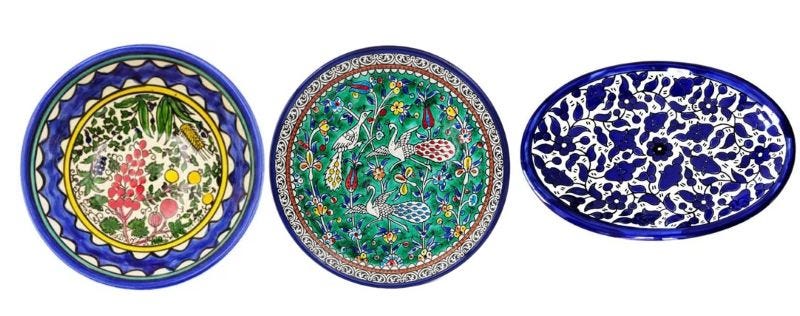
I went to see where they come from.
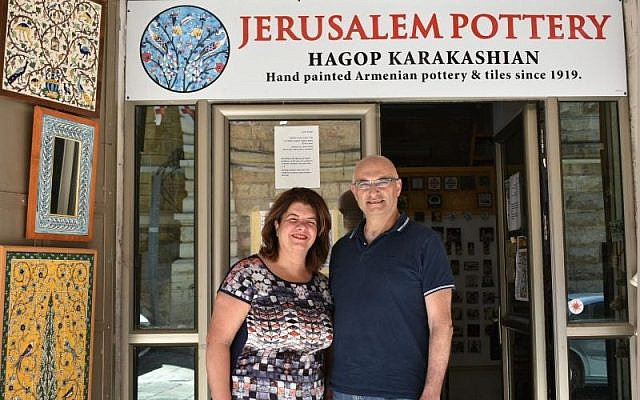
That’s how I ended up in a small shop on Greek Orthodox Patriarch Street, sitting across from Hagop Karakashian. He’s quiet, polite, and warm. He’s definitely not a salesman. From Hagop, you will never hear: “My friend, come inside, I make you a deal, my friend.” His shop isn’t trying to pull you in. It’s there if you want it.
Hagop’s grandfather, Megerditch Karakashian, was a master painter from Kütahya, in what is now Turkey. In 1919, he was invited to Jerusalem by the British to take part in a project to create 40,000 hand-painted ceramic tiles of the Dome of the Rock. That project never happened, but his family stayed, making their new home in Jerusalem. (Interestingly, the project was derailed because the Muslim authorities refused to allow Armenians, who are Christians, to create the materials for their holy site.)
Leaving Turkey meant leaving persecution behind. It meant distance from the Armenian genocide, which would eventually claim the lives of a million and a half Armenians. He brought his family here slowly. In 1922, together with a partner, he opened a small workshop and began producing tiles, work rooted in a deep tradition that had traveled with him.
His son, Stepan Karakashian, continued developing the craft.
If you are wondering, yes, Karakashian sounds a lot like Kardashian. The Kardashians are by far the most famous Armenian family ever. Cher, the Goddess of Pop, is also Armenian. Does anyone want to guess her real name? Cheryl Sarkisian.
Back to the point. Today, Stepan’s son, Hagop, is the third generation doing the same work, painting each piece by hand, just the way he was taught.
The tiles are beautiful.
They are also surrounded by competition that didn’t exist for his grandfather or his father.
The shop next door sells ceramics that look almost identical. So does the shop three doors down. They have the same shapes and colors. But there is one difference. It’s called Made in China. Mass-produced by machines, they sell at a fraction of the price. And to most people walking through the Old City, the difference is invisible.
Hagop knows exactly what he’s up against. He doesn’t complain about competition or trends. The way he works is how his father worked and how his grandfather before him worked. For Hagop, veering from that simply isn’t an option. It would be a betrayal. He would rather live with less than turn this into something it was never meant to be, giving something up that isn’t his to give.
Hagop has one child. A daughter.
The question he carries is simple and heavy. Will she continue this work, or will she choose something else? Perhaps something that makes more sense in the world she lives in now, with its focus on technology, startups, and growth.
And this seems to be a question a lot of people in the Armenian community are asking themselves as their precious, tight-knit community slowly scatters. Young people, for the most part, are choosing to seek their futures abroad, far away from the wars and uncertainty that make planning a future here really hard.
It’s almost hard not to wonder: is this 1,600-year-old community in the final moments of its “Fourth Quarter”?
A few days later, my deep dive into the Armenian community led me to an old photo shop a few streets over.
I’ve always loved old, musty shops. Used record stores when I was a kid. Bookstores in college. Places that just somehow seem stuck in time.
That’s how I ended up walking into Elia Photo Service in the Old City.
A Photo Shop That Time Forgot
The shop opened in 1949, and it looks like it. Old cameras in glass cases. Drawers full of negatives. Walls lined with black-and-white photographs of Jerusalem stretching back decades.
Inside, I met Elia Kahvedjian.
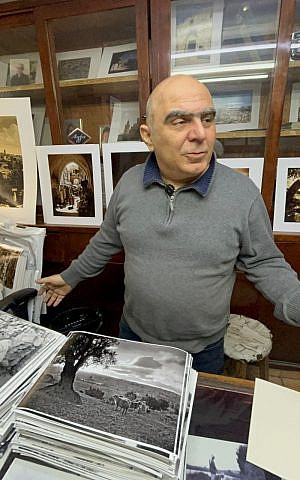
Elia left a job in Israel’s high-tech sector to revive this shop when it was about to close. The shop belonged to his grandfather, who carried the same name.
His grandfather was a survivor of the Armenian genocide, which saw the murder of over 1.5 million Armenians at the hands of the Ottoman Turks. As a child, he was handed to a Kurdish family moments before witnessing the murder of his parents by Ottoman soldiers. He was sold into slavery at the age of five or six, the family doesn’t exactly know, and eventually abandoned on the street. As an orphaned child, he was taken in by an American aid organization and moved between orphanages in Aleppo, Beirut, Nazareth, and eventually, in 1924, he landed in Jerusalem as a teenager.
Kahvedjian wasn’t his grandfather’s real name. The problem was, he had no idea what his real name actually was. His first job as a boy was dragging heavy bags of coffee from place to place, and that’s how he got the name. Kahveh in Arabic means coffee. And the djian, that’s how he made it sound more Armenian. The family kept the name.
His grandfather apprenticed with the Armenian photographer Joseph Toumayan, where he learned the craft. In 1942, he bought a photo shop and named it Elia Photo Service. During World War II, British intelligence and the Royal Air Force relied on his work, making him one of the key photographers documenting Jerusalem under the British Mandate. He photographed everyday life and moments of upheaval alike, opening the shop when the Old City was under Jordanian control and building an archive without realizing it.
Elia, the grandson, inherited that archive. And with it, a decision.
We sat together drinking espresso. Not Turkish coffee, as is the custom here. I didn’t ask why, but I had my suspicions. It seems sort of like buying a German car for Jews. I wondered what he kicks his feet up on when he sits on his couch.
An hour passed. No one walked in. The phone didn’t ring. I found myself wondering how many of these amazing photographs he sells in a week. I bought a few. How could I not?
It was impossible to ignore the reality. This shop is just not going to fly in the modern world we live in. Everything about it resists efficiency. Elia refuses to scan the archive and sell it online. In fact, he refuses advice that would almost certainly help him financially.
Because, just like for Hagop Karakashian, this place is just not about making money. It’s about so much more than that. It helps Elia make sense of his world, to understand who he is, where he comes from. Sure, there could be so many ways he could update and become more efficient, but again, doing so would seem like a betrayal, like giving away something that isn’t his to give.
Eventually, I asked him that elephant-in-the-room question:
What happens to this place when you’re no longer here?
He answered without hesitation. He said he would do everything he could to keep it open long after he’s gone.
Not because it makes sense as a business, because it clearly doesn’t, but rather because it tells his story, his family’s story. Because it tells Jerusalem’s story. Because it defines who he is.
The Question That Followed Me Out the Door
I left both shops thinking about my own work.
People often tell me I should move my podcast to video. That I should interview people in a studio. That YouTube is where the audience is. That audio limits reach. That if I want numbers, I need to adapt. Maybe I should interview celebrities instead of esoteric shop owners. Keep Substacks to 200 words. Add more pictures. More memes.
And you know what? They’re probably right.
In the same way someone could tell Hagop to mass-produce his tiles or Elia to digitize his archive and sell it globally. All of that would work. All of it would make sense.
But it would also turn their work, and mine, into something it was never meant to be.
What Hagop and Elia share is a refusal to chase relevance. They’re choosing meaning instead. And that choice seems to come with a kind of peace.
In a world that’s swapped tradition for technology, they aren’t rushing. They’re content to sit, to talk, to be present. They’re grounded because they know who they are.
It’s hard to believe that people like this, and places like this, still exist. I’m deeply grateful that they do. They remind us that tradition is one of the ways human beings make sense of themselves.
My Wife the Therapist
As always, before hitting publish, I ran all of this by my wife, Ali, the therapist.
Her take was simple: At the end of the day, one of our most fundamental human needs is meaning. Not success. Not popularity. Meaning. A sense that who we are and what we’re doing actually fits together.
Hagop and Elia have that.
I admire these two men. I look up to them. And if I’m honest, I want to be more like them. Because there’s something quietly joyful about living as part of a story that didn’t start with you and won’t end with you.
Related Posts