
Middle East Analyst
The Gaza Executive Board: Why Washington Is Ignoring Netanyahu
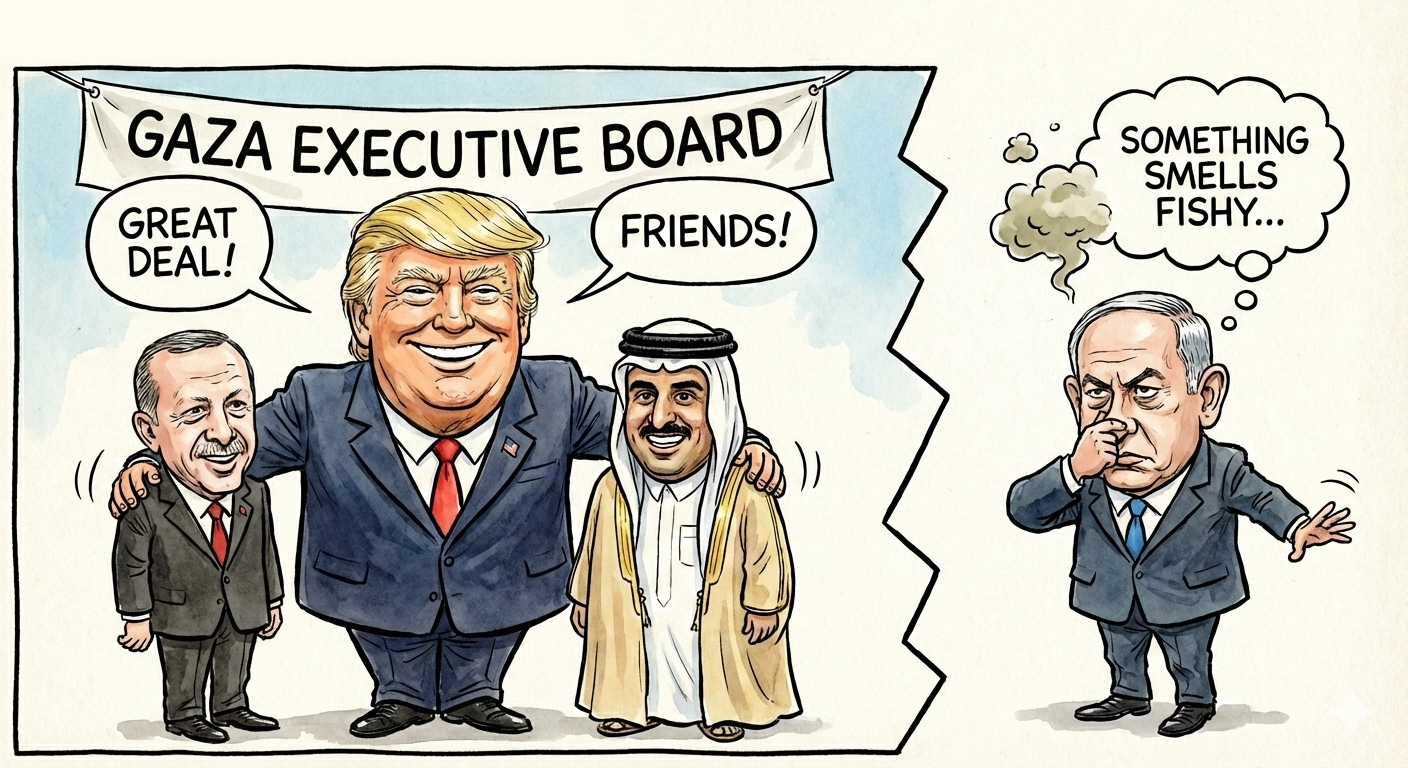
graphic by author
The recent public friction between Washington and Jerusalem over the emerging Gaza governance architecture is more than a diplomatic spat—it is a signal that the United States has stopped asking for permission.
After Prime Minister Benjamin Netanyahu’s office issued a sharp rebuke of the newly proposed Executive Board for Gaza, claiming the move was uncoordinated and counter to Israeli policy, the American response was unusually blunt. “This is our show, not his,” one senior official told Axios. This rhetorical escalation reveals a fundamental shift: The U.S. is no longer seeking a consensus; it is seeking a result.
A Pragmatic Architecture
The proposed Gaza Board of Peace and its Executive Board are designed to be the engines of “Phase Two”: a postwar reality focused on reconstruction, investment, and—most importantly—demilitarization via diplomacy.
The reported roster for this board includes U.S. envoys, international figures, and a “coalition of the relevant”: Egypt, Qatar, Turkey, and the UAE. Notably absent is Saudi Arabia. This omission is telling. It suggests that Washington is signaling that the first priority is demilitarization. Without out it, any planning for reconstruction would be irrelevant. (It also raises questions as to whether Saudi Arabia is dissatisfied with Trump’s plans for the Board of Peace.)
The Logic of Rivals
Netanyahu’s objections focus on Turkey and Qatar, whom he views as Hamas’s political patrons. To Israel, giving these states a seat at the table risks legitimizing the very forces that fueled the conflict.
However, Washington’s view is strictly transactional:
- The U.S. Perspective: Only Turkey and Qatar possess the direct channels of influence necessary to facilitate a credible, diplomatic demilitarization of Hamas. Without them, there is no “off-ramp,” only an endless insurgency.
- The “Maximum Pressure” Factor: Under the Trump administration’s 2026 strategy, the goal is total disarmament and the dismantling of tunnel networks. The appointment of a senior U.S. military commander to lead an International Stabilization Force reinforces that this is a security-first initiative, where the Executive Board first serves as a vehicle for diplomatic disarmament. Then if successful at its first mission, it may become a vehicle for governance and reconstruction.
The Silent Constraint: IDF Overextension
While Netanyahu’s public resistance satisfies his hardline coalition partners, his options are limited. Since late 2023, the Israel Defense Forces (IDF) have operated at an unsustainable tempo.,
Between sustained missions in Gaza, counter-insurgency operations, and the constant pressure of the northern front, the cumulative strain on personnel and logistics is a quiet but decisive factor. A renewed, open-ended ground campaign in Gaza would require a level of national mobilization and international support that is currently out of reach.
Furthermore, Israel’s true strategic horizon remains Iran. For Jerusalem, a U.S.-led framework that “outsources” the management of Gaza—even to rivals like Turkey—is a strategic win if it allows the IDF to pivot back to the existential threat of Tehran’s nuclear and missile programs.
The Bottom Line
An Executive Board that includes Ankara and Doha is Washington’s only chance of actually advancing to Phase II. Netanyahu may continue to protest the optics to satisfy his base, but the intensity of his reaction confirms he knows the initiative is real, imminent, and likely unstoppable.
In 2026, the U.S. strategy is clear: Treat political objections as manageable friction, and diplomatic demilitarization as the only path forward. For the first time in years, Washington isn’t just managing the crisis—it’s moving the goalposts.
Related Topics
Related Posts