CEO of Time to Stand Up for Israel
The Generation Israel Cannot Afford to Lose
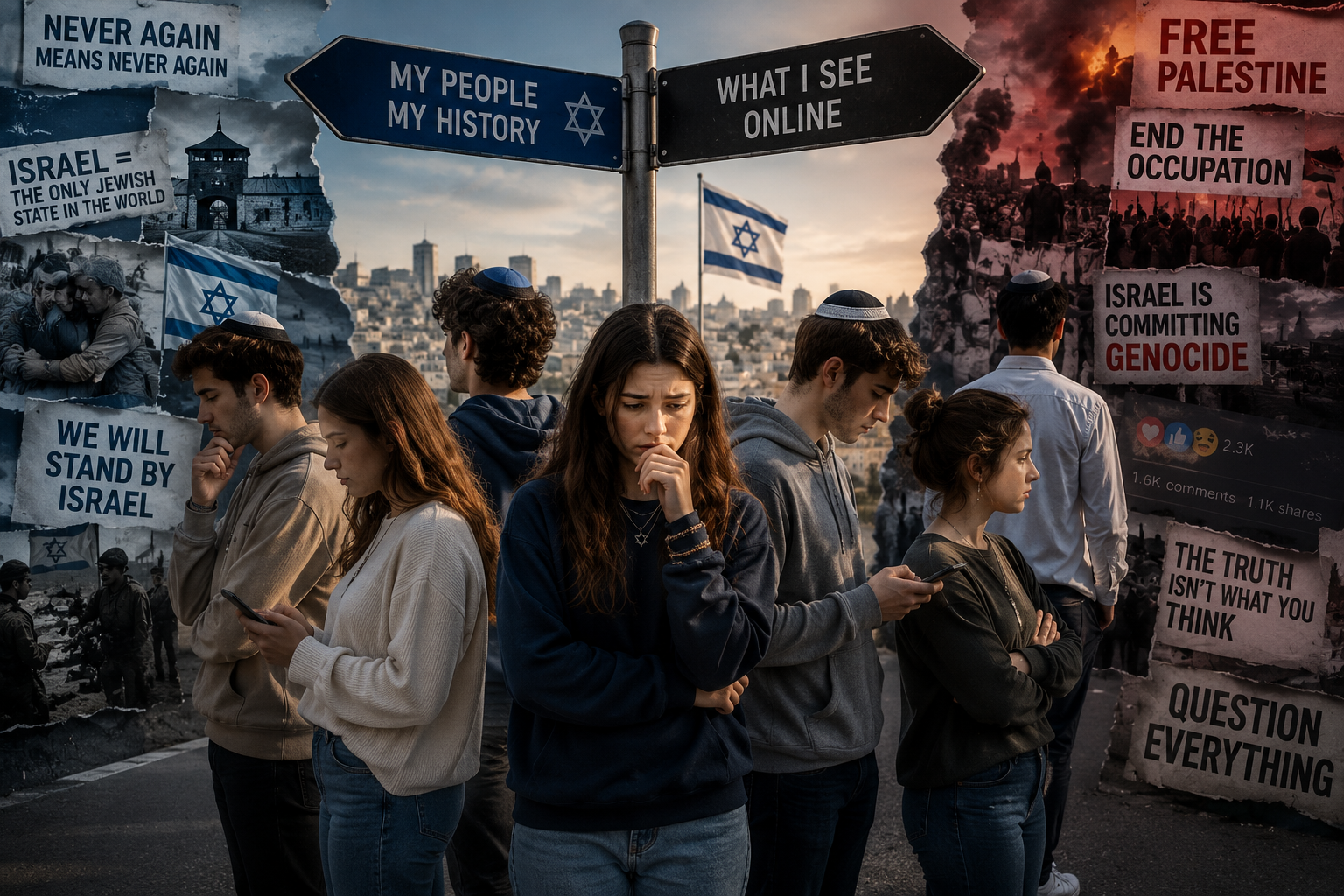
Photo Credits: Sabine Sterk (AI)
Israel knows how to intercept a missile. It knows how to destroy a weapons depot, penetrate an enemy’s intelligence network and send its pilots thousands of kilometers from home. It has built one of the most capable defense systems in the world.
But there is one threat for which Iron Dome offers no protection: a generation that is slowly forgetting why Israel needs defending in the first place.
Recent polling among American Jews should concern everyone who cares about Israel. An AP NORC survey found a significant generational divide in the place Israel occupies within Jewish identity. Among religiously affiliated Jewish Americans, roughly half of those aged 45 and older said supporting Israel was extremely or very important to their Jewish identity. Among younger adults, that fell to about four in ten. Even more disturbing, around three in ten religiously affiliated Jewish adults under 45 said they believed Israel had committed genocide in Gaza.
Another recent survey found that some young Jewish adults are withdrawing from Jewish spaces partly because of arguments surrounding Israel and the Palestinians. At the same time, three quarters still regularly participate in some form of Jewish life.
That distinction matters enormously.
This is not a generation that has necessarily abandoned Judaism. It is a generation whose relationship with Israel is changing.
For those of us who have spent years advocating for Israel, the easiest reaction would be anger. I believe that would be a mistake. Instead, we should ask ourselves an uncomfortable question: How did we allow this to happen?
Perhaps part of the answer is that we assumed Israel’s story would tell itself.
It does not.
Many young people discussing Israel today did not experience the Second Intifada. They do not remember the horrifying period when Israelis wondered whether boarding a bus, sitting in a café or going to a restaurant might cost them their lives. They did not grow up watching the aftermath of suicide bombings in Jerusalem and Tel Aviv.
Many know the checkpoint but not the terrorism that helped make checkpoints necessary. They know the security barrier but not the suicide bombings that preceded its construction. They know Israeli military operations but often know remarkably little about the attacks that triggered them.
Increasingly, even October 7 risks being separated from everything that followed it.
History becomes compressed until cause and consequence are reversed. Israel’s response is remembered in enormous detail while the circumstances that forced Israel to respond gradually disappear into the background.
This is one of the greatest challenges Israel advocacy faces.
We have become very good at responding. Someone makes an accusation and we produce statistics. Someone posts misinformation and we publish a correction. Someone attacks Israel and we explain why the accusation is wrong.
I have done exactly that for years.
But perhaps correcting lies is no longer enough.
Israel advocacy must become better at explaining the complete story before someone else writes a false version of it.
Young people need to understand that Israel did not suddenly appear in 1948 as a foreign colonial project. Jewish history in the land stretches back thousands of years. Zionism was not invented as an instrument of European colonialism. It was the national movement of a people returning to their ancestral homeland after centuries of persecution, exile and longing.
They need to understand that Israel is not simply a conflict.
Israel is also a society.
It is Jews from Europe, North Africa, the Middle East, Ethiopia, India, the former Soviet Union and countless other places. It is Muslims, Christians, Druze, Bedouins and others living within the same small country. It is hospitals where Jewish and Arab doctors work beside one another. It is universities, technology companies, farms, families, arguments, elections, music, restaurants and ordinary people trying to live ordinary lives.
None of this means Israel should be above criticism.
Quite the opposite.
Israel is a democracy, and criticism is part of democracy. Israelis themselves criticize their government every single day. Supporting Israel should never require someone to agree with every prime minister, every coalition or every military decision.
But there is an enormous difference between criticizing Israel and losing sight of why Israel exists.
That is where advocacy must change.
We cannot simply tell young people what to think. We must give them the knowledge necessary to think for themselves.
Take them to Israel. Let them meet Israelis rather than merely reading about them. Let them speak with Jewish families from communities attacked by terrorists, but also with Arab Israelis, Druze soldiers, doctors, entrepreneurs, students and ordinary citizens. Let them visit the border communities. Let them understand how incredibly small the country actually is. Let them see the distance between Israel’s population centers and the enemies openly committed to its destruction.
And most importantly, let them ask difficult questions.
If our case for Israel cannot survive difficult questions, we have failed as advocates.
I believe it can.
Israel has survived conventional wars, terrorism, rockets, international isolation and repeated attempts to destroy it. It survived not because Israelis agreed about everything, but because generation after generation understood something fundamental: there must be one place in this world where the Jewish people are responsible for their own survival.
The generation growing up today did not witness the history that made that necessity obvious to previous generations.
We therefore have to teach it.
Not through propaganda. Not through slogans. Not by pretending Israel never makes mistakes.
Through history, context, encounters and truth.
Israel has spent billions building systems capable of intercepting threats from the sky. Perhaps it is time to invest just as seriously in reaching the minds of the generation below.
Because missiles can destroy buildings.
Losing the understanding of why Israel exists can destroy something far more difficult to rebuild.
Israel can intercept missiles.
It cannot intercept indifference.
And the generation we fail to reach today may be the generation Israel desperately needs tomorrow.
Related Topics
Related Posts