
CEO of Time to Stand Up for Israel
The Victims Nobody Wants To See: Hamas Is Torturing and Murdering Its Own People
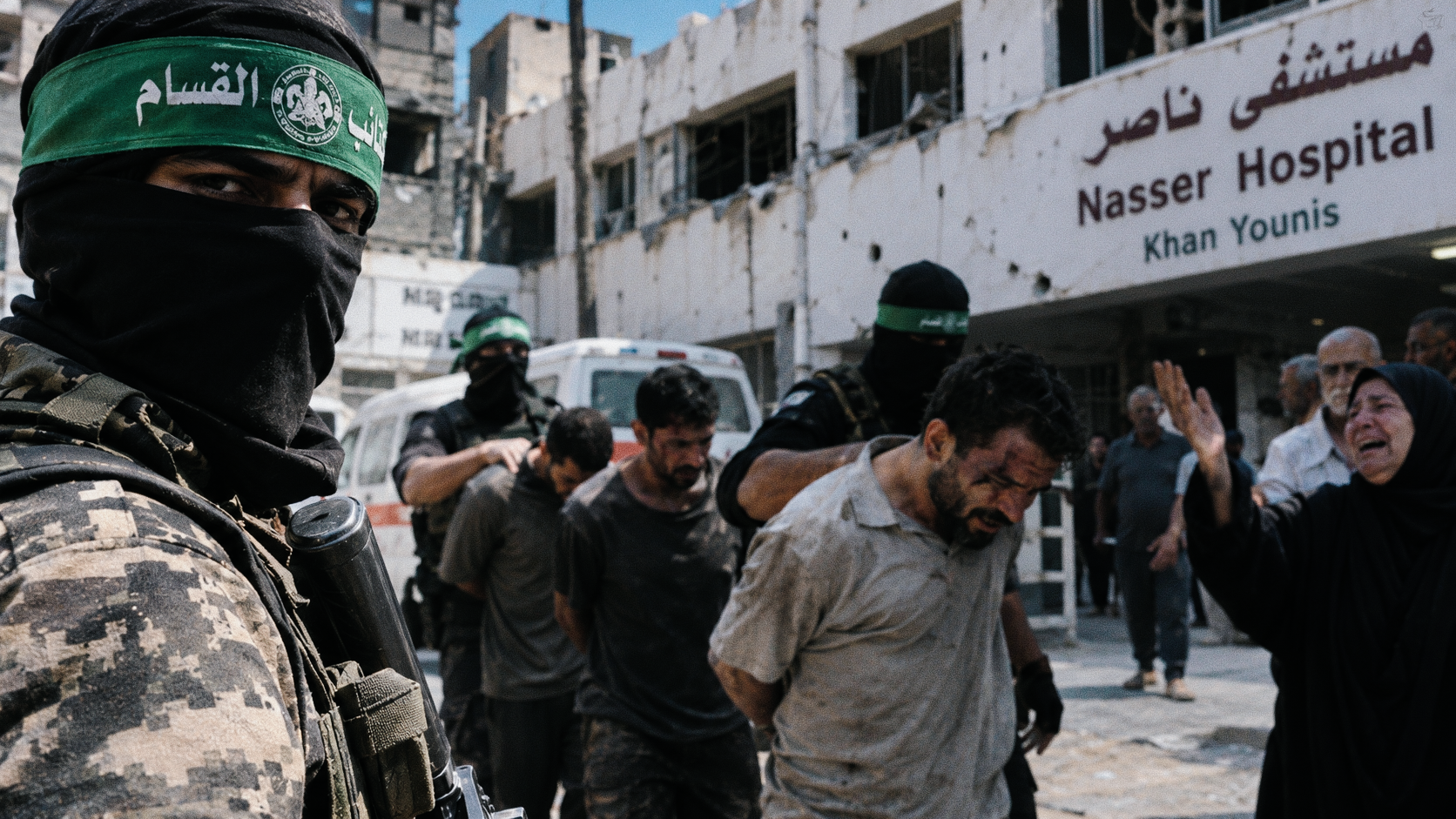
Photo credits: Sabine Sterk ( AI)
When Israel is accused, the world screams. When Hamas executes, tortures and terrorizes the very people it claims to represent, the silence is almost deafening.
There is something profoundly disturbing about the international obsession with Palestinian suffering when Israel can be blamed, while the suffering inflicted by Hamas on its own population receives a fraction of the attention. For years, the world has been presented with an image of Gaza in which every tragedy, every death and every injustice somehow leads back to Israel. Yet behind that carefully cultivated narrative exists another Gaza, one where masked men drag civilians into the streets, where accusations of collaboration can become death sentences, where families are intimidated into silence and where the people supposedly being liberated are themselves prisoners of a ruthless terrorist organization. This is not a story Hamas wants the world to hear. More disturbingly, it is a story that much of the international community appears remarkably unwilling to confront.
When a Hospital Becomes a Place of Fear
Consider the allegations surrounding Nasser Hospital in Khan Younis. A hospital should be a sanctuary, a place where the wounded receive treatment and where human life takes precedence over political ideology. Yet accounts from Gaza describe a far darker reality. According to findings attributed to a United Nations human rights commission, 249 incidents of extrajudicial punishment were documented between August 2024 and January 2026, with 108 reportedly resulting in death. The described methods included executions, deliberate shootings intended to disable victims, broken bones and savage beatings with metal pipes and concrete blocks. Hamas operatives and police were implicated in a substantial number of these incidents, alongside other armed factions.
Witnesses have also described armed activity and violent punishment within hospital compounds, including Nasser Hospital. Doctors Without Borders reportedly suspended certain nonessential activities there after its personnel witnessed masked armed men arresting patients. These accounts raise serious questions about the protection of medical facilities and the civilians who depend on them. A hospital cannot function as a genuine sanctuary when armed organizations are allegedly using its surroundings to intimidate, detain or punish people.
Gazan journalist Hamza al-Masri has made particularly horrifying allegations. Speaking to Al Arabiya, he described an incident in which Hamas allegedly executed 22 young men inside a bus near Nasser Hospital, with survivors subsequently killed inside the hospital itself. Such claims demand independent investigation, but their implications are staggering. Imagine the international headlines if Israeli soldiers had been accused of carrying out precisely the same act. Imagine the emergency meetings, the demonstrations, the condemnations and the demands for immediate accountability. Yet when the alleged perpetrators are Hamas members and the victims are Gazans, the story struggles to command comparable attention. Why?
Are the lives of Gazans worth less when their killers are not Israeli?
Hamas Has Always Feared Its Own Population
To understand this brutality, we must abandon the convenient fiction that Hamas is simply a resistance movement that emerged in response to the latest war. Hamas was founded in 1987, and its violent repression of fellow Palestinians has deep historical roots. Yahya Sinwar, who would eventually become one of the principal architects of the October 7, 2023 massacre, was involved in establishing an internal security organization known as al-Majd. Its purpose included identifying and punishing Palestinians suspected of cooperating with Israel. Sinwar was subsequently convicted by Israel for the murders of four Palestinians.
This is an essential part of Hamas history that is too often ignored. Long before the current devastation in Gaza, Hamas was already prepared to murder members of the population it claimed to defend. Violence against perceived internal enemies was not an unfortunate consequence of war. It was embedded in the organization’s methods from its earliest years.
In 2007, Hamas violently consolidated its control over Gaza after fighting with its Palestinian rival Fatah. The images from that period should never be forgotten. Political opponents were attacked, imprisoned and killed. Human rights organizations documented abuses by Palestinian armed factions, including torture and unlawful killings. Over subsequent years, Hamas developed an extensive internal security structure designed to monitor dissent, suppress political opposition and maintain control.
And what happened to the people of Gaza who dared to protest? They faced intimidation, arrest and violence. During the 2019 We Want to Live protests, Gazans demanded better living conditions and economic opportunities. Hamas security forces responded with beatings, arrests and repression. These were not Israeli demonstrations. These were Gazans protesting against their own rulers, demanding the basic dignity that so many Western activists claim to champion.
Where were the enormous international demonstrations for those people? Where were the university encampments demanding freedom from Hamas? Where were the celebrities holding signs condemning the suppression of Palestinian dissent?
The Terror of Being Called a Collaborator
One of Hamas’s most effective instruments of control is the accusation of collaboration with Israel. In an environment where an accusation can lead to torture or execution, the distinction between genuine evidence and political convenience becomes dangerously blurred. A critic can be branded a traitor. A rival can be accused of espionage. A grieving family can be intimidated into abandoning its search for answers.
According to Hamza al-Masri, families who challenge the treatment of detained relatives risk having those relatives publicly labeled Israeli agents. The message is terrifyingly simple. Remain silent, or your loved one may be condemned as a collaborator. This is psychological warfare directed against an entire society.
More recently, masked armed groups associated with Hamas’s efforts to restore control have reportedly used public beatings, shootings and filmed punishments to terrorize suspected opponents. Groups known as Sahm and Rada have been linked in reporting to these intimidation campaigns. Publicly distributing images of violence serves a calculated purpose. It tells every potential critic that resistance to Hamas authority can have devastating consequences.
Following the October 2025 ceasefire, footage emerged of armed men publicly executing accused collaborators in Gaza City. Rather than allowing a traumatized population to begin recovering, Hamas moved to demonstrate that its coercive power remained intact. The spectacle of public punishment was itself part of the message. And still, international attention remained overwhelmingly focused elsewhere.
The Moral Bankruptcy of Selective Outrage
There is a particularly cruel irony in watching activists in Europe and the United States proclaim themselves defenders of Palestinian human rights while refusing to confront the organization that systematically denies Gazans those rights.
If you genuinely care about the people of Gaza, how can you remain silent when Hamas imprisons journalists, tortures suspected opponents and executes people without a fair trial? How can you demand accountability from Israel while treating Hamas brutality as an inconvenient distraction?
Human rights are not supposed to depend on the nationality of the perpetrator.
None of this means that Israel should be exempt from scrutiny. Allegations of wrongdoing by any armed force deserve serious investigation. Civilian suffering must never be dismissed simply because acknowledging it complicates a political argument. But precisely the same standard must apply to Hamas. Condemning Hamas for murdering Gazans does not diminish concern for civilians harmed by Israeli military operations. It establishes that their lives matter regardless of who kills them.
The uncomfortable truth is that Hamas benefits enormously from the international tendency to view Gaza exclusively through the lens of Israeli responsibility. When every discussion begins and ends with Israel, Hamas’s own decisions, crimes and responsibilities become secondary. Its leaders can present themselves as defenders of a population while denying that population basic freedoms, political alternatives and personal security.
This selective outrage does not protect Gazans. It helps shield their oppressors from accountability.
Gaza Deserves Freedom From Hamas
Israel has repeatedly been accused of being the central obstacle to Palestinian freedom. Yet there is a fundamental question that deserves an answer. What kind of freedom can exist under a movement that executes its own people, crushes dissent and treats political disagreement as treason?
A society cannot be free when journalists fear reporting the truth. It cannot be free when families fear asking what happened to their missing sons. It cannot be free when armed men can turn public squares into execution grounds or when medical facilities become associated with intimidation and detention.
And it certainly cannot be free under an organization that glorifies violence against Israeli civilians while simultaneously brutalizing Gazans.
The people of Gaza deserve leaders who invest in their future rather than sacrifice it to an ideological war. They deserve functioning hospitals, economic opportunities, independent institutions, freedom of expression and the right to criticize those in power without fearing for their lives.
Israel deserves security from terrorism, rocket attacks, kidnappings and massacres. These two principles are not contradictory. In fact, they are closely connected. A Gaza governed through terror, both against Israelis and against its own inhabitants, offers neither population a sustainable future.
The international community must finally recognize that Hamas is not merely a threat to Israel. It is also a threat to the people living under its authority.
Silence Is Not Compassion
For too long, the suffering of Gazans has been selectively amplified or ignored depending on whether it serves a particular political narrative. Victims of Israeli military action become international symbols. Victims of Hamas repression too often disappear into obscurity.
Their suffering is no less real. Their families deserve no less sympathy. Their killers deserve no less scrutiny.
The world cannot credibly claim to defend Palestinian human rights while refusing to confront the Palestinian armed movement that systematically violates them.
If the international community genuinely wants peace, dignity and freedom for Gaza, it must stop treating Hamas as an unavoidable political reality whose brutality can be overlooked. It must listen to the Gazans who risk their lives speaking out, demand independent investigations into allegations of torture and execution, and insist that those responsible face justice.
Because the lives of Gazans should matter even when Israel cannot be blamed for their deaths.
And until the world is prepared to say that without hesitation, its claims of universal compassion will remain painfully hollow.
Related Topics
Related Posts