
Writing on Jewish identity, Israel, and American politics
The Genocide Inversion
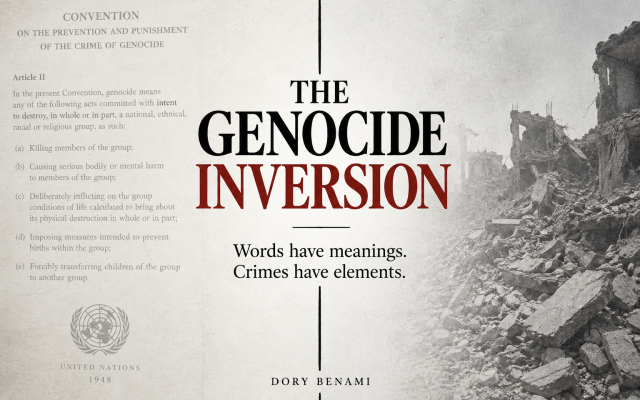
Words have meanings. Crimes have elements. And one of the gravest accusations in human history should require more than repetition.
For nearly three years, Israel has been accused of committing genocide in Gaza. The accusation has moved from protests and social media into newspapers, universities, human rights organizations and political speeches. Eventually, repetition begins to masquerade as proof.
But genocide is not a synonym for a terrible war.
It is a specific crime.
Under the Genocide Convention, prohibited acts must be committed with the intent to destroy, in whole or in part, a national, ethnic, racial or religious group as such.
That final requirement matters enormously.
Civilians can die in horrifying numbers without genocide occurring. Cities can be destroyed without genocide occurring. People can be displaced without genocide occurring. None of these facts makes the suffering less real. They simply do not, by themselves, establish the specific intent that genocide requires.
We understood this distinction in other wars.
The United States and its allies fought ISIS in Mosul in an extraordinarily destructive urban battle. An Associated Press investigation estimated that between 9,000 and 11,000 civilians died during the nine month battle, with at least 3,200 killed by Iraqi or coalition airstrikes, artillery or mortar fire. Yet few people seriously argue that the coalition therefore intended to destroy Iraqis as a people.
The atomic bombing of Hiroshima killed tens of thousands of civilians almost immediately, with many more dying afterward. Sam Harris recently invoked Hiroshima and Nagasaki to make a useful distinction: enormous civilian death does not, by itself, establish genocide. Whatever one thinks about the morality of the atomic bombings, the question of intent remains indispensable.
Why?
Because body count and genocidal intent are different questions.
That distinction seems to disappear when the country fighting is Israel.
What the ICJ actually said
One of the most persistent claims about this war is that the International Court of Justice found that Israel was committing a “plausible genocide.”
It did not.
In April 2024, Joan Donoghue, who had been president of the ICJ when the court issued its January 2024 provisional measures order, explained the point explicitly. The court had determined that at least some of the rights asserted by South Africa under the Genocide Convention were plausible, including the right of Gazans to be protected from acts of genocide. It had not decided that the allegation that genocide was occurring was itself plausible.
The court’s own order is explicit that it was considering the plausibility of the rights for which South Africa sought protection pending a decision on the merits.
That distinction was widely blurred.
It matters because “the ICJ says genocide is plausible” became one of the most powerful talking points of the entire war. The court had said something considerably narrower.
This does not prove that Israel could never commit genocide. It means the case still has to be made.
And that brings us back to intent.
Look at what Israel actually did
If Israel’s objective were to destroy Gaza’s population as a people, some of its conduct becomes remarkably difficult to explain.
Israel repeatedly issued evacuation warnings before military operations. It designated evacuation routes and humanitarian areas. It facilitated humanitarian assistance despite fighting an enemy operating inside the territory receiving that aid.
Critics have challenged the adequacy and implementation of those measures. That criticism should be considered on its merits. But the measures themselves remain relevant when the legal question is whether Israel possessed the specific intent to destroy a people.
Consider one particularly difficult act to reconcile with that claim.
In 2024, after poliovirus was detected in Gaza, humanitarian pauses in military operations were implemented so that a vaccination campaign could reach hundreds of thousands of Gazan children.
WHO and UNICEF had called for the pauses, saying they were necessary to conduct the campaign. The campaign targeted more than 640,000 children under ten. WHO subsequently reported that more than 187,000 children were vaccinated in central Gaza during just the first phase of the campaign.
Vaccinating children does not erase civilian deaths. It does not absolve Israel of mistakes. It does not mean that every Israeli strike was justified.
But evidence does not cease to be evidence because it complicates a preferred narrative.
If the accusation is that Israel intended to destroy Gazans as a people, facilitating a campaign designed to protect more than 640,000 Gazan children from polio is relevant to that question.
So are warnings.
So is humanitarian aid.
So are evacuation orders.
None of these facts is dispositive on its own. Taken together, however, they must be incorporated into any serious analysis of genocidal intent.
Instead, they are frequently treated as though they do not exist.
Hamas cannot disappear from the war it started
There is another extraordinary feature of the genocide narrative: Hamas gradually vanishes from it.
This war did not begin with Israel randomly deciding to destroy Gaza.
On October 7, 2023, Hamas and other armed groups crossed into Israel, murdered approximately 1,200 people and abducted roughly 250 others. Civilians were slaughtered in their homes and at a music festival. Hostages were taken into Gaza, many of them held underground.
Hamas then fought from a densely populated urban environment.
Its military infrastructure was intertwined with civilian infrastructure. Fighters operated from tunnels beneath populated areas. Weapons and other military assets were placed within the civilian environment.
None of this gives Israel unlimited permission to kill civilians.
It does, however, fundamentally affect the battlefield on which civilian deaths occur.
Every serious analysis of this war therefore has to ask two questions simultaneously:
What obligations did Israel have toward civilians?
And what responsibility did Hamas bear for constructing a battlefield in which separating fighters from civilians was extraordinarily difficult?
Too much discussion asks only the first question.
The result is a strange moral universe in which Hamas starts a war, massacres civilians, takes hostages, embeds itself among its own population and continues fighting, yet Israel alone possesses agency.
That is not moral clarity.
It is the removal of Hamas from its own war.
War math
I have written elsewhere about what I call “war math.”
A death toll tells us something important: how many human beings died.
It does not tell us everything else we need to know.
How many were civilians? How many were combatants? How reliable are the underlying figures? How did the civilian to combatant ratio change over time? How does the battle compare with other examples of dense urban warfare? What precautions were taken? What military objectives were being pursued? And, if the allegation is genocide, what evidence establishes the specific intent to destroy the protected group?
These questions do not make dead civilians disappear into statistics.
They are the questions required to distinguish one kind of war from another.
If every sufficiently destructive urban war becomes genocide, then genocide ceases to describe a particular crime. It becomes an adjective meaning “a war I find exceptionally horrifying.”
That makes the word less useful precisely when we need it most.
Why “genocide inversion” matters
There is also something uniquely disturbing about applying this accusation casually to Israel.
Genocide is not simply another political insult in Jewish history.
The modern legal concept was developed by Raphael Lemkin, a Polish Jewish lawyer whose family was largely murdered in the Holocaust. Lemkin coined the word “genocide” and became one of the driving forces behind the adoption of the Genocide Convention in 1948.
That history does not immunize Israel from the Genocide Convention. Israel should be judged by the same law as every other country.
But the historical inversion deserves recognition.
Within living memory, Jews were the victims of an industrial project of extermination. Today, the Jewish state is routinely compared with the regime that attempted that extermination.
“Nazi.” “Genocide.” “Concentration camp.”
The vocabulary is not incidental.
When accusations of genocide are made without demonstrating the required intent, Jewish historical memory itself is turned against Jews.
That is what I mean by genocide inversion.
It does not mean that criticism of Israel is antisemitic. It does not mean that Israel is incapable of wrongdoing. And it certainly does not mean that Gazan suffering should be minimized.
It means that an accusation this grave must be proved rather than presumed.
Words have meanings
I do not need to believe that Israel has conducted this war perfectly to reject the genocide accusation.
I do not believe that Israel is perfect.
Governments make mistakes. Armies make mistakes. Individual soldiers can commit crimes. Those allegations should be investigated on the evidence.
But war crimes, disproportionate attacks, civilian casualties, forced displacement and genocide are not interchangeable concepts.
The distinctions exist for a reason.
Genocide requires something more: the specific intent to destroy a people as such.
If that element cannot be established, accumulating photographs of destruction or repeating a death toll does not manufacture it.
The suffering in Gaza is real.
The horrors of October 7 are real.
Hamas’s responsibility is real.
Israel’s obligations under the laws of war are real.
All of those propositions can coexist.
What cannot survive serious scrutiny is the idea that the most serious accusation available to us becomes true because enough people repeat it.
Words have meanings.
Crimes have elements.
And genocide should remain one of them.
Sources
Convention on the Prevention and Punishment of the Crime of Genocide, United Nations, Article II. The Convention defines genocide through specified prohibited acts committed with the “intent to destroy, in whole or in part, a national, ethnical, racial or religious group, as such.”
International Court of Justice, South Africa v. Israel, Order of January 26, 2024. The Court found that at least some of the rights asserted by South Africa were plausible, including the right of Gazans to be protected from acts of genocide and related prohibited acts. The Court was considering provisional measures and did not decide the merits of South Africa’s genocide allegation.
Joan Donoghue, former President of the International Court of Justice, BBC HARDtalk, April 2024. Donoghue subsequently clarified that the Court had not decided that the claim that genocide was occurring was itself “plausible”; the plausibility determination concerned rights asserted under the Genocide Convention.
World Health Organization, “Humanitarian pauses vital for critical polio vaccination campaign in the Gaza Strip,” August 16, 2024, and “First phase of polio campaign concludes successfully in Gaza,” September 4, 2024. WHO and UNICEF called for humanitarian pauses to permit a vaccination campaign targeting more than 640,000 children under ten. WHO subsequently reported that more than 187,000 children were vaccinated during the first phase in central Gaza.
Associated Press, “Mosul is a graveyard: Final IS battle kills 9,000 civilians,” December 2017. The AP investigation estimated that between 9,000 and 11,000 civilians died during the nine month battle for Mosul and attributed at least 3,200 deaths to Iraqi or coalition airstrikes, artillery or mortar fire.
Sam Harris, discussion of Gaza, genocide and the atomic bombings of Hiroshima and Nagasaki, 2026. Harris invoked the atomic bombings to distinguish the scale of civilian killing from the separate question of genocidal intent.
United States Holocaust Memorial Museum, materials on Raphael Lemkin and the Genocide Convention. Lemkin, a Polish Jewish lawyer who lost much of his family in the Holocaust, coined the term “genocide” and campaigned for its recognition as an international crime.
Amnesty International, “You Feel Like You Are Subhuman: Israel’s Genocide Against Palestinians in Gaza,” December 2024. Amnesty concluded that Israel committed genocide in Gaza and argued that genocidal intent could be inferred from Israel’s conduct and statements by Israeli officials. I disagree with that conclusion for the reasons set out above.
Related Topics
Related Posts