
Clear analysis of Israel's politics, security and history
The Opposition: Demanded Surrender, Now Promising Victory
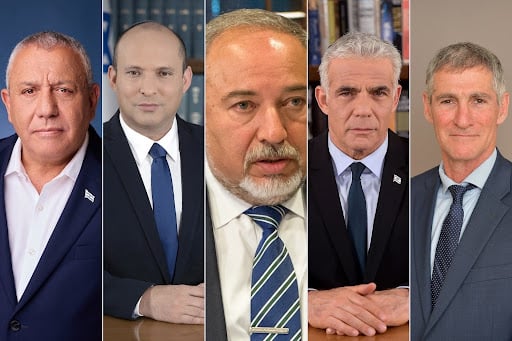
Photo montage: Gadi Eisenkot © Yahav Trudler / Yahav Studio; Naftali Bennett and Yair Lapid © Avi Ohayon; Yair Golan © Shlomi Amsalem; Avigdor Liberman, US Department of Defense / Jette Carr (public domain). Images sourced from Wikimedia Commons, cropped and combined. Composite licensed under CC BY-SA 4.0. Original photographs licensed under CC BY-SA 3.0 and 4.0, as applicable.
Israel is in the final weeks of an election campaign, and the election propaganda machine is now in full swing. Old claims are being recycled, accusations made and records rewritten, while almost three years of war continue to be presented very differently depending on which side of the political divide you listen to.
October 7 was a catastrophic failure, and yes, it happened on Netanyahu’s watch. Much of the opposition’s campaign appears increasingly focused on assigning responsibility for the failures that led to that day. Yet far less attention is being paid to the decisions and policies these same politicians advocated in the months and years that followed.
The deeply ingrained strategic thinking that preceded October 7, the conceptzia, was shared across pretty much all of Israel’s political and security establishment. The notable exceptions were Smotrich and Ben Gvir, but their views were ironically dismissed as extreme, messianic and therefore irrelevant. Regardless of how much blame one chooses to assign Netanyahu for October 7, perhaps the more important question today is who actually learned from the catastrophic conceptzia that had just collapsed? What did Israel’s political leaders say and do afterwards to ensure it doesn’t happen again?
As the war unfolded, they faced real choices, under immense pressure, with real consequences. At virtually every critical stage, Netanyahu’s opponents told Israelis what they believed he was doing wrong and what Israel should do instead. Those statements matter now because they allow us to judge today’s criticism against the decisions these same politicians advocated when the outcome was still unknown. They also offer a far more reliable indication of how each might lead Israel through a future war or security crisis than the promises and rhetoric used to win votes.
The following sections examine what each opposition leader advocated before the October 2025 hostage agreement, and what they are saying now, after the remaining hostages were returned.
Gadi Eisenkot
On January 18, 2024, little more than three months after October 7, Gadi Eisenkot gave his first interview since the massacre to Ilana Dayan on Channel 12’s Uvda. With Israel’s ground offensive still in its opening months, Eisenkot was already publicly questioning whether Hamas could be completely defeated. “Whoever speaks of the absolute defeat of Hamas in Gaza and of it no longer having the will or the capability to harm Israel is not speaking the truth,” he said. “That is why we should not tell tales.”
Just as striking was how early Eisenkot believed Israel should have turned its attention towards ending the war and “the day after”. He argued that discussions about the desired end-state and mechanisms for ending the war should have begun two and a half months earlier, within approximately the first two weeks of Israel’s ground offensive.
Throughout the rest of 2024, Eisenkot criticised Netanyahu for failing to advance the hostage agreement. He argued that Israel could stop fighting for four months, or as long as necessary, to secure the hostages, while insisting that this would not mean the end of the war. The problem was that no such deal was on the table.
On February 10, 2025, the first stage of a new three-phase hostage agreement was being implemented. The second stage envisaged releasing the remaining living hostages, a permanent end to the war and complete Israeli withdrawal from Gaza. Eisenkot stated: “From a value point of view, and from the point of view of the ethos of the State of Israel, there is an obligation to complete all stages of the agreement.” Asked about the possibility of Hamas remaining in control of Gaza, he maintained that Israel could continue fighting Hamas in the years ahead.
What he’s saying now
October 4, 2026: “Three years have passed and Hamas is still standing with 30,000. I promise you that a government headed by me will either destroy or dismantle Hamas — and it will not take very long.”
Naftali Bennett
In the early months of the war, Naftali Bennett was consistently adamant that Israel must eliminate Hamas, dismantle its military capabilities and disarm Gaza, while retaining overall responsibility for its security. That determination remained largely unchanged well into 2025.
However, on June 28, 2025, Bennett called for an end to the war through a comprehensive agreement securing the release of all remaining hostages. Speaking on Channel 12’s Meet the Press, he proposed pulling Israeli forces back from their positions inside Gaza to the perimeter along its border, leaving the destruction of Hamas to the next government.
Hamas, meanwhile, demanded a permanent end to the war, complete Israeli withdrawal and guarantees against renewed fighting. Bennett was advocating an end to the war while presenting the Israeli public with terms Hamas had never agreed to accept.
What he’s saying now
October 7, 2026: “It’s shocking that three years later, Hamas is still standing. It’s a disgrace, it’s shameful. How is it possible that we haven’t destroyed them? It’s an absolute disgrace.”
Avigdor Liberman
In November 2023, Avigdor Liberman was adamant that Israel must completely defeat Hamas, eliminate its leadership and rescue the hostages by force. “We must make a decision to release all the hostages by force,” he declared in an interview with The Jerusalem Post. “I don’t believe in deals with Hamas; they will cheat and claim some of the hostages are in the hands of PIJ, and some in the hands of other groups.”
By December 8, 2024, Liberman had abandoned his earlier opposition to negotiating with Hamas. Quite the contrary, he was now accusing Netanyahu of obstructing a hostage agreement that he claimed had already been finalised. According to Liberman, negotiations were finished, agreements had been reached, and the real obstacle was Netanyahu’s need to satisfy Smotrich and his coalition partners. Yet Brett McGurk, Biden’s own Middle East negotiator, later revealed that Hamas had repeatedly refused to accept the proposed agreement.
On May 20, 2025, Liberman called for the release of all hostages at any price, including ending the war. He maintained that Israel could subsequently resume operations against Hamas.
On June 30, 2025, he made his position unmistakable, calling for all remaining hostages to be released in a single agreement, even at the cost of ending the war and withdrawing Israeli forces entirely from Gaza.
What he’s saying now
October 7, 2026: “The sea is the same sea, and Bibi is the same Bibi – always surrenders to terror!”
Yair Lapid
On October 16, 2023, nine days after the massacre, Yair Lapid was unequivocal. “We must go in there and make sure Hamas is eliminated once and for all. We will not have Hamas on our border anymore,” he declared in an interview with CNN’s Christiane Amanpour.
Just three months later, on January 21, 2024, Lapid was publicly advocating a hostage agreement even at the cost of ending the war. “If the price is stopping the war, then so be it,” he declared in an interview with Galei Tzahal.
Three months was all it took for Lapid to cave on his initial demands.
What he’s saying now
October 8, 2026: “Three years after the massacre – Hamas rules the Gaza Strip with thirty thousand terrorists – Netanyahu won’t succeed in erasing this insane failure from any protocol. To what national and security humiliation Netanyahu has dragged us down. Anyone who wants Israel to return to winning – must send him home.”
Yair Golan
By May 2024, while Yahya Sinwar was still alive, Yair Golan was openly calling for an end to the fighting and the return of all hostages. He also insisted that Israel could retain its freedom to act militarily against Hamas afterwards. Once again, he was advocating a comprehensive deal that Hamas had never accepted.
In October 2024, Golan also proposed ending the war and establishing an alternative government in Gaza, without explaining how it would replace Hamas while the organisation remained armed.
What he’s saying now
October 11, 2026: “Netanyahu continues to allow the Hamas monsters who massacred the residents of the Gaza envelope, raped and murdered brutally — to rebuild, train, build tunnels and recruit fighters…. A responsible leader who understands security would have destroyed Hamas’s rule long ago, and would not have given it a single second after Sinwar’s elimination to rebuild.”
The Deal They Demanded
By June 2025, all opposition leaders, bar none, had advocated accepting Hamas’s demands to secure a comprehensive deal that would bring all the hostages home. Despite some presenting their proposals differently, or insisting on conditions Hamas had never agreed to, the fact remained that, up until that point, Hamas was adamant about the terms required for the release of all remaining hostages.
Those demands included:
- Complete withdrawal of Israeli forces from Gaza.
- A permanent end to the war, backed by international guarantees, including from the United States, with the UN endorsing the ceasefire framework.
- The reconstruction of Gaza.
- Hamas retaining its weapons and effective power in Gaza.
These demands were no secret. Hamas leaders repeatedly stated them publicly as the price for releasing all remaining hostages, and opposition leaders were well aware of them.
Hamas would be left armed and entrenched on Israel’s border, just metres away from the communities it had massacred on October 7, having learned perhaps the most dangerous lesson of all: that taking Israeli hostages would force Israel to abandon its military objectives and ultimately concede to the demands of those holding them.
Of course, the opposition leaders did not present their proposals in those terms. Some insisted Israel could bring the hostages home and then return to fighting Hamas. Others spoke of replacing Hamas with an alternative government, despite the organisation’s military capabilities remaining intact. Whether or not they believed those reassurances, they were incompatible with the conditions Hamas had already made clear it would insist upon.
Hamas was not naïve. They insisted on international guarantees precisely because they understood the implications of a permanent ceasefire. Once Israel had formally agreed to end the war, withdrawn its forces and allowed reconstruction to begin, launching another large-scale ground invasion would become extraordinarily difficult. Israel would face an unprecedented level of international opposition, including from its most important ally, the United States, which would itself have helped guarantee the agreement. Israel would also face the prospect of sending its soldiers back into territory already secured at considerable cost in lives.
Hamas had also made its position on disarmament clear. It would not surrender its weapons or military power to Egypt, the Gulf states or any other proposed replacement authority. Egypt, which both Avigdor Liberman and Yair Lapid had proposed should take control of Gaza, had explicitly rejected deploying its troops there in June 2024.
The bottom line is that, regardless of how they framed it, these opposition leaders advocated ending the war on Hamas’s demands, leaving it right on Israel’s doorstep, with no obligation to disarm or relinquish control. They could dress it up with promises of “returning to fight” or “replacing Hamas”, but there is only one way to describe what they were advocating: a de facto surrender.
The Deal Netanyahu Eventually Accepted
Following the October 2025 hostage agreement, critics argued that Netanyahu could have brought the hostages home much earlier on essentially the same terms.
The differences between the earlier proposals and the agreement Netanyahu eventually accepted were substantial. Trump’s 20-point plan explicitly required Hamas to disarm and relinquish control of Gaza. Equally significant was Israel’s territorial control. Under the initial Yellow Line, the IDF retained approximately 53% of Gaza, providing substantial defensive depth for the Gaza border communities. That figure has since risen to roughly 70%, with future Israeli withdrawals dependent on demilitarisation. These were fundamentally different terms from those proposed in earlier hostage deals, a distinction that cannot be ignored.
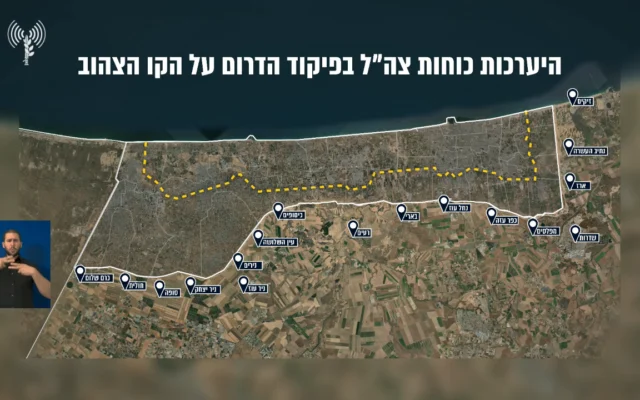
Most importantly, all the remaining living hostages were released relatively quickly once the deal was agreed, with the remains of the deceased hostages subsequently returned or recovered by the IDF.
Another familiar claim is that the agreement was Trump’s achievement alone, with Netanyahu simply forced to accept it. Trump deserves considerable credit for bringing the negotiations to a successful conclusion. Crucially, the agreement also reflected the objectives Netanyahu had maintained since the beginning of the war: returning the hostages, dismantling Hamas’s military and governing capabilities, and ensuring Gaza could never again threaten Israel. The latter objectives remain unfulfilled, but they are explicit requirements of the agreement, with their implementation still being pursued.
The timing of the agreement also matters. Netanyahu pressed ahead with the Gaza City offensive despite fierce opposition criticism. Lapid called the decision “exactly what Hamas wanted”, Liberman accused Netanyahu of sacrificing Israel’s security for political survival, and Golan warned of a “disaster for generations”. Israel then struck Hamas’s leadership in Doha, an operation that Likud subsequently argued had brought the war to Qatar’s doorstep, increasing pressure on Hamas and helping create the conditions for Trump to secure the eventual hostage agreement.
What Might Have Been
Had Israel accepted the deal opposition leaders advocated much earlier in the war, where would we be? Hamas would have remained heavily armed, controlling the entirety of Gaza, with most of its tunnel network still intact. Israeli forces would have withdrawn completely, while international guarantees against renewed fighting would have made another full-scale ground invasion extraordinarily difficult, if not practically impossible. Had Eisenkot, Lapid and Golan got their way, Sinwar would still have been alive today.
Even the return of every hostage was far from assured. Just as Hamas had falsely claimed it could not locate some of the younger women it was supposed to release in November 2023, it is entirely plausible that it could have used the same excuse again. With the IDF withdrawn, Israel would also have lost its ability to independently recover the remains of murdered hostages, as it eventually had to do with Ran Gvili ז״ל.
Netanyahu has yet to achieve all his declared war objectives. The agreement he signed provides a framework for achieving them, but considerable work remains. Yet even judging him on what has been achieved so far, compared with what the opposition advocated, the words famously attributed to legendary Tottenham manager Bill Nicholson come to mind: “It is better to fail aiming high than to succeed aiming low. And we of Spurs have set our sights very high, so high in fact that even failure will have in it an echo of glory.”
Israel’s war has already delivered extraordinary military achievements, with echoes of glory that will resonate for generations. The conditions have been set for achieving its remaining objectives, but the decisions taken from here will determine whether those gains are consolidated into a lasting victory or ultimately squandered. The question now is which leader is best equipped to finish the job. Election promises are easy to make, but there is no hiding from what each leader advocated when the pressure was on and the stakes were highest.
Forget the hype. Check the receipts.
Related Posts