Urban Sociologist and Global Affairs Commentator
The Geometry of Modi’s Absence at Khamenei’s Funeral
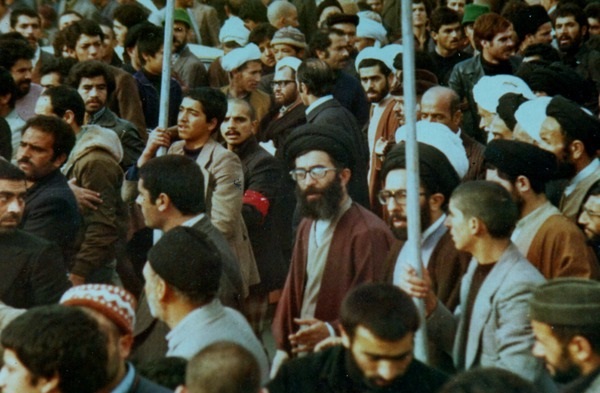
Ali Khamenei (1978) in a protest during Iranian Revolution (Source: Wikimedia Commons)
State funerals, like all theatre, are exercises in geometry. The question is never simply who attends, but where they stand, how close to the centre, and how high up the hierarchy. India’s decision to send Minister of State for External Affairs Pabitra Margherita and Bihar Governor Lt. Gen. (Retd.) Syed Ata Hasnain to the funeral of Ayatollah Ali Khamenei, while Prime Minister Modi stays away (citing a packed schedule), is, in that geometry, a precisely drawn angle: neither a right angle nor an obtuse one. Deliberately acute.
The broader context is extraordinary in ways that the most mainstream media commentaries do not fully appreciate. Khamenei was killed on February 28 in a joint US-Israeli military strike that targeted senior Iranian leadership during a major escalation in West Asia. This is not the passing of an aged statesman after a long illness. It is the assassination of a sovereign head of an ideological state, a killing that drew condemnation from China, Russia, and North Korea, while many Western leaders welcomed the news. India’s representation decision, therefore, is not made in the diplomatic vacuum of peacetime mourning. It is made in a charged atmosphere where the very act of attending is being parsed as an alignment choice by every major power watching.
The Hierarchy of Absence
The first and most significant signal is what India did not do. Modi received an invitation from President Pezeshkian, but he chose not to attend. This matters because the Iranian invitation to India for the funeral of the slain Supreme Leader is an astute diplomatic move: Tehran wanted a major democratic leader’s physical presence, which would have conferred a form of legitimacy upon the Islamic Republic’s ceremony at a moment when Iran is navigating a post-Khamenei succession crisis and trying to demonstrate international standing.
But the downgrade is notable also when measured against India’s own precedent. In 2024, after the deaths of Iranian President Ebrahim Raisi and Foreign Minister Hossein Amir-Abdollahian in a helicopter crash, then Vice-President Jagdeep Dhankhar had visited Tehran to represent India. Raisi was a president, constitutionally subordinate to the Supreme Leader. Khamenei was the Supreme Leader himself, the apex of the Islamic Republic’s power structure. And yet India is sending a lower-ranked delegation this time: a Minister of State (not a cabinet minister) and a state governor. The downgrade is quiet but deliberate. Protocol speaks where diplomats choose not to.
Lower-level Chinese and Russian delegations are also expected to attend, which provides India some cover, but the comparison is instructive rather than exculpatory. Beijing and Moscow openly condemned the killing as a “serious violation of Iran’s sovereignty.” India said nothing of the sort. That silence already represented one choice; the delegation’s rank now represents a second.
The Specific Weight of Hasnain
One dimension deserves careful attention. The inclusion of Lt. Gen. (Retd.) Syed Ata Hasnain is not merely about optics of Muslim representation, though that dimension undoubtedly exists, particularly given the religious character of Shia mourning rituals. Lt. Gen. Hasnain, a highly decorated former Indian Army officer with expertise in the Middle East and counter-extremism, brings strategic depth.
What this means in practice is interesting: India has chosen a figure whose expertise is in countering extremism to attend the funeral of a man who spent decades sponsoring militant proxies across West Asia. The subtext, if one chooses to read it, is that India maintains the relationship through the register of security and strategy, not ideology or solidarity. It is a subtle but unmistakable framing.
There is also a domestic audience for Hasnain’s inclusion. Prime Minister Modi was not averse to attending the funerals of leaders who were staunch friends of India, even if they were not in public office at the time of their death. Khamenei, who frequently drew comparisons between Palestinians in Gaza and Muslims in Kashmir, was not in that category. Sending a decorated Muslim military officer, one whose identity is defined by national service rather than religious politics, threads a domestic needle for Modi’s government: demonstrating respect for India’s Shia and broader Muslim community without elevating Khamenei’s ideological legacy.
The Weight of the Context Modi Is Avoiding
The religious nature of Khamenei’s funeral will be unmistakable. Unlike Sunni Islam, Shiism thrives on justice and resistance, and when the funeral is for someone who was killed or martyred, it acquires a more virulent form. The multi-city procession through Tehran, Qom, and Mashhad, culminating in burial at the Imam Reza shrine, will be suffused with the symbolism of revolutionary martyrdom. Iranian authorities are attempting to bus supporters in from other cities to produce what is described as “a funeral attended by millions,” and leadership is keen to replicate the massive crowds that gathered for Ayatollah Khomeini in 1989. The regime needs this to be a spectacle of legitimacy.
Modi’s absence denies the Islamic Republic a very specific trophy: the endorsement of one of the world’s most watched democratic leaders, at a moment when Iran is navigating a succession crisis, with the Interim Leadership Council, the IRGC, and the Assembly of Experts in contested deliberations over a permanent Supreme Leader. A photograph of Modi at the Grand Mosalla in Tehran would have been propaganda of considerable value. It will not exist.
The Pakistan Counterpoint
Pakistani Prime Minister Shehbaz Sharif and other international leaders are also expected to attend. This contrast is worth dwelling on. Pakistan, another nuclear power, sharing borders with both Iran and India, has chosen a higher level of representation. For India, this is not an embarrassing contrast but a deliberate one. New Delhi has consistently sought to distinguish its strategic posture from Islamabad’s, particularly in its approach to the Islamic world. India aligns with Gulf Arab states, Israel, and the United States in ways Pakistan cannot easily replicate. Modi’s absence from Tehran, set against Sharif’s presence, is a data point for Washington, Riyadh, and Tel Aviv about where India really stands.
The Afghan and Central Asian Dimension
A less examined angle: delegations are expected from Iraq, Pakistan, Afghanistan, Syria, Lebanon, Russia, China, and several Central Asian countries. India’s Chabahar port project is fundamentally about access to Afghanistan and Central Asia, bypassing Pakistan. The Iranian state, not the Khamenei ideology, but the geographic and institutional entity, remains a transit partner India cannot replace. Sending a delegation, even a reduced one, preserves that channel and signals to Tehran that India intends to continue economic engagement regardless of the ideological character of whatever leadership emerges from the succession process.
This is perhaps the most pragmatic dimension of the decision: India is essentially communicating to the post-Khamenei Iranian state, whichever form it takes, that the relationship survives the Supreme Leader’s death and India’s conspicuous absence from his mourning rituals.
What the Woman, Life, Freedom Movement Reads Into It
India has not said a word about the Zan, Zendegi, Azadi movement publicly. It never officially endorsed the protests that followed Mahsa Amini’s death, and it has historically been allergic to commenting on other countries’ internal political arrangements. And yet: a democratic Indian Prime Minister declining to attend the funeral of the man who oversaw the violent repression of those protests, and the January 2026 massacre in which more than 36,500 Iranians were killed by security forces during a two-day crackdown on nationwide protests, carries meaning that requires no press statement. Silence, in this case, is its own statement. The absence of Modi’s presence at the ceremony is the closest India can get to acknowledging the Iranian people’s suffering without formally intervening in another nation’s internal affairs. It is diplomatic empathy expressed through protocol.
The Limits of Calibrated Ambiguity
There is a strong critique to be made of this approach: it is, ultimately, a strategy that keeps all options open while committing to none. India benefits from the relationship with Iran without ever clearly standing with Iran. It signals discomfort with the Islamic Republic without ever risking the cost of real criticism. It gestures at democratic values without being willing to pay the diplomatic price of defending them.
The counterargument, which New Delhi would offer, is that moral absolutism is a luxury that geographically landlocked or strategically exposed powers cannot afford. The Indian government was more concerned with the welfare of over one crore Indian expatriates in the Gulf, a sizeable portion from Kerala, and comforting and reassuring Gulf Arab countries was more vital for India than identifying the aggressor. Real diplomacy serves real interests. A boycott of Khamenei’s funeral would have made not a single Iranian protester safer while potentially jeopardising connectivity infrastructure India spent decades building.
That tension, between values and interests, between symbolism and strategy, will not be resolved by any single delegation decision. But India’s answer, at least for this moment, is to send two serious people, of deliberately measured rank, to walk through a door that the Prime Minister himself has chosen to leave closed.
In that quiet geometry, the message is legible to those who know how to read it.
Related Topics
Related Posts