
The Geopolitical Choice In Israel’s Upcoming Election
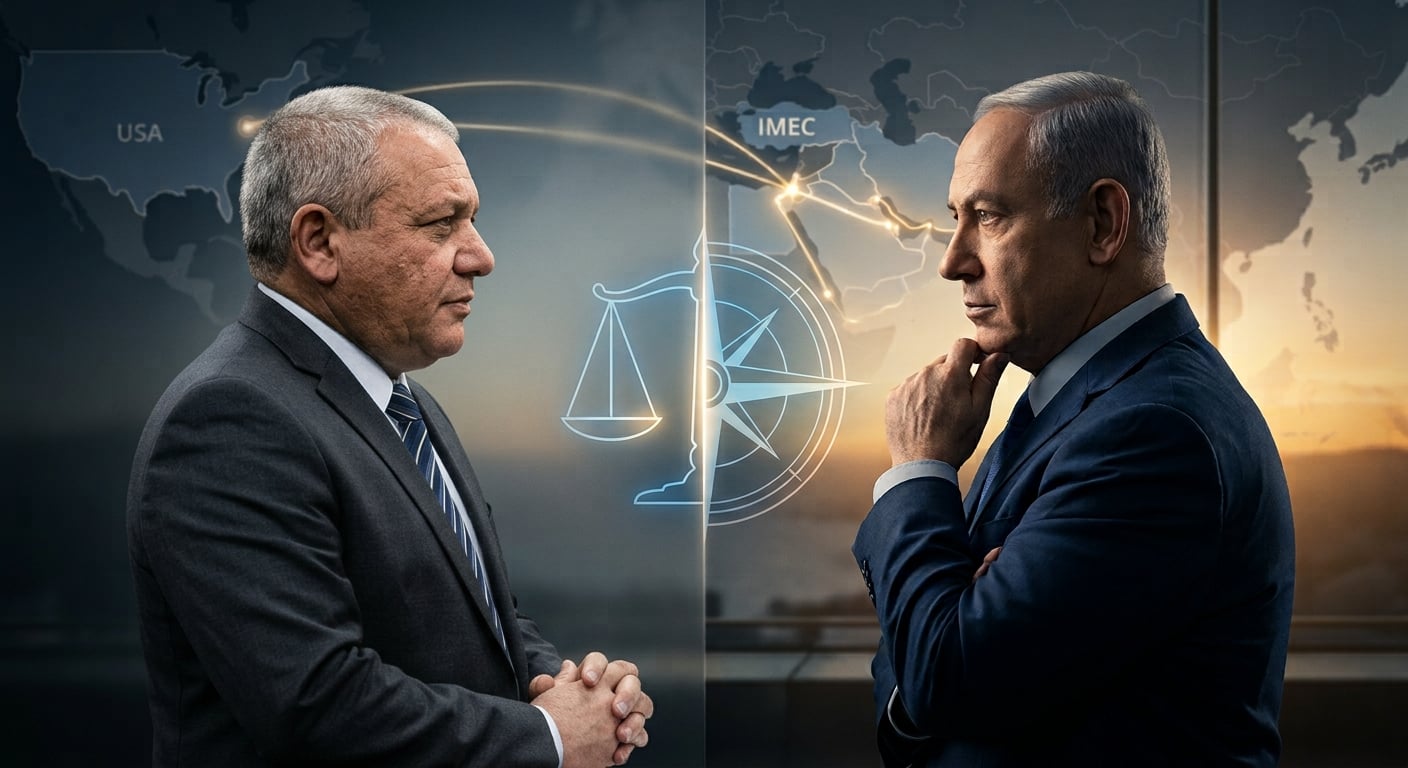
Netanyahu’s Strategic Deterrence vs. Eisenkot’s Progressive Realignment
On Oct. 27, Israel will elect a new government and Prime Minister. While these elections are critical in shaping Israel’s identity for years to come, they also hold major geopolitical implications for the U.S. and the Western world.
The leading candidates, Benjamin Netanyahu and Gadi Eisenkot, represent two fundamentally contrasting worldviews.
For years, Netanyahu’s doctrine focused on building a powerful capitalist engine—driven by deregulation, breaking market barriers, and positioning Israel as an R&D hub for global tech giants like Intel and NVIDIA. Strategically, his model relied on turning Israel into a regional defense-tech superpower, forging alliances with the moderate Sunni axis, and opening land and maritime trade routes to the East.
As Israeli analyst Shlomo Filber highlighted on X, these emerging maritime and land trade routes form a new global trade zone designed to counter and replace the China-Russia-Iran-Europe axis. Backed by the United States and anchored in an expanded Abraham Accords framework, this new alliance links India, Saudi Arabia, the Gulf States, Israel, and Greece. For Washington, this corridor represents a critical asset in its global trade rivalry with China, while positioning Israel as a central hub for global commerce connecting East and West.
In the recent war, Netanyahu acted consistently and systematically to dismantle the Iranian-built “ring of fire” surrounding Israel—chiefly Hamas and Hezbollah—before moving on to target the head of the snake in Iran alongside President Trump.
Throughout his tenure, Netanyahu has worked tirelessly to transform Israel into a technological superpower, leveraging its defense and cyber capabilities while setting an ambitious goal to position the country as a world leader in artificial intelligence.
This ambition aligns with Filber’s assessment on X regarding Israel’s evolving strategic weight. Beyond the civilian tech boom led by Unit 8200 alumni, Israel is becoming an indispensable defense partner to the U.S. Together, they co-develop and export advanced military tech, operational knowledge, and combat-proven expertise—making Israel a primary global defense resource.
The systemic impact of this multi-front war will shape the strategic landscape of the Middle East for decades to come. As Turkish Foreign Minister Hakan Fidan—a veteran intelligence chief representing one of Israel’s most formidable regional rivals—noted: “If you haven’t developed your own cyber, SIGINT, and space intelligence capabilities, you shouldn’t even enter a verbal debate with Israel or America.” Deterrence remains the ultimate rule of regional diplomacy: when you project undeniable strength, no adversary seeks a confrontation.
In a recent interview on Channel 14, Netanyahu revealed that nearly all Arab nations, as well as several Western European countries, quietly reach out to Israel on a regular basis seeking assistance. While some of these governments publicly criticize Israel for domestic or diplomatic political reasons, behind closed doors, their priorities look vastly different: “They need Arrow missile defense systems, intelligence, and operational support,” Netanyahu noted, adding that foreign officials often privately admit, “We have to make these statements, but we don’t really mean it.” His underlying principle for regional partnerships remains straightforward: “If you treat Israel with respect, you will receive all the assistance you need—and more.”
Compounding this doctrine is Netanyahu’s articulate, fluent mastery of the English language, enabling him to project authority and command the narrative across international forums like the UN and major Western media outlets.
Eisenkot, on the other hand, represents a worldview centered on statism (mamlachtijut), pursuing peace with the Palestinians, scaling down ground forces, and seeking a swift end to the war.
As IDF Chief of Staff, Eisenkot conceived and led the “Gideon” multi-year strategic plan, launched in 2015 and implemented over nearly a decade. The primary objective of the Gideon plan was to streamline the military by reducing standing forces and relying heavily on advanced technology rather than traditional boots on the ground. Under this strategy, Eisenkot disbanded entire infantry and armored brigades, released thousands of reservists, and cut thousands of career soldier positions. The plan drew fierce criticism—most notably from former Military Ombudsman Maj. Gen. (res.) Yitzhak Brik—who argued that it severely eroded the ground forces’ readiness for a multi-front war.
During his tenure in the war cabinet, Eisenkot repeatedly pushed to halt the fighting in Gaza and stop the offensive in Rafah, advocating instead for a quick deal with Hamas, before eventually resigning from the government. He has repeatedly expressed his belief in the necessity of separating from the Palestinians—a approach that de facto implies withdrawing from Judea and Samaria and paving the way for a Palestinian state.
At the same time, Eisenkot embodies a traditional security paradigm focused on institutional force-building and tight, predictable alignment with Washington—specifically the Pentagon and CENTCOM. Under Eisenkot leadership, the U.S. would gain a predictable, state-oriented partner operating in close coordination with American defense institutions and recognizing the limits of military power.
If elected, Eisenkot’s likely coalition partners to form a government would include “The Democrats” led by Yair Golan and Mansour Abbas’s Ra’am party. Abbas represents the Muslim Brotherhood movement—an organization outlawed in most moderate Arab nations, such as Egypt. Forming a government alongside Muslim Brotherhood affiliates could raise serious concerns among key regional Arab partners.
The Democrats, led by Yair Golan, represent a self-defined liberal and partially socialist agenda. Both Eisenkot’s movement and The Democrats integrate DEI (Diversity, Equity, and Inclusion) platforms into their agendas, with Golan’s party also emphasizing climate change policies.
An Eisenkot-led government would likely focus primarily on domestic affairs rather than expanding regional alliances and grand foreign policy. Strategically, it would seek to reduce Israel’s footprint by striving for a settlement with the Palestinians through withdrawals from Judea and Samaria, parts of the Mount Hermon crest, and Southern Lebanon.
Ultimately, the upcoming elections will not only impact Israel’s future—they will reshape the geopolitical balance of the U.S. and the entire Western world.