
The golden cat of King Solomon
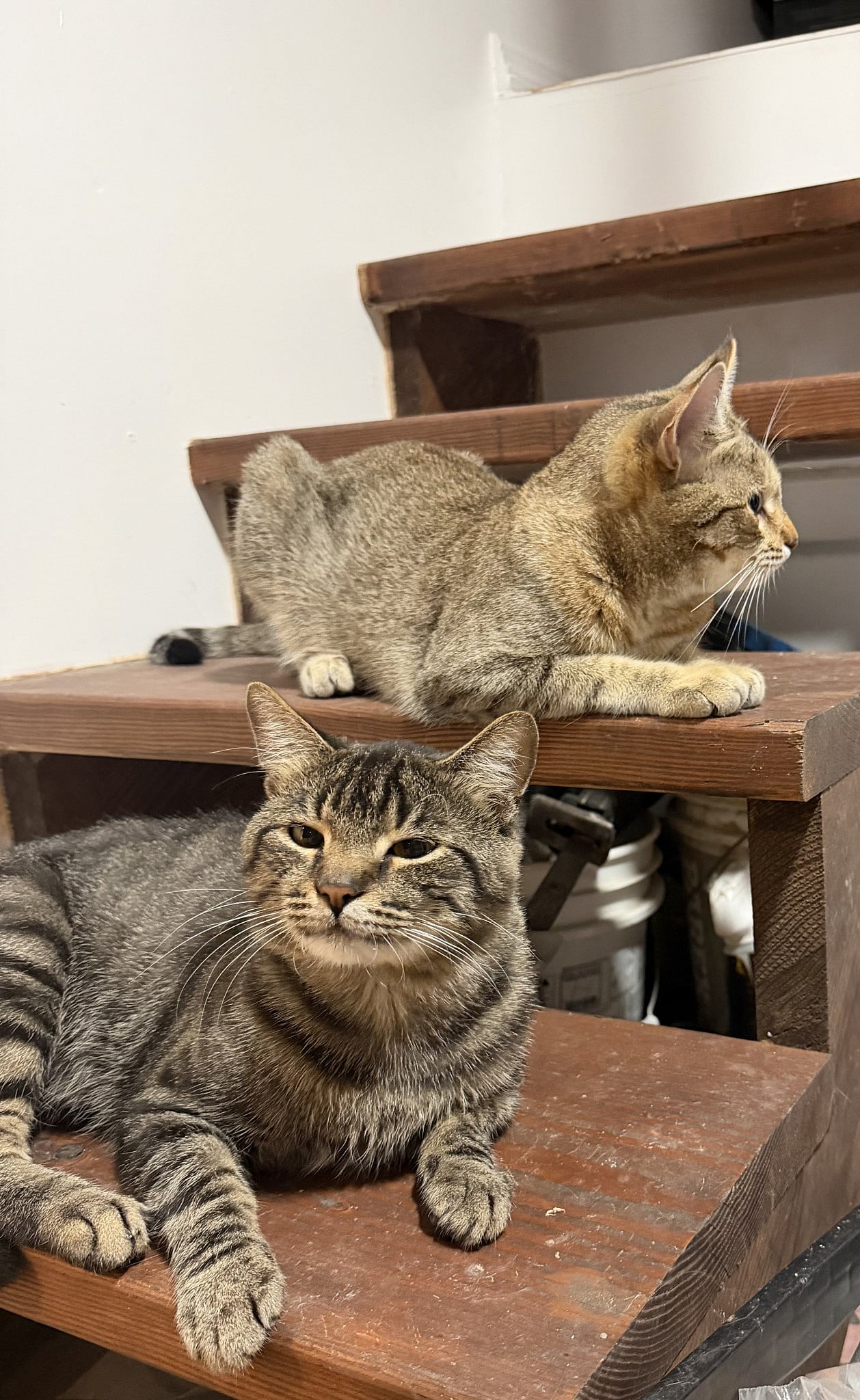
THE GOLDEN CAT OF KING SOLOMON
From an Ancient Jewish Tradition to the Living Royal House of Kanaani
By Rabbi Mikhail Salita (Rav Papa Kanaani)
Author’s Note:
What follows is a brief literary preview of my forthcoming work, The Golden Cat of King Solomon, part of the series Rav Papa Kanaani’s Tales — Cats of the Land of Israel.
I am keeping the complete manuscript unpublished while it is being presented to literary agents and publishers with whom I am currently in discussion. The scene below therefore reveals only a small part of the story: the encounter between King Solomon and a mysterious cat who, in my literary world, is destined to occupy an extraordinary place.
Jewish tradition preserved a remarkable image for us: a golden cat on the fifth step of King Solomon’s throne, facing a golden rooster.
It did not, however, tell us the cat’s story.
So I imagined one.
The Golden Cat of King Solomon
At dawn, a cat appeared at the gates of the royal palace.
His coat was covered with the dust of the road. His paws bore the marks of a long journey. Yet he carried himself with such quiet dignity that he seemed not to have wandered accidentally to the king’s gates, but to have arrived precisely where he intended to go.
A guard blocked his way.
“Stop. Where are you going?”
The cat raised his head.
“To the king.”
“To King Solomon?”
The cat regarded him with mild surprise.
“Is there another king in this palace?”
The guard was about to laugh, but for some reason thought better of it.
Within minutes, word of the unusual visitor had reached the palace.
“Your Majesty, there is a cat at the gate.”
Solomon looked up.
“And what is so unusual about a cat?”
“He says he has come to see you.”
The king was silent for a moment.
“Then why is he still standing at the gate?”
The guard hesitated.
“Your Majesty… he is only a cat.”
Solomon looked at him.
“I heard you the first time. Let him in.”
The cat was brought into the royal courtyard.
For a while, Solomon silently studied the traveler. Then his eyes settled on the dust covering the cat’s coat and the paws wounded by the road.
“You have traveled a long way,” said the king.
The cat looked up at him.
“You know?”
Solomon smiled.
“The Master of the Universe has granted me wisdom to understand much of what takes place among His creatures. But even a king is not given knowledge of everything.”
He turned to his servants.
“Bring him water. And give him something to eat. He has traveled a long way. A hungry and exhausted traveler is not questioned at the door.”
A bowl of water was placed before the cat.
He drank for a long time.
Then he ate, settled himself in the middle of the royal courtyard, and calmly began washing his face.
Solomon watched him.
At last, the king smiled.
“And wash him.”
The servants looked at Solomon in surprise.
“Judging by his appearance,” Solomon continued, “our guest has crossed half my kingdom before deciding to present himself to me. And this is, after all, a royal palace.”
A quiet ripple of laughter passed through the courtyard.
Even the cat stopped washing himself for a moment and looked at Solomon.
“I heard that,” he said.
“I was counting on it,” replied the king.
When the traveler was brought back — clean, fed, and rested — Solomon invited him closer.
“Now tell me. Why have you come?”
“I already told your guard. I came to see the king.”
“That much I understand. But why?”
The cat considered the question.
“Perhaps I am not the only one who must answer that.”
The courtyard fell silent.
Solomon studied him.
For several days, one question had occupied the king’s thoughts.
The craftsmen were working on his extraordinary throne. On its fifth step, a place remained unfilled opposite the golden rooster.
What animal should occupy it?
Solomon had considered powerful beasts. Perhaps a bear. Perhaps another creature worthy of a royal throne.
But no answer had satisfied him.
Now a cat sat before him.
“I considered placing a bear opposite the rooster,” Solomon said.
The cat tilted his head.
“Then why didn’t you?”
“Because strength alone does not make a creature worthy of a place upon a throne of wisdom.”
“So you were waiting?”
Solomon regarded him with interest.
“Perhaps.”
The cat sat quietly before the king.
Solomon looked at the golden rooster.
Then at the cat.
“For several days I have been searching for an answer,” he said. “And today you came to my gates on your own.”
“Perhaps I was searching for a king.”
Solomon smiled.
“Or perhaps the king was waiting for a cat.”
For a moment, silence settled between them.
Solomon raised his eyes toward heaven.
“I will not claim to know the designs of the Master of the Universe. Even the wisdom of a king remains human wisdom. But when an answer arrives at your own gates, one should at least possess enough wisdom to open the door.”
The cat said nothing.
For a while, neither did Solomon.
Then the king turned to the craftsmen.
“The place opposite the rooster is empty no longer.”
He pointed to the cat.
“Place a golden cat there.”
That is where this brief excerpt ends.
But the golden cat remains upon the throne.
Where Literature Ends and Jewish Tradition Begins
Solomon’s conversation with the cat is my literary creation.
The golden cat on the throne is not.
The Tanakh describes King Solomon’s extraordinary throne. In Melakhim I — First Kings — it is a great throne of ivory overlaid with gold and approached by six steps. The same biblical account describes the extraordinary wisdom granted to Solomon by God and tells us that his knowledge encompassed trees, animals, birds, creeping creatures, and fish.
Later Jewish tradition gives the throne an even richer description. Targum Sheni to the Book of Esther describes pairs of golden animals associated with its steps. On the fifth step of the throne itself appears the remarkable pairing that inspired my story:
a golden cat facing a golden rooster.
That distinction matters.
The cat was not merely “near the throne.” It was not somewhere in the palace or sitting beside the king.
The golden cat was part of the throne itself.
Later Jewish tradition also develops the image of Solomon as a king endowed with an extraordinary understanding of the world of God’s creatures.
The speaking cat, therefore, is literature.
But the spiritual world in which Solomon’s wisdom reaches beyond human affairs is deeply rooted in Jewish tradition.
And that brings me to a question I have found difficult to dismiss.
If There Was a Golden Royal Cat, Where Did the Image Come From?
We do not know the name of King Solomon’s cat.
We have no remains, no ancient pedigree, and no source telling us that a particular living animal served as the model for the golden cat.
Here, however, I allow myself a little ordinary Jewish sechel — common sense.
I find it difficult to imagine such a striking image existing entirely in a cultural vacuum.
If Jewish tradition remembered a cat not merely somewhere in the royal palace but as part of King Solomon’s throne itself, it seems natural to me to imagine that cats also had a place in the living world of royal Jerusalem.
That is my reading of the tradition, not an archaeological claim.
And it is here that an ancient story unexpectedly encounters a modern one.
Almost Three Thousand Years Later
Centuries pass.
Kingdoms disappear. Empires rise and fall. Jerusalem changes.
Then, in the modern era, a new breed of cat emerges in Jerusalem itself.
The Kanaani.
The modern story of the Kanaani began in Jerusalem in the 1990s.
For me, that is more than a geographical coincidence.
I am a custodian of the Kanaani and have devoted a significant part of my work to the preservation and international revival of this exceptionally rare Israeli breed.
Today, I want to state publicly the idea that joins these two stories.
Heirs to King Solomon’s Feline Throne
I regard the Kanaani as the modern symbolic heirs of King Solomon’s golden cat.
Not because anyone can produce a genetic pedigree stretching back almost three thousand years. No such evidence exists, and I make no such claim.
I am speaking of another kind of inheritance:
an inheritance of place, memory, symbol, and Jewish cultural tradition.
The golden cat belongs to the world of King Solomon.
Its image belongs to Jewish tradition.
Solomon’s throne belongs to the story of Jerusalem.
And the modern story of the Kanaani also begins in Jerusalem.
So who, if not the Kanaani — an Israeli breed born in Jerusalem — should carry forward, in our own time, the symbolic lineage of Israel’s royal cats?
For me, the answer is clear.
The Royal House of Kanaani
From that idea follows another.
If the Kanaani carries the symbolic inheritance of King Solomon’s golden cat, there can also be a modern feline royal house to carry that inheritance forward.
I therefore introduce:
The Royal House of Kanaani
This is not a new cat registry. It is not a substitute for TICA, WCF, or any other system of registration, judging, or championship titles. Nor is it an attempt to turn literary tradition into biological fact.
It is a cultural and literary royal house devoted to the identity, continuity, and preservation of a living Israeli breed.
A cat show can name a champion.
A ranking can record the accomplishments of an individual cat.
But the royal titles here do not signify victory.
They signify inheritance, continuity, and responsibility.
At the head of the Royal House stand:
King Arbuz
King of the Royal House of Kanaani
Queen Haifa
Queen of the Royal House of Kanaani
And with them comes the next generation:
Crown Prince Sky
Heir to the Royal House of Kanaani
Crown Princess Laila Yom Tov
Princess Haya
Princess Neshama
Princess Sasha
Together, they form the living Royal House of Kanaani — the Heirs to King Solomon’s Feline Throne.
The titles are symbolic.
The cats are very real.
They are living representatives of an extraordinarily rare Israeli breed whose modern story began in Jerusalem and whose future depends upon preservation, responsible breeding, international recognition, and future generations.
Thus begins a modern symbolic dynasty of Israel’s royal cats.
Not with an invented document claiming three thousand years of biological descent, but with an ancient Jewish image, the city of Jerusalem, and a living Israeli breed entrusted with carrying the story forward.
I Am Not the King. I Am the Custodian.
The human being has a different role in this story.
I do not call myself king of the Royal House of Kanaani.
The royal house belongs to the cats.
My role is:
Custodian of the Heirs to King Solomon’s Feline Throne
The word custodian matters deeply to me.
A rare breed is not simply something a person owns.
It is something entrusted to his care for a period of time.
My responsibility is to preserve Kanaani bloodlines, document their history, help build a genetically viable population, introduce the breed to people in other countries, and pass on to another generation not only the cats themselves, but their story.
I write this as an ordained rabbi, an ordained Animal Chaplain, an author, and a custodian of the Kanaani.
My spiritual and academic work has led me to the study of Psalms, Perek Shirah, Jewish spirituality, and the place of animals within God’s creation.
Neither rabbinic ordination nor Animal Chaplaincy gives me license to rewrite an ancient source.
Quite the opposite.
They place upon me a responsibility to tell the reader plainly where the source ends and where my interpretation begins.
The golden cat on the fifth step is tradition.
The story of how the cat came to Solomon is literature.
The Kanaani as the Heirs to King Solomon’s Feline Throne is the contemporary cultural concept I am proposing as an author and custodian of the breed.
Those distinctions matter to me.
The Crown as Responsibility
Why should an exceptionally rare breed need a royal story at all?
Not for vanity.
For memory.
For recognition.
And, ultimately, for preservation.
People forget statistics.
But a child may remember for the rest of his or her life the story of a cat who once came to the gates of King Solomon.
That child may later discover that the golden cat truly does appear in Jewish tradition.
Then discover that a real Israeli breed called the Kanaani exists.
And perhaps, one day, want to learn more about it — or even help preserve it.
Then literature becomes a means of preservation.
Tradition becomes education.
An ancient symbol becomes a responsibility toward a living creature.
I began by trying to preserve a rare breed.
Over time, I came to understand something else:
Preserving the Kanaani means preserving more than the cats. It means preserving their story.
From the Golden Cat to the Living Kanaani
Almost three thousand years ago, Jewish tradition placed a golden cat on the fifth step of King Solomon’s royal throne.
Today, I bring that image into the present through the living Kanaani — not as an archaeological reconstruction, and not as a claim of proven biological descent, but as a symbolic inheritance carried forward by a modern Israeli breed.
And so, within the literary and cultural world of Rav Papa Kanaani, there is now:
THE ROYAL HOUSE OF KANAANI
King Arbuz
Queen Haifa
Crown Prince Sky
Crown Princess Laila Yom Tov
Princess Haya
Princess Neshama
Princess Sasha
Together:
Heirs to King Solomon’s Feline Throne
And my place among them is:
Custodian of the Heirs to King Solomon’s Feline Throne
Perhaps one day a child will ask me:
“Rav Papa Kanaani, where did this royal feline family begin?”
And I will answer:
“With a cat who once came to the gates of King Solomon.”
Because inheritance does not always travel through blood alone.
Sometimes it travels through a land.
Through a city.
Through memory.
Through an ancient text.
Through a story someone chooses to tell anew.
And through living creatures entrusted to carry it forward.
KANAANI
Heirs to King Solomon’s Feline Throne