"These fragments I have shored against my ruins"
The Grammar of Empathy: A Maternal Reading of Simon Baron-Cohen’s Framework
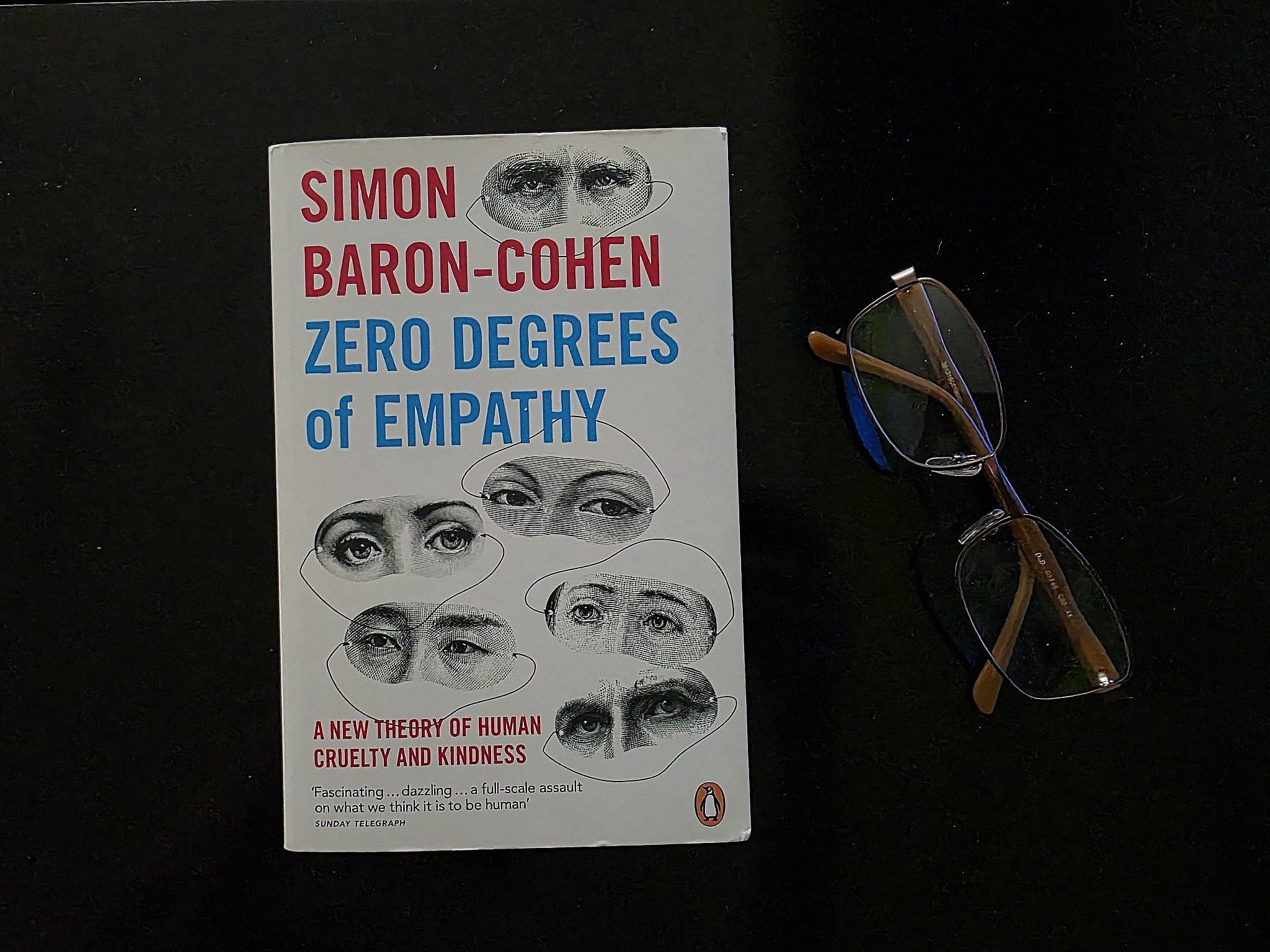
Zero Degrees of Empathy by Simon Baron-Cohen
For mothers navigating the delicate terrain of neurodivergent parenting, empathy has always been less about affect and more about structure. Long before Simon Baron-Cohen introduced the concept of zero-positive empathy, our lives unfolded in the margins, beyond sentiment and beneath scrutiny. We lived under the psychic weight of Leo Kanner’s clinical observations, who in 1943 gave autism its clinical name and, inadvertently, its first cultural wound. His early descriptions of autistic children included not only behavioural observations but also grim commentary on their parents: emotionally distant, obsessively intellectual, and, in his words, “refrigerator-like” and “just happening to defrost enough to produce a child”, suggesting that autism may be related to a “maternal lack of genuine warmth”. For Jewish mothers — many of whom were educated, articulate, and already navigating post-war identity politics — this diagnosis became a double allegation. Not only were their children misunderstood, but they themselves were cast as the cause.
And later, Bruno Bettelheim, Holocaust survivor and psychoanalytic celebrity, took Leo Kanner’s early musings on parental coldness and turned them into a full-blown accusation. His devastating metaphor, in The Empty Fortress (1967), likened autistic children to prisoners in concentration camps; emotionally starved, psychologically imprisoned in their own minds, and their mothers to the guards. For Jewish mothers — many of whom were survivors themselves, or daughters of survivors — it was a second trauma. For decades, they were seen as cold, detached, and complicit. They were not just blamed, but pathologised. Bettelheim’s theory didn’t just misdiagnose autism; it also rewrote maternal identity as a clinical flaw. The emotional toll was immense: guilt, shame, and social stigma haunted these women for decades. And for decades, women carried that accusation in silence.
In 2011, Simon Baron-Cohen offered a different lens. His concept of zero-positive empathy didn’t just reclassify autistic cognition; it quietly acquitted generations of women. It allowed us to see our children not as emotionally broken and vacant, but as ethically structured. And it allowed us to see ourselves not as failed nurturers, but as interpreters of a different emotional syntax.
Coined in his 2011 book Zero Degrees of Empathy (published in the US as The Science of Evil: On Empathy and the Origins of Human Cruelty), zero-positive empathy refers to individuals who may lack emotional empathy (that is, the instinctive ability to feel what others feel) but who possess strong systemising abilities and a deep sense of moral reasoning. These individuals often understand others’ emotions cognitively, even if they don’t resonate with them emotionally; they show ethical consistency, fairness, and principled behaviour. They are unlikely to cause harm, and may in fact be hyper-attuned to justice and rules. Simon Baron-Cohen introduced this term to distinguish people on the autism spectrum from those with zero-negative empathy (e.g. psychopathy, narcissistic personality disorder), who may also lack emotional empathy but do so in ways that are harmful or exploitative.
Zero-positive empathy, according to Simon Baron-Cohen, is a structured empathy rooted in rules, not resonance. For autistic people, this framing has been both validating and limiting. Some have embraced the idea, finding clarity in the distinction between emotional intuition and ethical principle. Others feel flattened by it: misread, misunderstood, miscast. Many autistic individuals experience a deep, often overwhelming emotional attunement that defies diagnostic expectations.
But for mothers like me, the term echoes in the grammar of daily life. I didn’t raise a child who lacked empathy; I raised one who expressed it differently. Through precision, through patterns, through acts that resisted sentiment but radiated care. Yet, from a maternal perspective, there is one aspect the theory leaves unspoken: the intimacy of adaptation; the constant recalibration, the shared code built between mother and child. It’s not zero. It’s another grammar entirely.
Within Jewish communities, where intellectual motherhood is often layered with ancestral expectation, autism has long existed in tension with empathy, ethics, and visibility. Simon Baron-Cohen’s framework doesn’t just speak to psychological theory, but to Jewish history, from Bettelheim’s haunting influence to the quiet evolution of communal understanding. His work is not just academic; it is Jewish continuity, recontextualised.
Long before I ever inhabited motherhood as lived reality, long before the quiet recalibrations, the linguistic detours, and the domestic logic puzzles, I read his earlier works on autism, empathy, and systemising; they did not arrive in my life as revelation. It was already present, threaded through conversations among Jewish academics and those with a healthy suspicion of diagnostic grandeur. In that climate, his theories felt less like discoveries and more like shared scaffolding.
By the time Zero Degrees of Empathy appeared in 2011, I was already parenting a child whose cognitive choreography defied neurotypical expectations. Simon Baron-Cohen’s concept of zero-positive empathy did not absolve me — parenting rarely deals in absolution. But it offered something perhaps even more powerful: explanation. And for women of my generation, still walking through the residual fog of the refrigerator mother myth, that distinction was seismic.
We were no longer cold; we were contextual. Our children weren’t the consequence of detachment; they were the authors of alternative social grammars. His concept reframed us not as failed mothers, but as precise interpreters of a different emotional syntax; women reading the structure where others expected sentiment. For me, it was not the kind of relief that invites tears but the kind that steadies the breath. In the most British way, it helped me to keep calm and carry on.
And even more vitally, Simon Baron-Cohen’s framework gave society permission to see our children differently. No longer the emotionless automata miscast by popular psychology, autistic individuals (especially those with zero-positive profiles) were reintroduced as deeply ethical creatures. Creatures who, though they may not mirror emotional distress, act with principled clarity and an almost fierce allegiance to fairness.
It was a quiet revolution — the kind academics rarely announce, but which mothers feel immediately. Simon Baron-Cohen charted the terrain. We live in its weather.
My daughter does not cry on cue, nor does she respond with the expected murmurs of sympathy. While others process emotion out loud, she is already sketching a solution. She listens for the fault line in a situation, not the tremor in the voice describing it. People often find that disconcerting, as I used to as well, before I learnt to see it for what it is: her version of care, clearer and steadier than most.
Living under inherited and internalised guilt and guarding the only thing I had left, my integrity, I found that raising her meant redesigning the day before it began: routines, spaces, social choreography — all required constant adjustment. This was less about comfort and more about survival. I spent years discerning between coping and masking, carrying an unspoken fear beneath it all: the possibility that love is not enough.
Some people offered us thin, performative sympathy, the diluted empathy of concern without consequence, which I learnt to refuse. Instead, we built a household where empathy was not instinctive but iterated. My daughter didn’t speak the language of fluent sentiment but of conditional verbs and negotiated clauses. Her affection arrived as structure, not sigh. Mothering under these conditions resembled a semicolon: a continuous sentence of care, occasionally interrupted, but never broken.
As she grew, so did her cognitive empathy. She understood, interpreted, and predicted reactions like a strategist. Sometimes, her sensitivity bordered on hyper-empathy, but the difference, invisible to most, was elemental: she did not feel others’ pain but mapped it with uncanny precision. The behavioural output mimicked care; the internal structure was analytical, not affective.
If empathy must be visible to be validated, my daughter fails every test. But if empathy is a form of structural integrity, then she is among its most gifted practitioners.
This, of course, brings me to the final conundrum, one Simon Baron-Cohen himself left intriguingly unposed: if zero-positive empathy and hyper-empathy can result in strikingly similar behaviours, what distinguishes them ethically, emotionally, and socially? And more provocatively: why does society reward emotional resonance over principled compassion?
In many ways, this reflection unfolds within a distinctly Jewish tradition; not one of definitive answers, but one that privileges inquiry over certainty. We midrash our way through complexity, layering commentary upon commentary, not to dismantle the text but to make it liveable.
Empathy, in this context, is less a feeling than a form of interpretation; a practice built through engagement and re-examination, not performed but constructed. Parenting a neurodivergent child echoes this tradition and becomes a constant exegesis: each moment a commentary, each adaptation a rereading of the old script. We do not presume; we parse. We search for resonance in unconventional constructions and rebuild care in the syntax of responsiveness.
Simon Baron-Cohen’s work, though scientific in tone, lends itself to this kind of interpretive engagement. His concept of zero-positive empathy doesn’t ask for emotional resonance but for ethical framework. And that, for mothers like me, is familiar terrain. We do not always feel what others feel. But we build systems that allow others to be felt.
This is what Simon Baron-Cohen’s work offered: not just theory, but a grammar. And empathy, at its most enduring, may be just that: a structure built from care, parsed through difference, conjugated through time.
Motherhood within Jewish communities, situated amidst cultural expectations and neurodivergent parenting, has long been subject to scrutiny: sometimes reverent, often reductive. In the context of autism, it was pathologised. We were cast not as caregivers, but as causes. The legacy of Leo Kanner and Bruno Bettelheim didn’t just misread our children; it also misread us. But what Simon Baron-Cohen’s framework allows is a reclamation: maternal identity not as emotional failure, but as ethical discernment. Jewish mothers have always operated at the intersection of care and cognition, where one does not simply feel, but interprets, anticipates, restructures. And in the realm of neurodivergent parenting, that is not a flaw but fluency.
The world is evolving in its understanding of neurodiversity. But it owes a quiet debt to the mothers who survived its earlier misreadings; women who calibrated care, not to be seen, but to be correct. Simon Baron-Cohen’s work has given us a new vocabulary. Judaism gives us the questions. Together, they grant us a way to parent with both ethical depth and emotional precision, and perhaps, finally, without apology.
Related Topics
Related Posts