Urban sociologist and geopolitical commentator
The Grammar of Grief: Towards a Philosophical and Cultural Analysis
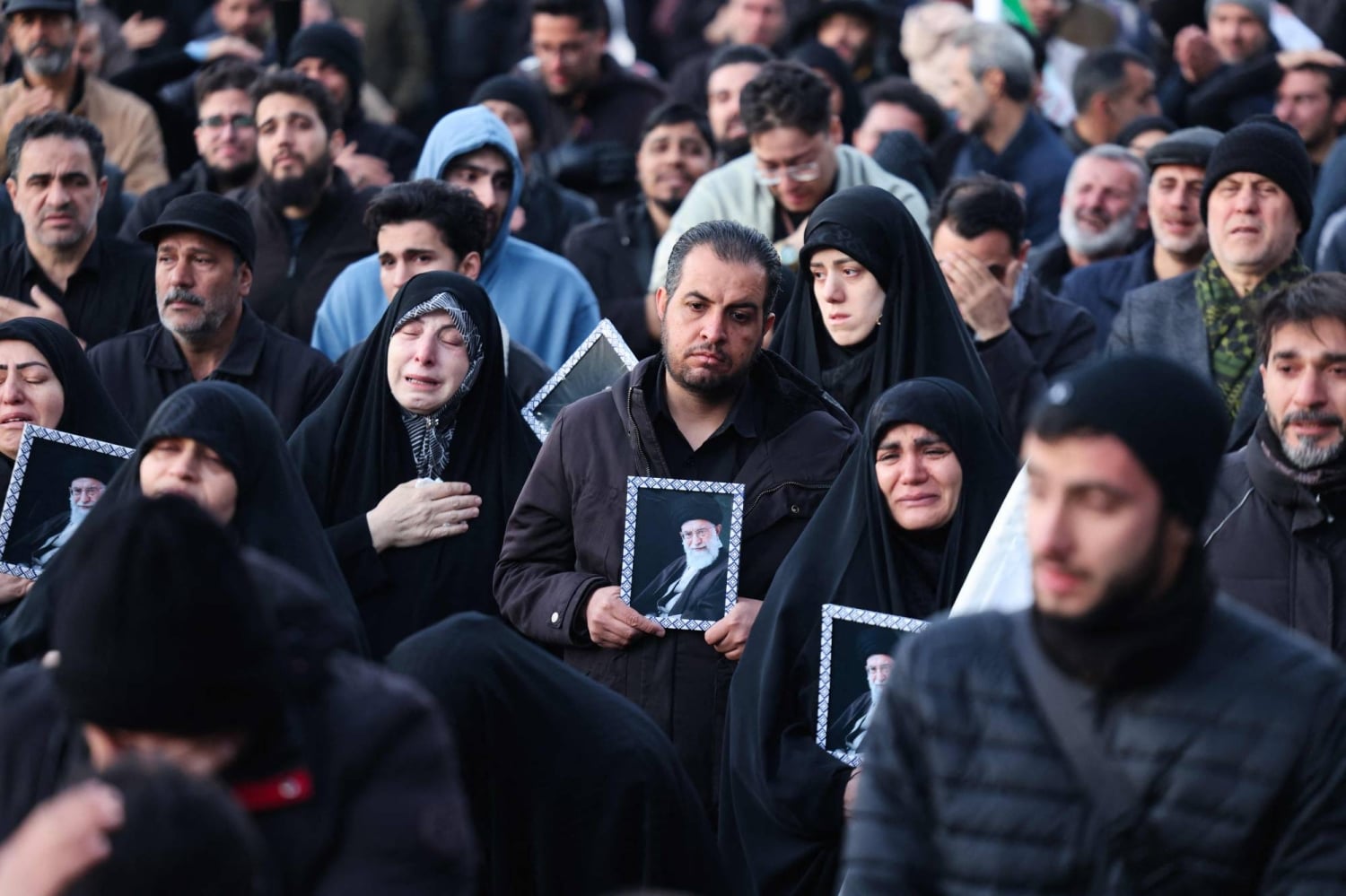
People mourn the death of Iran's supreme leader Ayatollah Ali Khamenei, who was killed in joint US and Israeli strikes, at a square in Tehran on March 1, 2026. (Photo by ATTA KENARE / AFP)
On mourning as the organizing intelligence of a civilization, and what is lost when a culture makes lamentation its highest art
Every civilization chooses a supreme aesthetic – a form through which it measures the quality of a human life. The Greeks chose kalos kagathos, the beautiful and the good fused in a single person. The Confucian tradition chose ren, the cultivation of relational virtue through ceaseless self-refinement. Classical (Vedic) India chose truth (satya) realized through consciousness (cit/prajñā), expressed in right living (dharma), embodied by the wise person established in truth (sadvipra). Modern liberal culture, embarrassed by grandeur, settles for something called “flourishing” – a word deliberately vague enough to offend no one (for elaborations see, Martha Nussbaum’s capability approach; Charles Taylor’s human flourishing).
Iran’s Shia civilization chose something more arresting, and more troubling: it chose the perfection of grief.
This is not a polemical claim. It is, if anything, an observation of admiration before it is one of critique. The azadari traditions – the lamentation practices surrounding the martyrdom of Husayn ibn Ali at Karbala – represent one of the most elaborate, most internally coherent, most psychologically sophisticated ritual systems in human history. To dismiss them as morbid theatre or political manipulation is to miss what is genuinely extraordinary: a culture that has built, across fourteen centuries, a complete aesthetics of suffering.
But aesthetics, when they become totalizing, also become dangerous. That is the argument I want to make carefully here.
The structure of the system
Begin with what the system actually does, rather than what its theology claims it does. In the annual cycle of Muharram, and in the lesser observances scattered throughout the Shia calendar, the community does not merely commemorate a historical event. It re-enacts it with an intensity that collapses the distance between past and present. The reciter (maddah) does not describe Husayn’s death; he performs it, sweating, weeping, bringing an audience to the same threshold of grief as though Karbala were happening now, in this room, to us. The passion play (ta’ziyeh) does not represent martyrdom; it is martyrdom, temporarily, theatrically, and participants know this and consent to it and seek it.
What emerges from this structure is something that no other religious tradition has quite replicated: a fully institutionalized competition in emotional authenticity. The question that organizes social recognition in this system is not “what have you built?” or “what have you understood?” or even “how virtuously have you lived?” The question, at least during the ritual season, is: “how deeply can you feel the original wound?” Status accrues not to the most accomplished but to the most devastated: the reciter who brings a thousand people to tears, the organizer who stages the most overwhelming ceremony, the devotee who weeps with what is judged to be genuine rather than performed anguish.
In the words of Epicurus, an ancient Greek philosopher, “The art of living well and the art of dying well are one.” Shia culture did not dispute this. It simply redefined what dying well means, and then organized an entire civilization around rehearsing it.
The sociologist Emile Durkheim would recognize this immediately as “collective effervescence”: the temporary dissolution of the individual into the group through shared ecstatic experience. But the Shia tradition goes further than Durkheim imagined. It has professionalized the effervescence. It has created roles, hierarchies, apprenticeships, and reputations organized around the capacity to generate it. This is not religion borrowing from aesthetics. This is aesthetics becoming religion.
The theological defense and its limits
The standard theological response to this analysis, and it is a serious response that deserves serious engagement, is that the mourning is never merely aesthetic. It is pedagogical. Grief for Husayn is meant to produce courage against injustice, resistance against tyranny, solidarity with the oppressed. The Karbala narrative is not a tragedy; it is a moral program encoded in emotional form. You weep for Husayn so that, when your own Yazid appears, you will not collaborate.
This defense is both true and insufficient. True, because the ethical content of the Karbala story is genuinely rich: a small band refusing to capitulate to overwhelming power, choosing dignity over survival, making injustice visible by absorbing its full weight. These are not trivial moral ideas. They animated revolutionary Iran, they underwrite contemporary resistance movements, they encode a model of principled non-capitulation that any serious ethics should take seriously.
Insufficient, because the relationship between the intensity of the ritual and the depth of the ethical formation is not guaranteed, and in fact, there is substantial evidence that they can come apart. A community can perfect the aesthetics of lamentation while its everyday ethics stagnate or regress. The reciter can move thousands to tears with no corresponding change in how those thousands treat their neighbors, their servants, their political opponents. The ritual becomes, in such cases, not a preparation for ethical action but a substitute for it – an emotional discharge that relieves the pressure that might otherwise compel moral change.
This is not a pathology unique to Shia Islam. It is a pathology of all ritual. The question is whether the Shia tradition, by making mourning so central and so elaborate, has made itself more vulnerable to it.
What the “art of living” would require
To see what is at stake, consider what an “art of living” tradition would organize itself around. In contrast to the mourning system, which measures achievement by the depth of one’s re-entry into a historical tragedy, a living-arts tradition measures achievement by the quality of what one constructs in the present: understanding, virtue, beauty, relation, justice in one’s own time and place. It is forward-facing rather than backward-facing. Its ideal human being is not the most perfectly grieving one but the most fully realized one.
The contrast is not simply between optimism and pessimism, nor between action and contemplation. Some of the most demanding living-arts traditions are intensely contemplative (Sufi tariqa, for instance, or Buddhist vipassana). The difference is in the direction of the gaze: backward, toward the wound, or forward, toward the person one is becoming.
What is striking about the mourning system is not that it looks backward. All memory is backward-looking. But that Shia Islam has institutionalized the backward gaze as the highest form of human attention. The community’s most elaborated and most socially rewarded activity is the collective re-experience of a seventh-century catastrophe. The future, by comparison, is thin. Individual ethical formation, that is, the patient, unglamorous work of becoming a more just, more thoughtful, more generous person, generates almost no ritual attention and almost no social prestige.
The political complication
After 1979, this analysis acquires a further dimension. The Islamic Republic did not merely preserve the mourning traditions it inherited; it weaponized them. Karbala became the symbolic register through which the state narrated its wars, its enemies, and its own legitimacy (On wartime “Karbala-ization”). To grieve for Husayn was, simultaneously, to endorse the revolution. To intensify the rituals was to deepen one’s political as well as spiritual allegiance. The state poured resources into azadari, building it out, amplifying it, making it more visible and more coercive.
The effect was paradoxical. By fusing the mourning tradition with state power, the Islamic Republic both elevated and corrupted it. Elevated, because the rituals achieved a scale and elaboration previously impossible. Corrupted, because what had been, at its best, a tradition of resistance against illegitimate power became, in a specific political context, a vehicle for legitimating it. The very symbols of anti-tyranny were recruited into the service of a state that many of its subjects experienced as tyrannical.
This is the deepest irony in the story: a tradition that encodes, in its foundational narrative, the imperative to refuse unjust power, was made to serve the consolidation of power. And it could be made to serve that purpose precisely because the mourning tradition, by orienting its members so intensely toward the past, left them with fewer conceptual and emotional resources for evaluating the present.
What is gained and what is lost
It would be dishonest to end here, as though only pathology deserves attention. The mourning tradition has given something real and irreplaceable to the people who live within it: a language for suffering. In a world that largely instructs its inhabitants to be productive, optimistic, and forward-looking, a world that has almost no cultural resources for acknowledging pain as pain, the Shia tradition stands as a remarkable counter-testimony. It says: grief is not a malfunction. It is not a phase. It is not something to be managed and resolved. It is a form of knowledge. It has a grammar. It can be deepened, refined, shared, and transmitted. It is part of what it means to be human.
This is a genuine achievement. The Western modernity that might be tempted to look down on the lamentation traditions has its own pathology: it has nearly lost the capacity for communal grief. Its mourning is privatized, medicalized, time-limited. It grieves alone, in therapy, with a diagnosis. The Shia community grieves together, publicly, without apology, in a language centuries in the making. There is wisdom there that the secular world has largely forfeited.
And yet. A complete account of the human must include both the language of loss and the language of construction. The deepest critique of the mourning tradition is not that it is morbid or backward or irrational. It is that it is incomplete. A civilization that has elaborated the aesthetics of grief to a very high level but left the aesthetics of living comparatively underdeveloped has not achieved the fullest version of what human culture can do. It has mastered one half of the grammar and left the other half largely unwritten.
The question, for any tradition, not only this one, is whether the grammar of grief and the grammar of living can be held together without one collapsing the other. Whether the capacity for deep mourning can coexist with, and even nourish, the capacity for deep construction. Whether looking backward at a seventh-century wound can genuinely illuminate the path forward, or whether, at a certain pitch of intensity, it forecloses it.
That question does not have a settled answer. But it is precisely the question that a serious encounter with Iranian Shia culture forces onto the table, and for that, the tradition deserves genuine respect, even from those who suspect the answer is not entirely reassuring.
Related Topics
Related Posts