
Urban sociologist and geopolitical commentator
The Great Nicobar Project and India’s Return to Itself
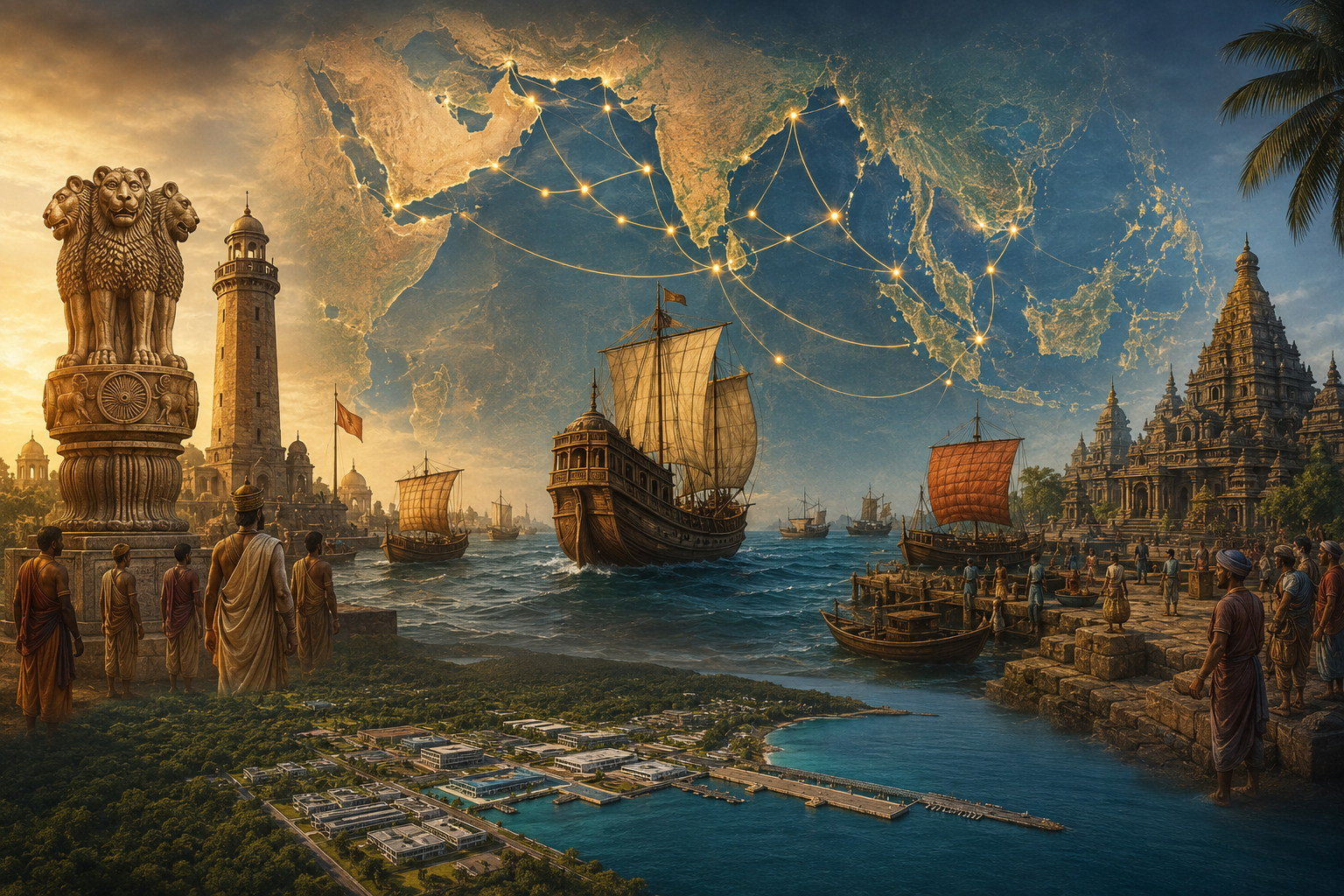
The longue durée of Indo-maritime stewardship. AI image. (Credit: ChatGPT)
The longue durée of Indo-maritime stewardship – where the Mauryan embrace of statecraft, the Chola command of the Indian Ocean, and the Srivijayan trade networks India anchored, these are not ornaments, but the actual case for why India building at Great Nicobar is a restoration, not an imposition.
The Amnesia That Mistook Itself for Virtue
There is a peculiar form of intellectual capture that afflicts postcolonial nations. It comes not from the colonizer’s guns but from his categories. Among the most consequential pieces of that mental furniture, for India, is this: the idea that an India that acts in the world, that builds, projects, commands, reaches, is somehow the aberration, while an India that deliberates, defers, and withdraws into continental anxiety is the authentic and morally superior form.
This idea has no Indian origin. It is colonial sediment. Classical India was a civilization of extraordinary strategic appetite, commercial reach, and maritime ambition. It built empires at sea. It seeded civilizations across two oceans. It threaded the Indo-Pacific with the sinew of trade, culture, law, and statecraft long before the words “Indo-Pacific” existed.
The Great Nicobar Island, sitting at the southern tip of India’s Andaman chain, roughly 160 km from Sumatra and a few hundred kilometers from the main Strait of Malacca shipping lane, the most consequential maritime chokepoint on earth, is not a new frontier. It is an old one, remembered. At its deepest register, the debate about what India should build there is a debate about whether India will reclaim its identity as a civilization that has always been at home on the sea, or remain landlocked in its own imagination.
The World That India Made
Begin not with a treaty or a battle but with the pepper.
Pliny the Elder lamented the heavy drain of gold from Rome into India, calling India “the sink of the world’s most precious metals.” The figure of roughly 100 million sesterces per annum, with half going to India alone, appears throughout his Naturalis Historia as the primary ancient source for complaints about Roman gold flowing east for spices, muslin, gems, and aromatics (Simmons 2023). Roman senators debated sumptuary laws to curb the appetite for serica and indica – silk and Indian goods: “It was decided that vessels of solid gold should not be made for the serving of food, and that men should not disgrace themselves with silken clothing from the East.” (Tacitus’s Annals, Book II, Ch. 33). Two south Indian dynasties, the Pandyas and the Cheras, went as far as sending embassies to Rome to discuss the balance-of-payments problem. “In 70 CE, the Emperor Vespasian become so worried about the eastward drain of gold that he put a temporary ban on its export.” (Dalrymple 2024:66).
What the transaction reveals is the shape of the ancient world’s economy: it was organized around India. “Certainly, by the first millennium B.C. commerce was already thriving between the Red Sea and northwest India” (Abu-Lughod 1989:264). The Periplus of the Erythraean Sea, that extraordinary Greek merchant’s manual from the first century CE, “demonstrates that navigation manuals for the sea route to India were highly refined by that time, confirming Europe’s long-standing trade with the subcontinent.” (Abu-Lughod 1989:265). It describes Indian ports – Barygaza (Bharuch), Muziris, Arikamedu – in loving operational detail (Parker 2008, Ch.4). The monsoon winds, which Indian and Arab sailors had mapped and mastered centuries before anyone else, were the engine of the entire Indian Ocean economy.
The first Roman contact with China was made possible by Indian merchants and sailors. Historian Josephine Quinn (2024:283) writes, “The real silk roads of the early first millennium CE were across the Indian Ocean, faster and cheaper than the overland journey, with Indian and Egyptian ports mediating trade between China and points west.” She further notes that trade between China and India had increased from the third century BCE, and “all it took to integrate the Red Sea into these networks was an understanding of the monsoon winds… the journey from the Red Sea to India and back could be completed well within a year.”
The Cholas understood this with a strategic clarity that few empires in history have matched. Under Rajendra Chola I (1012-44), they were the preeminent naval civilization of their age. In 1025 CE, Rajendra launched an extraordinary campaign, crossing the Bay of Bengal, raiding Srivijayan ports in Sumatra (first raided less extensively in 1017), and Kedah in the Malay Peninsula (Sen 2009: 68-70; Sastri 1955: 214-17). The Srivijayans may have “perceived the entry of Cholas into the South China Sea as a major threat to their participation in trans-shipment trade” (Sen 2009:70). The military objectives were specific: to break Srivijayan stranglehold on the Strait of Malacca and reopen the trade arteries connecting India’s Coromandel coast with China. The Strait of Malacca – the same waters that Great Nicobar now commands with its geography.
The Tamil trading diaspora – the nanadesis, the ainuruvar, the ayyavole merchants – carried not just goods but temples, languages, legal codes, and artistic traditions (Sastri 1955; Champakalakshmi 1996:311-330; Mukherjee 2017:107). Cambodia’s Angkor and Java’s Borobudur arose in the same civilizational watershed (Abu-Lughod 1989:299-301; Champakalakshmi 1996).
India was not a passive participant in the ancient world. It was the organizing intelligence of half the world’s commerce.
The Kautilyan Premise
The Arthashastra is, at its core, a theory of what the state is for. Kautilya’s answer is not power for its own sake: the state exists to create the conditions – security, order, infrastructure, trade – under which human beings can pursue artha (material well-being), dharma (right conduct), and kama (fulfillment). Power is the instrument, not the end.
Read the Arthashastra’s passages on ports (Trautmann 2012:312-16; also, Olivelle 2019:15-16). Kautilya specifies in extraordinary detail how to build them, administer them, tax them without strangling them, protect them militarily, and attract traders from distant lands. This is the text of a civilization that understood, two and a half millennia ago, that the sea is not a barrier but a highway, and that whoever controls the highway controls the terms of civilization.
The Mauryan empire under Chandragupta – Kautilya’s own project – unified the subcontinent not merely through military conquest but through the deliberate creation of the infrastructure of connectivity: roads (the Uttarapatha and Dakshinapatha; Neelis 2011, Ch.3), standard weights and measures, state intelligence networks, and active promotion of trade. The Mauryan period saw Indian merchants operating as far as Alexandria and the Hellenistic courts of Antioch and Pergamon. This is the actual India – strategic, commercial, administratively serious, and profoundly engaged with the material world, that the colonial period interrupted.
What the Interruption Cost
The Portuguese arrival in 1498 disrupted an Indian Ocean that K.N. Chaudhuri (1985) documented as a system of remarkable order: shared maritime law, mutual recognition of commercial rights, multilingual merchant communities, and an ethos of relative peaceful exchange. The Portuguese ended this. They came not as traders but as armed conquerors, bringing the concept of cartaz – the forced license, the protection racket disguised as regulation (Maloni 2011). “By firing on the leading port in Malabar, the Portuguese demonstrated to all Muslim ship-owners and no less to the local rulers that the period of unarmed trading was over in the Indian Ocean.” (Chaudhuri 1985:68). The papers of Afonso de Albuquerque reveal a comprehensive plan centered on the permanent colonization of naval and trading posts by Portuguese settlers (Chaudhuri 1985:69).
The Maratha admiral Kanhoji Angre (1669-1729) came closest to contesting this: his fleet genuinely troubled Portuguese and English shipping, and by the early 18th century he controlled the entire coast from Savantwadi to Bombay (Sridharan 2000:43). But the Marathas were a continental power that happened to have a navy, not a maritime civilization. When the British consolidated control over the Indian Ocean, they did so against an India that had, over three centuries of interruption, lost its sea memory.
The colonial period systematically reoriented India’s self-understanding away from the ocean. By independence in 1947, India had an extraordinary merchant marine tradition – the lascars, the Parsi shipbuilders, the Nattukotai Chettiars – but had been structurally severed from the maritime strategic identity that had once been central to how it understood itself. Nehru was a man of the continental imagination. Non-alignment made sense as a policy for a poor land power; it made much less sense as a maritime strategy. The Andaman and Nicobar Islands were administered as a remote penal colony and tourist periphery, their extraordinary strategic value almost completely unexploited for seven decades after independence.
This is the historical background against which Great Nicobar must be understood. It is not a new project. It is a long-delayed return.
The Ocean Is Not Waiting
The Indian Ocean in 2025 poses a structural challenge to India that is analogous to the Portuguese disruption of 1498. A single power – China – is moving with deliberate, systematic intent to position itself as the dominant presence across the maritime geography that classical India once organized. The “string of pearls” is visible infrastructure: Gwadar in Pakistan, Hambantota in Sri Lanka, Kyaukphyu in Myanmar, Chittagong in Bangladesh, Djibouti on the Horn of Africa, ports positioned across India’s maritime periphery, connected by the logic of the Belt and Road Initiative.
China is, in other words, attempting to do in the 21st century what the Cholas did in the 11th: organize the maritime world around itself. India is the only civilization-state with the geographic position, the historical precedent, the demographic scale, and the economic trajectory to offer an alternative organizing principle. Not as a hegemon, but as a civilizational anchor: a power whose presence in the Indian Ocean means that the ocean remains, as it was for most of its history, a space of shared commerce, multiple sovereignties, and no single master.
Great Nicobar is, in this framing, not merely a port. It is a declaration: India’s restatement, after centuries of colonial interruption and postcolonial hesitation, of its natural relationship with the sea that surrounds it.
The World That India Can Make Again
The Chola campaign to Malacca in 1025 was remembered, in the civilizational consciousness of Southeast Asia, as one episode in a long, enormously generative relationship. The temples of Prambanan and the court culture of the Khmer bear witness to what happened when India was present and active in the maritime world: other civilizations flourished. The result was not Indian cultural imperialism but the extraordinary syncretic civilizations of Southeast Asia, among the most beautiful and original in human history.
A Great Nicobar developed with strategic seriousness – a genuine transshipment hub, a forward military capability, a demonstration of Indian capacity to build and operate world-class maritime infrastructure – changes India’s position in every conversation about the Indo-Pacific. It gives India back the sea.
The Obligation That Comes With Return
A civilization that returns to itself does not return to its worst self. The question is not whether to build but in what spirit and with what obligations.
India building at Great Nicobar carries a serious obligation to the Shompen, one of the last isolated peoples on earth. That obligation cannot be dismissed as activist sentimentality. The Shompen’s territory must be genuinely protected, not as a romantic nature reserve but because a civilization that tramples the utterly vulnerable to build ports is not recovering its best self. It is repeating the worst of what was done to it.
The environmental obligations are real but not disqualifying. The leatherback turtles of Galathea Bay, the endemic ecosystems of the island, these deserve protection not because Western NGOs demand it but because India’s own civilizational tradition includes ahimsa toward the natural world. The Arthashastra specifies royal forests. Ashoka’s edicts mention animal welfare. An India serious about its civilizational heritage does not need to be told by Greenpeace to care about biodiversity. It has its own reasons, deeper than any imported environmentalism.
Build the port. Build the airstrip. Build the infrastructure that gives India maritime depth and strategic presence at the fulcrum of global trade. But build it as Chandragupta’s architects built: with precision, with governance, with a theory of what the construction is for beyond the construction itself.
The Sea Has Always Known
There is a passage in the Sangam poem Pattinappalai, composed around the 1st-2nd century CE, that describes the streets of Kaveripattinam, the great Chola port, under the weight of the world’s goods: swift horses arriving on ships, pepper coming inland by wagon, gold from the northern mountains, sandalwood from the west, goods from the Ganges and the Kāviri, food from Eelam, rare things from Kedah – heaped together on wide streets until the earth bends under them (rephrased; also see Chelliah 1946/1985:39-41).
That city is now mostly underwater, swallowed over centuries by the Bay of Bengal. But the sea it opened onto is still there, still carrying the commerce of the world through the same monsoon corridors that Tamil sailors first mastered.
Great Nicobar Island sits at the end of those corridors. The question is only whether India will remember what it is, and act accordingly. The sea has always known. It is waiting for India to remember too.
References
Abu-Lughod, Janet L. (1989). Before European Hegemony: The World System A.D. 1250-1350. New York: Oxford University Press.
Champaklakshmi, R. (1996). Trade, Ideology and Urbanization: South India 300 BC to AD 1300. Delhi: Oxford University Press.
Chaudhuri, K. N. (1985). Trade and Civilisation in the Indian Ocean: An Economic History from the Rise of Islam to 1750. Cambridge: Cambridge University Press.
Chelliah, J.V. (1946). Pattupattu – Ten Tamil Idylls (Tamil Verses with English Translation). Thanjavur: Tamil University (1985 Reprint).
Dalrymple, William. (2024). The Golden Road: How Ancient India Transformed the World. London: Bloomsbury Publishing.
Maloni, Ruby. “Control of the Seas: The Historical Exegesis of the Portuguese ‘Cartaz’.” Proceedings of the Indian History Congress 72 Part-I (2011): 476–84. http://www.jstor.org/stable/44146741.
Mukherjee, Rila. “Ambivalent Engagements: The Bay of Bengal in the Indian Ocean World.” International Journal of Maritime History 29, no. 1 (2017): 96–110. https://doi.org/10.1177/0843871416679119
Neelis, Jason. (2011). Early Buddhist Transmission and Trade Networks: Mobility and Exchange within and beyond the Northwestern Borderlands of South Asia. Leiden: Brill.
Olivelle, Patrick. “Long-Distance Trade in Ancient India: Evidence from Kauṭilya’s Arthaśāstra.” The Indian Economic and Social History Review 57, no. 1 (2019): 1–17. https://doi.org/10.1177/0019464619892894
Parker, Grant. (2008). The Making of Roman India. Cambridge: Cambridge University Press.
Pliny the Elder. Natural History. Translated by H. Rackham. Loeb Classical Library. Cambridge, MA: Harvard University Press, 1938–1963.
Quinn, Josephine. (2024). How the World Made the West: A 4,000-Year History. London: Bloomsbury Publishing.
Sastri, K. A. Nilakanta. (1955). The CōĻas. 2nd Edition (Revised). Madras: University of Madras.
Sen, Tansen. (2009). “The Military Campaigns of Rajendra Chola and the Chola-Srivijaya-China Triangle.” In Nagapattinam to Suvarnadwipa: Reflections on the Chola Naval Expeditions to Southeast Asia, edited by Hermann Kulke, K. Kesavapany, and Vijay Sakhuja, 61–75. Singapore: ISEAS Publishing.
Simmons, Jeremy A. “Behind Gold for Pepper: The Players and the Game of Indo Mediterranean Trade.” Journal of Global History 18, no. 3 (2023): 343–64. https://doi.org/10.1017/S1740022823000165.
Sridharan, K. (2000). Sea: Our Saviour. New Delhi: New Age International (P) Ltd.
Tacitus. The Annals. Translated by Alfred John Church and William Jackson Brodribb. New York: Modern Library, 1942. Book II: https://classics.mit.edu/Tacitus/annals.2.ii.html
Trautmann, Thomas R., trans. (2012). Arthaśāstra: The Science of Wealth. New Delhi: Penguin Books India.
Related Topics
Related Posts