
Israeli independent consultant and analyst exploring politics, security, and international affairs
The Hard Work of Making Israeli-Palestinian Peace
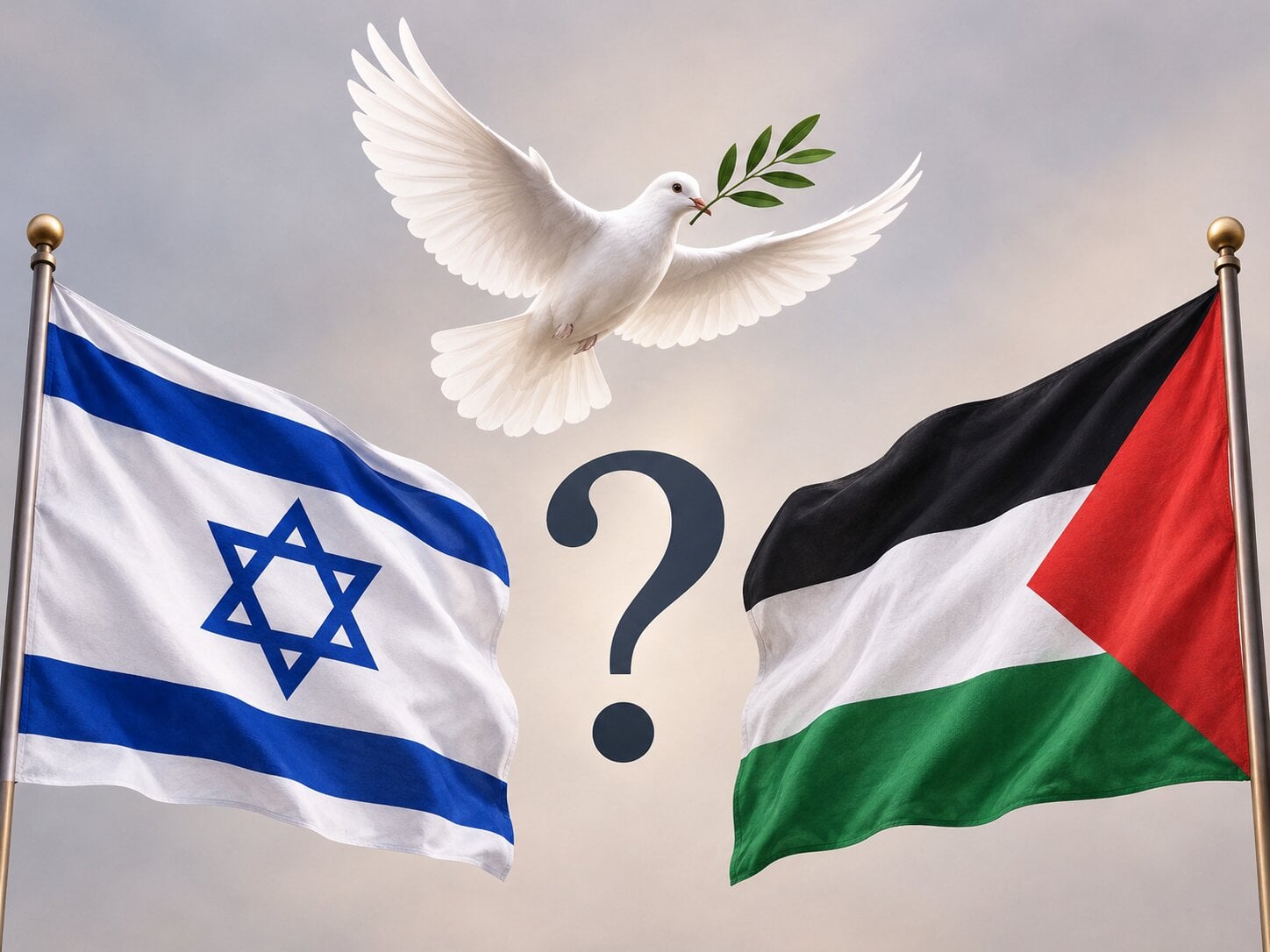
Israeli and Palestinian flags, a question mark and a dove of peace. (AI-generated illustration)
At the ELNET Jerusalem Summit on November 23, President Isaac Herzog emphasized the peace Israel has already established with Egypt and Jordan. He described the Egyptian treaty as an anchor of regional stability, urged Israel to take Jordan’s concerns seriously and condemned attacks by Jewish extremists against Palestinians in the West Bank. His remarks raised a question extending beyond diplomacy: how can Israel protect existing peace while confronting developments that threaten a wider settlement?
The concern was not confined to Israel. On November 22, Jordan’s Foreign Ministry condemned escalating settler attacks, called for accountability and warned of the damage to peace prospects. Two days later, Supreme Court President Yitzhak Amit questioned whether Israeli security authorities were adequately protecting Palestinians during proceedings involving residents of Burqa. These interventions reflected different responsibilities, but showed how violence in the West Bank affects Israel’s rule of law and its regional relationships.
The obstacles to Israeli-Palestinian peace are wider still. Hamas’s October 7, 2023 attacks, including the killing of civilians and taking of hostages, exposed grave failures in Israel’s security arrangements. Israel’s subsequent military campaign caused extensive destruction, displacement and civilian suffering in Gaza, drawing serious criticism within Israel as well as internationally.
Neither experience cancels out the responsibilities arising from the other. Israelis need protection against renewed attacks, while Palestinians need civilian security, functioning institutions and a political future beyond recurring war. Hamas’s armed power and Palestinian political divisions further complicate any agreement’s implementation.
These challenges cannot be addressed through Israeli-Palestinian negotiations alone. Israel’s peace treaties and newer Arab partnerships have endured disagreements over Gaza, settlements and Palestinian statehood. Yet diplomatic ties do not eliminate the consequences of an unresolved conflict. Jordan, whose security and religious responsibilities are closely tied to developments in the Palestinian territories, illustrates this particularly clearly.
Morocco offers another perspective on this regional challenge. Long before the Abraham Accords, its engagement in Arab-Israeli diplomacy went hand in hand with sustained support for Palestinians on the ground, spanning humanitarian relief, healthcare, education, social development and local institutions, particularly in Jerusalem and Gaza. That support has continued alongside its diplomatic relationship with Israel, as illustrated by Moroccan humanitarian aid delivered to Gaza through Israel in 2024.
At the United Nations’ November 23 observance for the International Day of Solidarity with the Palestinian People, King Mohammed VI addressed the committee responsible for Palestinian rights, setting out both a political objective and the practical conditions he considered necessary for lasting peace.
The King reaffirmed support for a Palestinian state along the June 4, 1967 lines, with East Jerusalem as its capital. He also called for humanitarian access to Gaza, political and administrative unity across Gaza, the West Bank and East Jerusalem, support for Palestinian institutions, the release of withheld revenues and freedom of movement for people, goods and capital. He described peace and coexistence as a realistic choice for the region.
For Israelis assessing a future agreement, these are consequential questions whatever the final political formula. A Palestinian administration unable to provide services, maintain stable finances or exercise authority across fragmented territory would struggle to fulfill its commitments. Accountable institutions cannot replace Israeli security guarantees, but those guarantees would also be difficult to implement without capable partners.
Territorial decisions present a related problem. INSS researchers Udi Dekel and Tammy Caner have warned that construction in E1, east of Jerusalem, could restrict future negotiating options and impose diplomatic costs, while acknowledging Israel’s strategic interests there. The attorney general’s November 17 suspension of construction tenders until a new government takes office postponed rather than resolved the dispute. A government may reject Palestinian statehood under present conditions without making a different arrangement harder for its successors to negotiate.
Jerusalem connects these questions directly to Israel’s existing regional peace. As chairman of the Organization of Islamic Cooperation’s Al-Quds Committee, King Mohammed VI warned that changes to the status quo at the holy compound could turn a political dispute into a wider religious confrontation exploited by extremists. He also pointed to the Bayt Mal Al-Quds Agency’s projects in health, education and social assistance, addressing residents’ daily needs alongside religious and political concerns.
Israel’s 1994 peace treaty with Jordan recognizes the Hashemite kingdom’s special role in Muslim holy shrines in Jerusalem. Israeli researchers Shmuel Berkovits and Ofir Winter have examined how tensions at the Temple Mount, known to Muslims as Al-Haram Al-Sharif, could strain relations with Amman.
Durable Israeli-Palestinian peace requires confronting distinct threats without overlooking any of them. Armed groups must not threaten Israeli civilians; Palestinian civilians must also be protected from violence, and institutions must be capable of governing responsibly. Decisions concerning territory, economic life and Jerusalem must preserve room for a workable political settlement.
Israel’s regional agreements show that peace can survive serious political disagreement. The harder task is to preserve conditions under which Israelis and Palestinians might reach an enforceable settlement of their own. That work begins before negotiations, in the decisions governments make today about security, accountability and the future they leave open.
Related Topics
Related Posts