
Carrie Bradshaw of the Middle East
The Healthy Masculine and the Bernie Bro
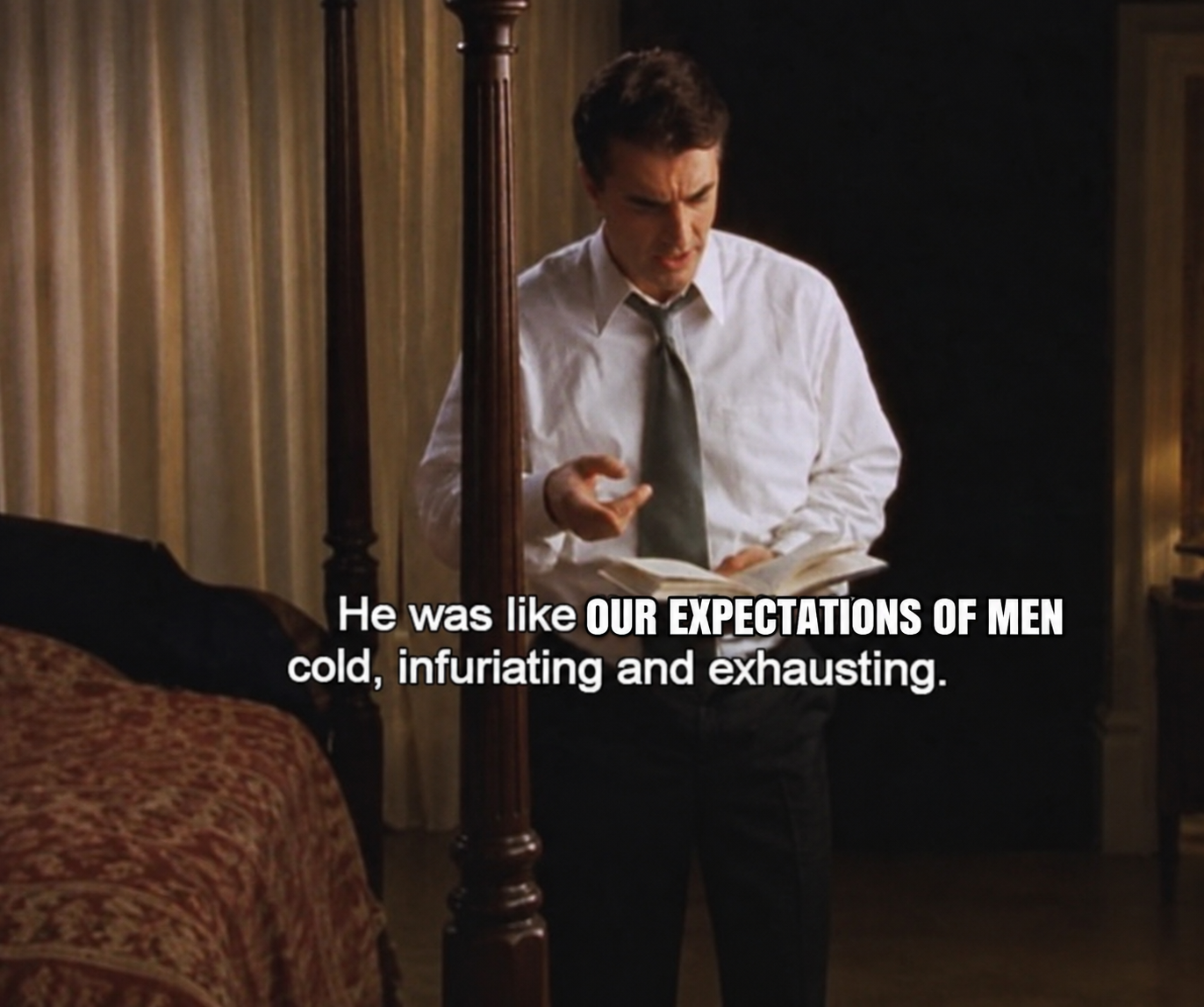
Adapted meme based on a scene from Sex and the City (HBO), included here for cultural commentary.
I was somewhere between a policy discussion and two glasses of wine when a man brought up dating. The event was hosted by a dear friend and Israel Policy Forum’s young leadership program, IPF Atid. A room full of politically engaged thirty-somethings had just stumbled onto a question apparently more complicated to answer than Middle East policy. How do you date in this politically polarized society? I sipped my wine and raised my hand as an expert. The way we date is the way we vote, and I’ve dated enough men to test this theory.
Bernie Bro and I dated during the 2020 primaries. He put down a fresh cup of homemade cold brew on the nightstand and kissed me before heading to the polls. I had already cast my vote for Elizabeth Warren. I enjoyed my time with Bernie Bro. For our first date, we saw What the Constitution Means to Me at the Center Theatre Group, followed by drinks and dancing before going back to his. If you haven’t seen the play, you can watch a live filmed production on Amazon. I highly recommend it.
It’s not that Bernie Bro was particularly politically motivated. While we enjoyed sending each other articles, podcasts, and talking about our country’s future, I don’t think he would have felt he had the space to do it if not for the wacky senator from Vermont. He wasn’t the only one.
The rise of the Bernie Bro came around the 2016 primaries. It was a harmless, progressive label centering everyone’s socialist Jewish uncle. The branding invited men in, giving them a wholesome alternative to dominating the conversation. This attracted many college educated men, but the Bros couldn’t get a win and the label became laughable at best. I’ve been lukewarm toward Bernie at best, but I think we neglected to understand what he was doing for men, and why we needed that.
It can take as little as twenty-three minutes for teenage boys to fall down the algorithmic rabbit hole into the manosphere, an online ecosystem crawling with aggressive definitions of masculinity, according to a Dublin City University study frequently referenced by UN Women. While the world of toxic masculinity is not new, the ways in which it’s being fed to boys are. The alternatives to extremism become more difficult to find. Bernie Bro and I would talk about most political issues. He’d voice his support for reproductive rights, at times with more gusto than even I would, and correct me whenever I referenced walking to class wearing the same clothes from the day before as my walk of shame, suggesting I hold my head up on my stride of pride. In a post MeToo world, these were hot button issues, and he wanted a seat at the table.
The Bernie Bro was mocked, sometimes for good reason. He could be loud, self-righteous, and his conviction that the podcast he’d just sent you would change your life could be…obnoxious. Underneath the caricature, however, was something we haven’t been good at replacing: a positive political identity for men. We’ve spent years asking what is wrong with men without asking what political identities would make men feel included, and what would make boys feel empowered. That’s what Bernie accidentally gave progressive men. When that identity disappeared, other movements were much more aggressive about offering alternatives.
Though Bernie Bro and I broke up due to COVID and the need for social distancing, men would wait a full presidential term before breaking up with the Democratic party. In 2024, 55% of men voted for Trump, up from 50% in 2020. The campaign deliberately sought out men, specifically young men, offering an anti-establishment identity that would allow them to feel wanted as men. Bernie offered something similar, leaving me to wonder… have we spent too much time figuring out what men shouldn’t be that we’ve forgotten to give them the space to figure out what they could be?
None of this starts with voting age men, nor does it start with a teenage boy with a smartphone in his hand. As the women’s movement grew, bashing down doors and creating new models for what a woman could be, we were able to give little girls expanding visions of what success and adulthood could look like. I was a little girl who needed that. I needed to be told I could be ambitious, loud, sexual, difficult, successful. It was a freedom we had to fight for.
The old script needed to be torn up. It limited women, and it didn’t do any favors for men. Tearing up the script isn’t the same as writing a new one. Boys need models for what it means to become a man, models that make room for vulnerability without turning ambition into domination. I don’t think Bernie Sanders is the answer, nor do I think we should hand teenage boys a political ideology with their first razor. But they do need somewhere to put their desire to matter without assuming that impulse makes them inherently bad.
Bernie Bro and I had a few social-distanced dates as the world fell apart before I realized there was no point in keeping it up. I don’t miss him. I don’t particularly miss Bernie Sanders’ presidential campaigns, either. I do miss the moment when a guy who wasn’t particularly political could find a political identity that made him feel invited into conversations about feminism, reproductive rights, and our collective future. Bernie Bro didn’t think supporting women required becoming less of a man. He just thought being a good man meant sitting at the same table.
Related Topics