The Heart Has Four Chambers (Noach & the South)
Reflections on a day in the South with Geerz & Parshat Noach
This week, among many other classic stories of Genesis, we read about Noah. We see a curious idea as he finishes his journey in the Ark. In his commentary on the Parsha, Rabbi Lord Johnathan Sacks ZT”L, points out the phrase in Chapter 8:16, “Then Gd said to Noah, ‘Leave the Ark’”
The question R. Saks asks is, why did Hashem have to tell Noah to leave?
Sacks paraphrases the Midrash. Noah says to himself, since Gd told me to go into the ark, I should wait for him to ask me to leave.
Saks also examines the text and highlights that once the flood ends, the pace and speed of the narrative crawl along, taking much longer for him to leave than you’d expect.
Parsha describes that first the water recedes, then the ark rests, then Noah sends a raven, then a dove, then he sends the dove again, and only then does it return with the olive branch. And even then, Noah sends the dove out one more time, but it does not return this time.
The Midrash says that only when Gd tells him to leave the ark, does Noah leave. In a way, Gd is expressing his exasperation.
Saks contrasts this with Rav Yehuda bar Ilai (Tanhuma, Noah 13-14). He wrote, “If I had been there, I would have broken down the ark and taken myself out.”
Sacks adds, “When it comes to rebuilding a shattered world, you do not wait for permission.”
This is a balancing act. However, our sages say that when it comes to repairing the world, we should be biased toward action.
Since October 7, our community and our nation have heeded these words. While no task is more important than the next, the collective efforts of chesed, advocacy, kindness, political action, prayer, and loving kindness have helped heal our shattered world.
Two years after October 7, a fragile ceasefire is in place. For those willing to see them, miracles abound. Two years in, surrounded by loss but also these divine interactions between man and his fellow man, and for many, man and Gd, how are we supposed to feel?
Rav Moshe Taragin shared another idea on the Shtark Tank podcast with Yaakov Wolff. These moments, times of miracles and challenges, even a shattering of the present, aren’t meant to be easy. We can manage conflicting emotions simultaneously.
Rav Taragin said, “The heart has four chambers.” He added, “Gd expects us to hold multiple emotions and feelings simultaneously.”
Taragin was reflecting on the miracles we’ve witnessed over the past two years. He also highlighted the challenges of the past two years, the hurt and loss that impacted his family and his Yeshiva community, and the modern-day miracle of the return of twenty live hostages, something he said he could have never imagined. Bearing witness and doing chesed are key ways to hold conflicting emotions at once.
To that end, early Sunday morning, I rose to take a not-so-long drive down to the communities of the Gaza envelope. Traveling just 60 miles away from home, my goal was to spend a few hours riding mountain bikes with dozens of others from the Geerz community. Geerz is a charity that funds weekly mountain biking experiences for children in foster care, group homes, soldiers facing PTSD, and communities facing significant difficulties. The benefits for physical and mental health from these experiences is exponential.
Our ride began in Kibbutz Be’eri, site of a devastating attack on October 7 that took the lives of 102 in the community, nearly 1 in 13 residents. We gathered in the parking lot, pumping up our tires, putting on our helmets, and high-fiving old friends.
Around us, Be’eri still showed signs, two years later, of the devastation, but it also showed signs of renewal, including many homes under construction. Even the bleary-eyed bike shop owner, whose shop has reopened, arrived to see a parking lot of mountain bikes, wondering who all these crazy people were.
We rolled out together through fields that had grown and regrown since the day of the attacks just two years ago. This ride wasn’t a race, nor was it challenging. It was a day of solidarity, celebration, solemnity, and joy. It was a time to be on the bike while reflecting on the difficulties so many face off of it.
Riding just a few miles from the border, we passed a bus stop with weary soldiers waiting for a ride home from the Gaza front. The freshly minted peace seemed to be holding, yet convoys of soldiers and equipment passed in both directions on the road beside us as we pedaled.
A highlight of our day and a focus of our outing was to visit Kibbutz Saad, just 3 kilometers from Gaza. Like Be’eri, the people of Kibbutz Saad faced tragedy on October 7 and then near-continuous bombardment for months.
We pulled into the community and gathered in a central square. Every classroom, community building, and office around us had a “Superstructure” erected atop them. Columns of cement and an extra cement roof meant that the school and community might continue apace regardless of attacks from nearby Gaza.
We visited the Geerz clubhouse on the outskirts of the Saad central square. In it, we saw twenty bikes, helmets, water backpacks, t-shirts, and repair equipment. We funded this equipment and the costs of the guides who would ensure that young community members, boys and girls, could enjoy a weekly (or more) mountain bike ride with their peers. These rides teach confidence, resilience, build community, and ideally spark joy.
As an aside, the communities surrounding Gaza are home to some of the most coveted and treasured “Single Track” mountain bike trails in Israel. The Be’eri forest hosts meandering and challenging trails designed to entice riders to enter the mystical and elusive “flow state” when one becomes one with the bike, nature, and something much bigger. These kids, who have faced every emotional horror possible, will now have access to a national treasure just pedal strokes outside their community to find positive opportunities and mental health respites.
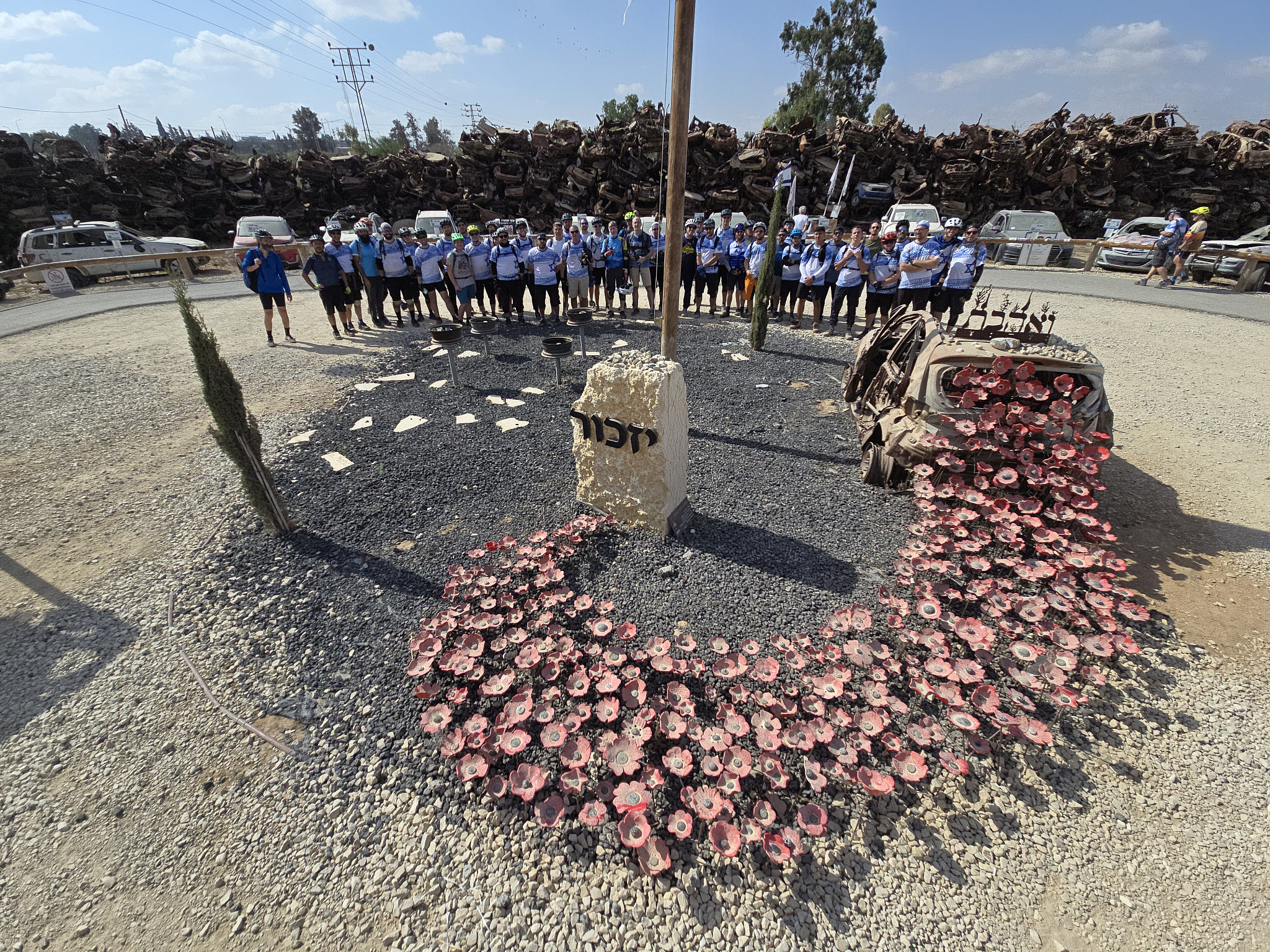
The starkest picture of the devastation and loss on October 7 that we experienced during the ride came next. We traveled a few more kilometers, and what appeared to be a “junkyard” came into view. As we came closer, it became clear that this was the memorial site dedicated to the lives lost on the road on October 7.
If you have ever visited the Holocaust Museum in Jerusalem, Yad VaShem, among the most moving displays is an endless pile of shoes recovered from the camps. Each pair represented a human. Stacked in a pile, the viewer has to seek to find humanity among the representations of mass devastation.
“The Car Wall,” a memorial site near Tkuma, also just a few kilometers from the border, evoked similar feelings. Stacked one atop another, neatly stacked crushed and burnt shells of cars made a dramatic and powerful background. Each car is a story. Each once full of life, now reduced to something more than refuse, but less than human.
In front of the wall, a dozen cars remained displayed in a semicircle. Each featured a vignette, photo, QR Code, and more, telling the story of the person(s) who traveled in the vehicle on that day and lost their lives. One hero made five trips back and forth from a nearby community to rescue Nova Festival attendees. He saved forty lives but lost his.
I rode side-by-side with an old friend on our last leg of the journey. The path took us through the epic Be’eri forest and its legendary trails. I did not achieve a “flow state” but instead cycled through as many emotions as the gears as I pedaled.
On a short and sharp hill, requiring acceleration and every ounce of strength, I thought of those who literally ran, breathless, for their lives, and tragically were cut down.
When I saw a shadow cast by a young eucalyptus tree, I marvelled at the years, centuries, and millennia of Jewish renewal and life, nurtured by our faith, emerging from catastrophe.
Glimpsing the burnt fields in the distance, yet to regrow, I was awed by parents and loved ones facing endless grief, mourning those killed and captured not only on October 7 but in combat and confrontations since. My prayer is that as nature heals, so can they.
It was a day of conflicting and simultaneous emotions, and one honoring our national journey. I hope this two-year lasting legacy will go beyond horror and sadness.
Rav Taragin is right. Our heart has many chambers. Gd, and our humanity, asks and requires us to hold many conflicting emotions at once: joy, pain, sadness, hope, and gratitude. That’s what makes us human and defines our relationship with the divine.
Noah’s journey also teaches us that to heal a shattered world, we must take quick and personal action. Showing up can be that action.
With our efforts and empathy, I hope that many more children may discover a moment’s peace and joy. I hope we, the Geerz crew, left the South just a little bit better by standing in solidarity, supporting each community, and encouraging a legacy of healing. And I hope each of the Kibbutz Saad kids finds their flow state out on the trails.
––
To learn more about Geerz and its work post October 7, click here.