
Cohost of "Physics to God" podcast
The Hidden Logic of The Story of Everything
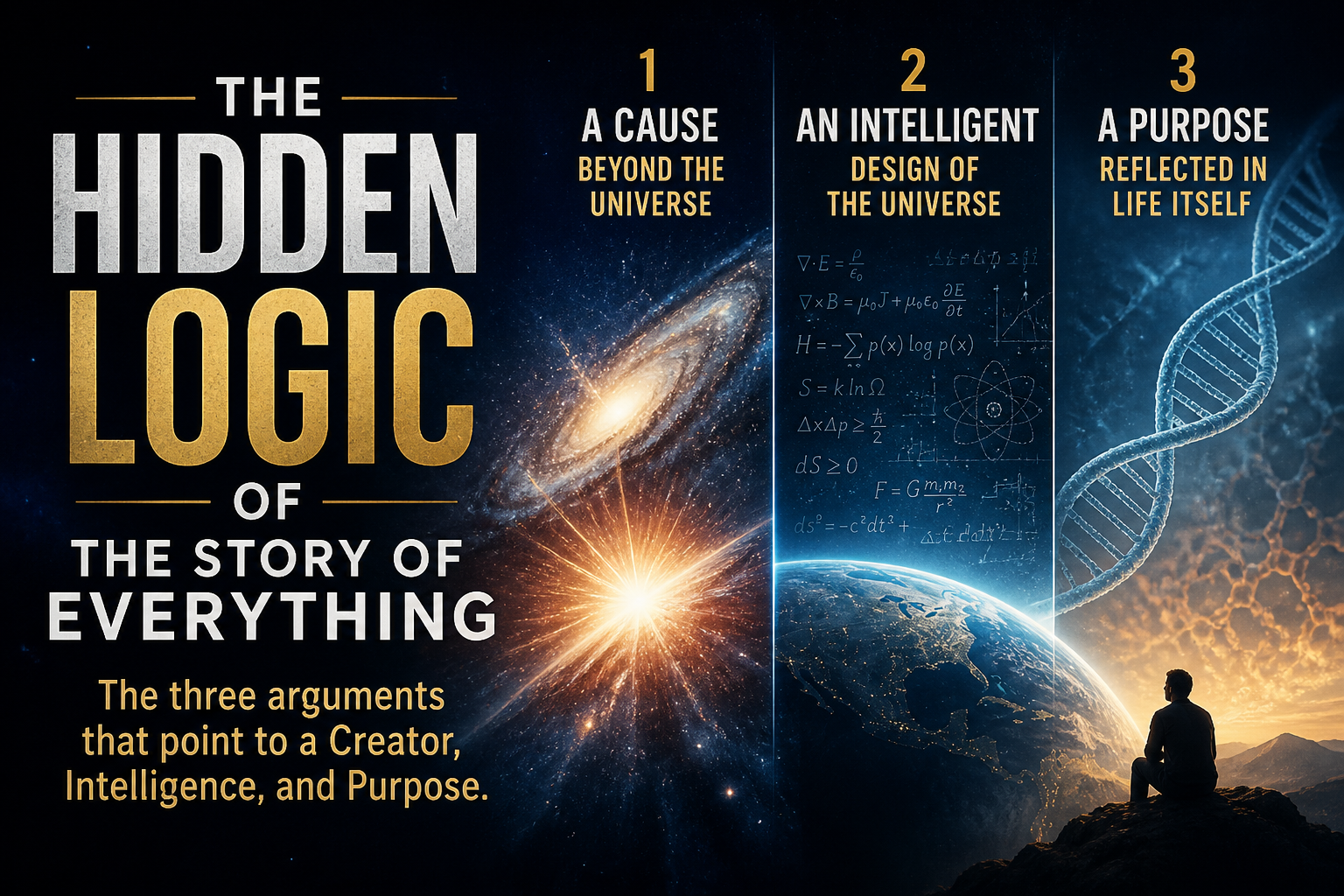
The debate over God and science has changed. The Story of Everything captures why.
The Story of Everything, the new film by Stephen Meyer, presents three major scientific arguments for God in a way that is clear, engaging, and highly accessible. It succeeds in doing something difficult: translating deep scientific and philosophical ideas into a compelling cinematic narrative without sacrificing the seriousness of the subject.
Like any film, however, its medium imposes limits. A documentary must move quickly, and that means some of the logical structure connecting its arguments remains implicit rather than fully spelled out. It’s not a flaw. It’s part of the nature of the format. But it does make it worthwhile to step back and trace the deeper flow of the argument.
What makes the film especially powerful is that its three arguments build on one another in a sequential philosophical progression.
The first begins with the Big Bang. If the universe had a beginning, then it requires a cause beyond itself. Since space, time, and matter all begin with the universe, that cause must transcend the physical universe altogether. This argument establishes an infinitely powerful creator, one capable of bringing the universe into existence from nothing.
The second argument moves from existence to design. Modern physics has uncovered that the fundamental constants of nature appear extraordinarily fine-tuned. If some of these constants were even slightly different, the universe would lack the stable structures needed for stars, chemistry, and complex physical systems. This pushes the argument further: the cause of the universe was not merely powerful, but intelligent, selecting the precise conditions necessary for a structured and ordered cosmos.
The third argument moves from cosmic order to biological purpose. The information-rich structure of DNA and the complexity of life point not merely to intelligence in the abstract, but to intention directed specifically toward living beings. If the first argument gives us a creator, and the second gives us an intelligent creator, the third implies that life itself was one of the central purposes of creation.
Seen in this light, the film’s three arguments form a remarkable progression: from cause, to intelligence, to life as a purpose.
That progression matters because the scientific debate has shifted dramatically over the past few decades. Questions once confined to philosophy and theology now stand at the center of modern cosmology, physics, and biology. And the evidence itself has increasingly shifted in favor of an intelligent cause behind the universe.
This is what gives The Story of Everything its importance. It has the potential to bring these arguments to a far wider audience than academic books or technical debates ever could. And in doing so, it may help accelerate a growing public awareness that the discoveries of modern science are increasingly pointing not away from God, but toward Him.
Related Topics
Related Posts