The Hidden Reason Chanukah Matters More Than Ever
What makes Chanukah so important to us today?
We know the story – a single jar of oil, enough for just one day, burned for eight. Yet what made this miracle so profound to have become a core part of our national memory, celebrating it every year for more than two thousand years?
If we see Chanukah as a celebration of the Maccabees’ victory over the Greeks, this question is amplified. The Israelites had other military victories – some accompanied by even more dramatic miracles – that we do not commemorate with an eight day festival. Think of Joshua and the walls being brought down at Jericho – or when giant boulders rained on our enemies. Those events were astonishing, yet they did not become yearly celebrations.
Even after the Maccabean victory, the times that followed were far from easy. The miracle of Chanukah did not usher in an era of peace. The struggles continued.
And yet, over two thousand years later, the Festival of Lights has become a core part of our national memory.
To understand what makes the Chanukah miracle so meaningful, Rabbi David Forhman and Immanuel Shalev, Founder and CEO of the Aleph Beta app, respectively, offer a fascinating insight.
They pose the question: Just like the oil in the Chanukah lights, which burned continuously yet was never consumed, where else in the Torah do we see something that burns without being destroyed?
- At the burning bush, where God first appears to Moses in a flame that engulfs the bush but does not consume it.
- At Sinai, where God’s presence is revealed to the nation through fire atop the mountain.
Let us set aside this insight for a moment and return to our original question:
What makes Chanukah so important to us today?
Imagine yourself in the position of the Jewish people at the time of the Maccabees. It had been over four hundred years since the age of open miracles and living prophets.
Then, the First Temple was destroyed and we were thrown into a dark and disorienting age without the prophets to lead us and without the open miracles that once made God’s presence so clearly felt.
How would we survive without miracles? We were never the most powerful empire on Earth, we may have feared.
When the Greeks invaded, these anxieties deepened. Thousands of Jews joined the Greeks and our nation spiralled into a civil war. It was, in the words of Immanuel Shalev “a very bleak time indeed, where all was threatened to be lost”.
Then, the Maccabees came together and won a war against all odds.
Yet, even after such an unlikely victory against the Greeks, the critical question on the peoples’ minds may have been: “Could God really still be with us? Did He win this battle for us?”
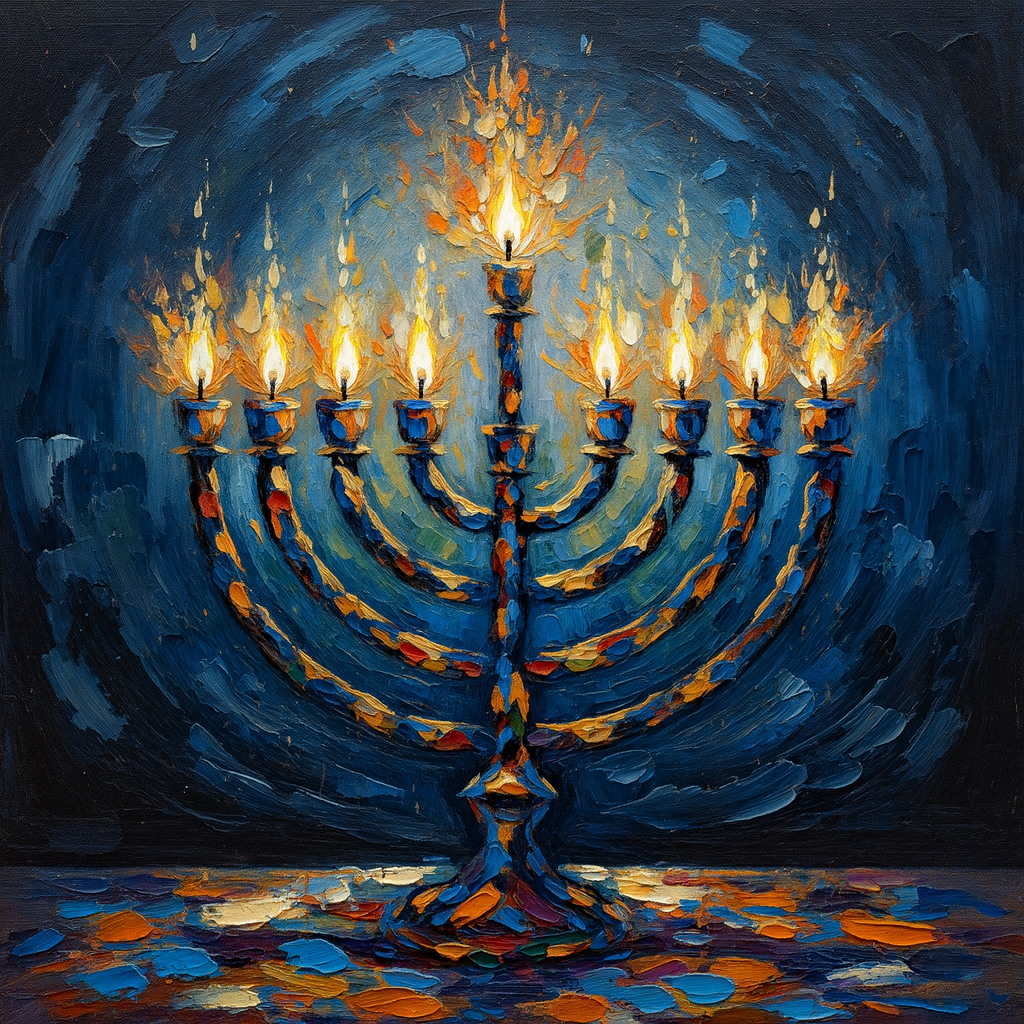
They found the answer in the menorah.
With only a fraction of the oil needed, the flame burned for eight nights.
If the oil was not being consumed, it was not the true source of the flame.
So what was?
Think back to the burning bush and to Sinai – moments in which fire burned without consuming – sustained by Divine Presence.
This is what makes the Chanukah miracle so profound. In the first open miracle since the destruction of the Temple, God was revealing Himself once more, saying, “I am here. I am still with you”.
2000 years later we can light the menorah each year in gratitude and recognition that even without our temple, open miracles and prophecy, God was with us then. And today, “even in the dark, we are not alone” ¹
The things we walk past
Sometimes the most remarkable things happen right before our eyes. And we miss them.
Moses noticed the bush was burning yet not being consumed by fire, while others may have passed by without realising anything extraordinary was happening.¹
Sometimes it is hard to appreciate what is right in front of us.
In late November I had the great privilege to listen to the incredibly moving Sacks Conversation in London with Rachel and Jon Goldberg-Polin, parents of Hersh Goldberg-Polin z”l, who was abducted from the Nova festival and murdered by Hamas 11 months later.
During their conversation with Daniel Taub, Rachel highlighted how even in the desert, even in the midst of God’s presence and receiving Manna from the sky multiple times daily, we still managed to kvetch and kvetch.
How much easier does that make it for us to complain today, when we are relatively in the dark, in comparison to the open miracles and years of prophecy three thousand years ago?
Can we train ourselves to see and respond to the miracles in our daily lives – on both a personal and national level?
As Rabbi Sacks z”l put it: “Never before in 4000 years of history have Jews enjoyed, simultaneously, independence and sovereignty in Israel, and freedom and equality in the Diaspora.
The existence of Israel is as near to a miracle as we will find in the sober pages of empirical history. Israel has had to face war and terror, but it has transformed the Jewish situation by the mere fact of its existence as the one place where Jews can defend themselves, instead of relying on the all-too-often unreliable goodwill of others. Around the world, our people are facing immense challenges, but it is still true that “Jewish life in the Diaspora is flourishing culturally, educationally and spiritually in ways that would have been unimaginable a century ago.” ²
Choosing life
The existence of the State of Israel and the return of all the living hostages is proof that there are unimagined possibilities.³ Miraculous outcomes can happen. “In Israel, in order to be a realist you must believe in miracles” David Ben Gurion famously said.
This is the time for each of us to recognise the miracles in our challenging times and to act with hope, taking action towards healing this fractured, troubled world of ours. From educating ourselves and teaching others about our own history, to walking towards seeing the other amongst our divided people.
This Chanukah, in the words of Rachel Goldberg-Polin, let us choose life and “wrap ourselves in the jacket of hope, and be blessed with a radical hope that keeps us not just strong, but courageous” in forging our pathway forward.
References:
- Aleph Beta. What Is The Meaning Of Hanukkah? (Part 1 of 2) https://www.alephbeta.org/playlist/meaning-of-hanukkah.
- Sacks, Jonathan. Future Tense: Jews, Judaism, and Israel in the Twenty-First Century. London: Hodder & Stoughton, 2009.
- The concept of unimagined possibilities – White, Tanya. “We Need a New Abraham: What the Hostages Taught Us About Faith.” Contemplating Torah, November 5, 2025. https://www.tanyawhite.org/post/we-need-a-new-abraham-what-the-hostages-taught-us-about-faith