Director of Diplomacy, Representative to UN Geneva & UNESCO, World Jewish Congress
The Holocaust Museum of Greece – An ark of memory being created in Thessaloniki
Thessaloniki, Greece’s second biggest city, has for centuries been a major Jewish center, often dubbed the “mother of Israel” or “Jerusalem of the Balkans.” The city was founded in 315 BCE by Macedonian general Cassander, who named it after his wife, Thessaloniki. She was a Macedonian princess, half-sister of Alexander the Great and daughter of Philip II, and her name commemorates her father’s victory (“niki” in Greek) in Thessaly. In the Jewish world, the city is known as Salonica or Saloniki.
The city’s Jewish community has a history stretching back over 2,000 years, already settled when the Apostle Paul came there to preach the new religion of Christianity in 49/50 CE. The Jewish population increased significantly when, in 1492, thousands of Sephardic Jews fleeing the Spanish Inquisition found shelter in Thessaloniki, at the time under Ottoman control. The newly arrived transformed the city and shaped its economic, cultural and political life for centuries.
On 7 November 1911, David Ben-Gurion arrived in Thessaloniki to learn Turkish ahead of his law studies. The city’s Jewish community impressed Ben-Gurion who famously called it “a Jewish city that has no equal in the world.” He also saw how the community thrived, comprised of all social strata, and noted that “the Jews were capable of all types of work,” increasing his faith that a Jewish state would be possible.
A few months later, the Greek army entered the city, making it now a part of the Greek state. 1917 brought along a catastrophic fire that burned down most of the Jewish neighborhoods, and the interwar period brought along economic hardships and an exchange of populations between Greece and Turkey, changing the city’s landscape. Many Jews chose to leave the city and migrate elsewhere, to Palestine, France and the United States, but the Jewish community continued to play an important role in the city affairs.
The life of this unique Sephardic metropolis came to an abrupt end with the German occupation of the city during the Second World War and the murder of more than 90% of the city’s 50,000 Jews. It was not only the living that were annihilated. So too was their material culture and heritage: their synagogues, community centers, libraries, shops, homes, possessions – anything that could bear witness of their existence in the city, including their ancient cemetery.
To commemorate the innocent victims lost, the Jewish Community, with the support of the Municipality of Thessaloniki, decided to create the Holocaust Museum of Greece in Thessaloniki, to safeguard the memory of the Holocaust, not only for this city but the whole of the country. With the Jewish Community, the Greek and German governments, and the Niarchos and Tavma foundations as founding donors and with support from and Albert Bourla via his donation of the Genesis Prize and the Claims Conference, the construction for the museum has started and it is expected to be completed in two years. It will be located in the area of the old railway station, to mark the original site of where the deportations of the city’s Jews to Auschwitz took place in 1943.
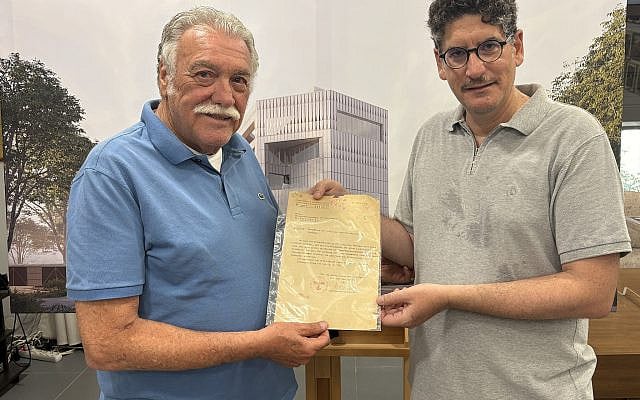
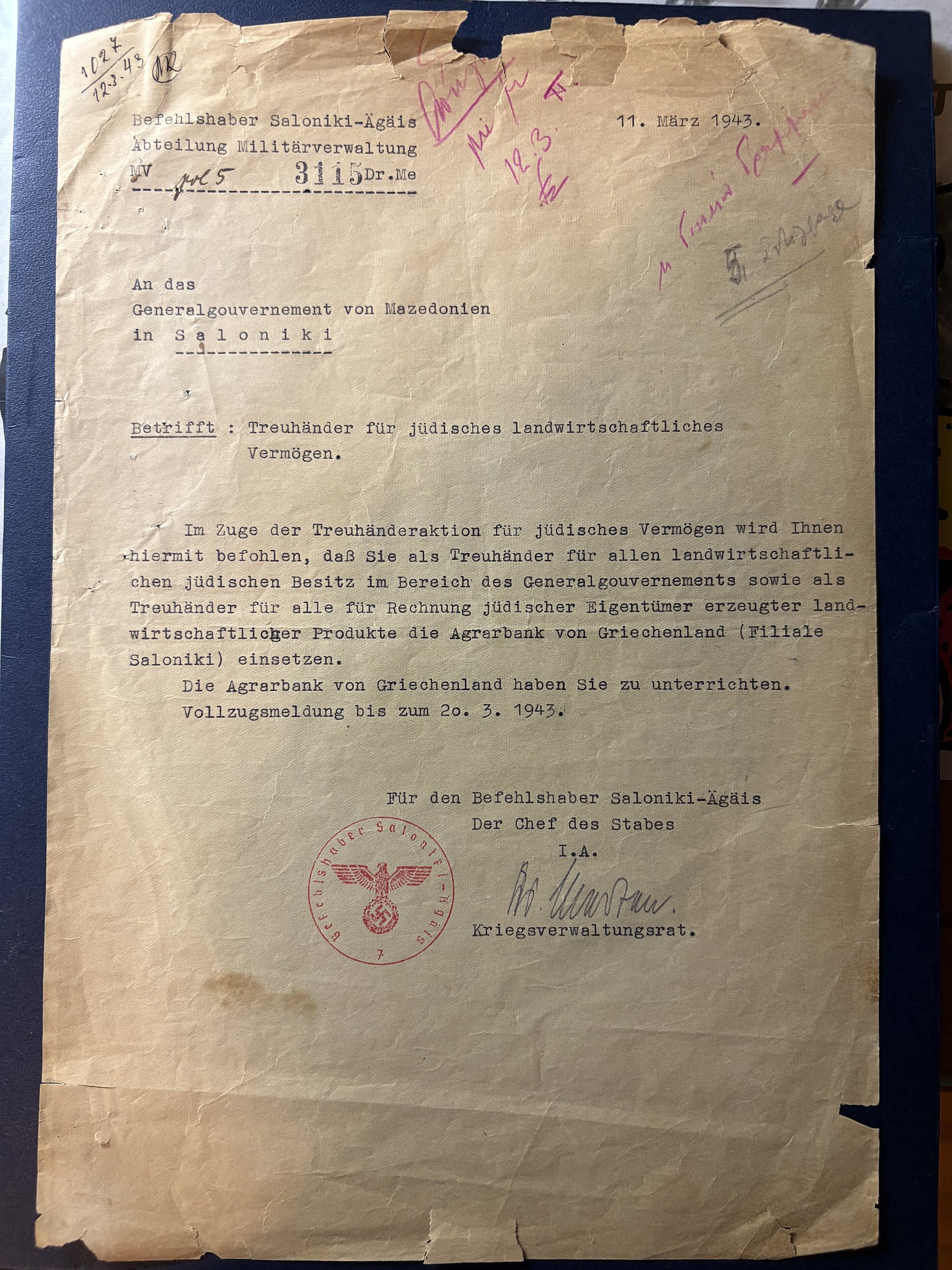
To support the museum’s important mission, I decided to donate two artifacts I recently acquired. The first is a German order from 11 March 1943, a few days before the first deportation train left the city. The Jews has already seen their ancient cemetery destroyed and the community libraries plundered; as of 25 February, they had to wear the yellow star and they were confined in ghettos. Their businesses were taken and they were given to Greek Christian custodians by an agency created for that purpose on 7 March, the Agency for the Custody of Jewish Properties (YDIP), and they were often emptied by the German and their local collaborators before being handed over.
The order in question, unknown until now, is signed by Max Merten, the German officer in charge of civilian affairs, who was quite notorious due to his involvement with the anti-Jewish measures and his conviction during his 1959 trial in Athens and subsequent release later in the same year. It concerns the agricultural properties of the Jews, which would not be dealt by YDIP, but by the Agricultural Bank of Greece. This document enriches our knowledge on the process of the spoliation of Jewish properties and opens new avenues for research and restitution.
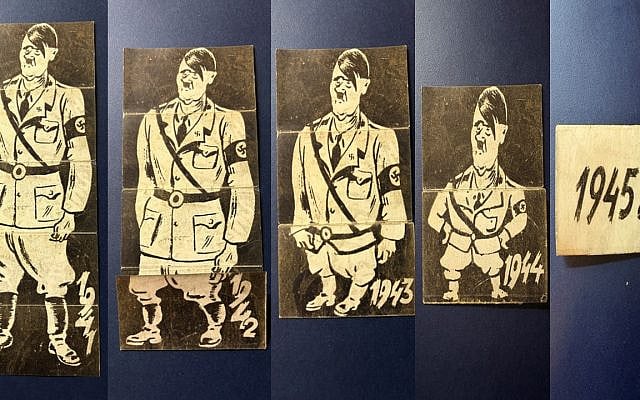
The second item is a satirical sketch, dating between end of 1944-beginning of 1945, depicting a caricature of Hitler. The full image shows him in the year 1941. As one folds in, the year becomes 1942, 1943, 1944, with Hitler becoming smaller and smaller. The last image shows 1945 with a question mark. This document must have been prepared and circulated by Allied propaganda to reduce faith in the Axis powers and boost morale for a victory against the Nazis and their allies.
The Museum will pay homage to the thousands of Holocaust victims from Thessaloniki and the whole of Greece. It will also highlight Jewish heritage and remembrance, honoring centuries of Jewish life, heritage and contribution. It will be home to educational activities, cultural events and archival research. In a time of resurgent hatred and antisemitism, the Museum aspires to safeguard the memory and promote messages of tolerance, anti-discrimination and co-existence, and to counter messages of denial and ignorance.
If you possess any documents or objects that relate to the history of the Jews of Greece, and the Holocaust in particular, and you wish to donate them to the Museum, you can contact the Jewish Community of Thessaloniki at info@jct.gr.
Related Topics