The Holy Stubbornness of a Wartime Bride
In Parashat Ki Tisa, the Torah presents one of its most psychologically nuanced portraits of the Jewish people through the repeated phrase am k’sheh oref, meaning “a stiff necked people.” The term echoes across the Torah six times, appearing four times in this week’s parsha and twice more in Devarim. Its repetition is intentional. It compels us to confront a trait that has always been both our enduring flaw and our unexpected strength.
The narrative unfolds in dramatic stages. God first applies the label after the sin of the Golden Calf, offering a piercing judgment of refusal and rebellion. Twice more, God declares that He cannot dwell among the people because their stubbornness would draw the force of divine justice too intensely. Yet in the parsha’s redemptive turning point, Moshe uses the very same phrase not to condemn the people but to plead for them:
“If I have found favor in Your eyes, let the Lord go in our midst, because it is a stiff necked people, and pardon our iniquity.”
Moshe transforms the critique into an argument for closeness. His logic is audacious. Israel’s stubbornness is not a reason for God to withdraw, but a reason He must remain.
Ramban (Nachmanides) illuminates this reversal. A people with such intense resolve, he explains, cannot be entrusted to intermediaries. An angel would lose patience and a human leader would despair. Only God possesses the limitless compassion required to guide, restrain, and forgive a people whose very nature resists being guided. What begins as an accusation becomes the foundation for an intimate bond.
Rav Samson Raphael Hirsch expands this idea by teaching that the same inner force that fuels rebellion can also sustain unwavering faith. The Netziv adds that a “stiff neck” is morally neutral. It is a deep reservoir of inner strength. When directed away from God, it leads to disaster. When aligned with God, it becomes a loyalty no empire can break.
Rabbi Yitzchak Nissenbaum, writing from within the nightmare of the Warsaw Ghetto, captured this paradox with haunting clarity. He imagined Moshe pleading before God:
“What is now their greatest flaw will one day become their most heroic quality. Just as they are stubborn in disobedience, so one day they will be stubborn in loyalty. Nations will demand that they assimilate, but they will refuse. They will suffer humiliation, persecution, torture, and death, yet they will remain faithful. They will go to their deaths saying Ani ma’amin.”
His words, written before his own murder, proved tragically prophetic.
We often imagine this kind of heroism as belonging only to the past. Yet yesterday I witnessed a glimpse of this holy stubbornness with my own eyes.
Living in the region that Israel inhabits today, surrounded by hostile actors and relentless threats, we unfortunately have no choice but to be firm and unyielding. We must remain vigilant and steady. But Ki Tisa teaches that our stubbornness must be directed toward God, not against Him, and that it must express itself through faith, continuity, and principled resilience.
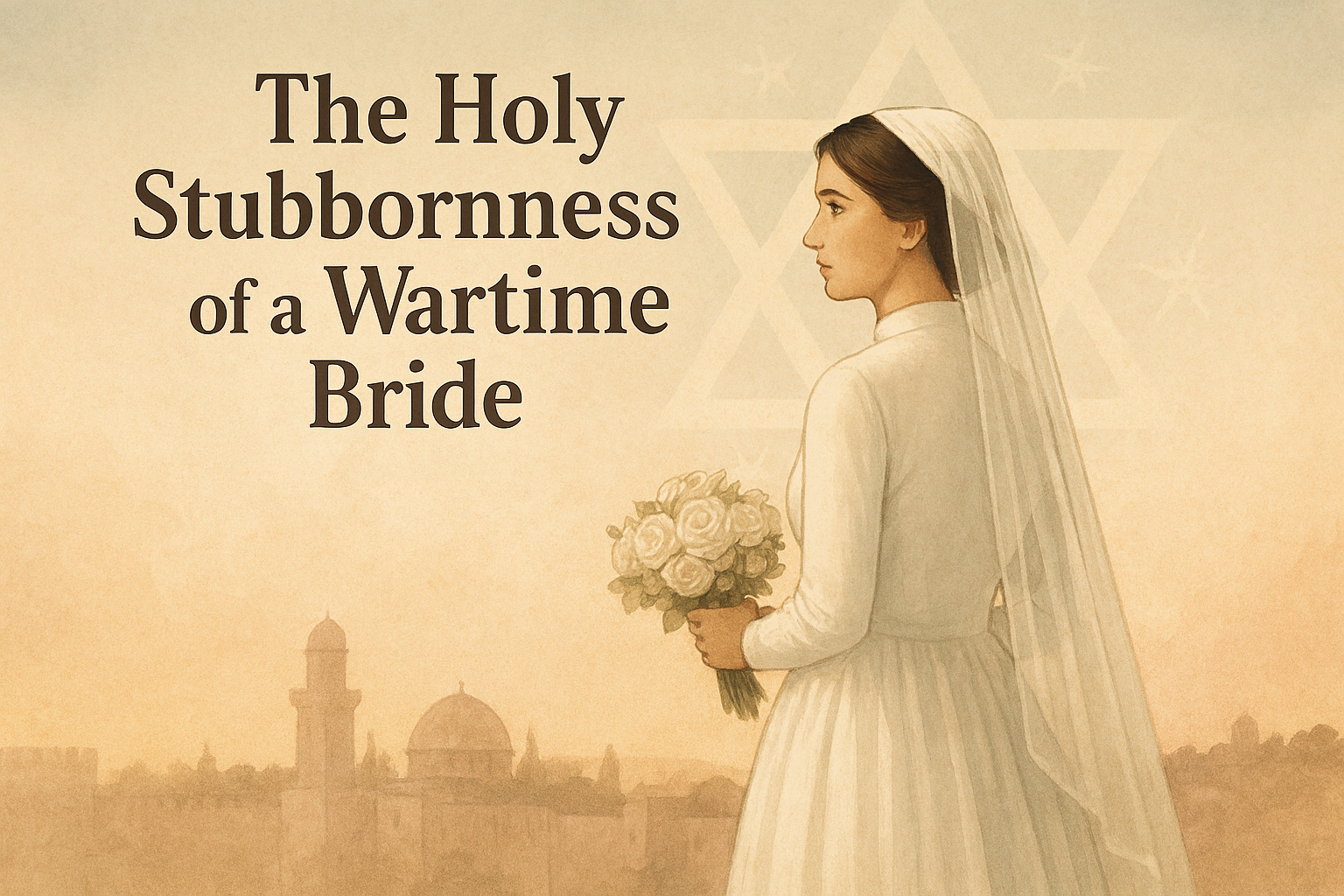
And so, in the shadow of an escalating war, with sirens sounding, uncertainty everywhere, soldiers deployed, and daily life disrupted, my daughter stood before me wearing her wedding dress for the first time. The atmosphere in the country is heavy. Security alerts interrupt the day. News updates arrive with a sense of dread. People whisper their worries about what tomorrow may bring. The reasonable choice might be to postpone the celebration, to wait for calmer days, to retreat until the storm subsides.
But she and her chatan refused to give in. They chose to build a Jewish home now, in this moment, in this land. It is an act of faith not in spite of the challenges but in defiance of them.
When I saw her radiant in that dress, I cried tears of joy. In that moment, the trait our parsha struggles with became something luminous and pure. She embodied stubbornness in the noblest sense. She refused to succumb to despair, refused to let terror dictate the timing of her joy, and refused to allow fear to decide the course of her life. In their quiet resolve, the rebellion of the Golden Calf was answered by the sanctity of the chuppah. Her stance declared: We will build. We will dance. We will not break.
The Torah’s repetition teaches that stubbornness is like nuclear energy. It is powerful and volatile. Left unrefined, it can destroy. Directed toward idolatry or complaint, it becomes our downfall. But when harnessed toward covenant, toward love of our people, and toward the refusal to let darkness extinguish Jewish life, it becomes our salvation.
My daughter’s and her wonderful husband to be’s upcoming wedding, even with the restrictions that now shape it and the ways it will differ from what we once imagined, reflects the beautiful stubbornness of a people who refuse to let their enemies script their destiny.
May we merit to be k’sheh oref in the right way: unyielding in our commitment to one another, steadfast in our heritage, and resolute in choosing life.
May we all stay safe.
Shabbat Shalom.