
The Home Army Commissioned a Jewish 9yr Old Under a Dead Catholic Child’s Name
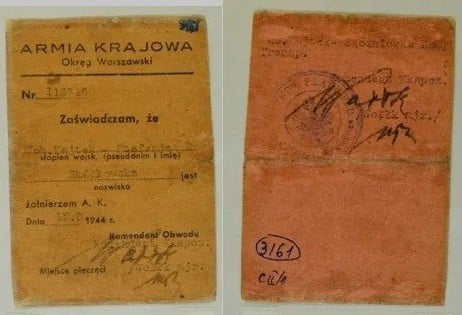
There is a card in my files. A copy of it, anyway. The original is held at the Ghetto Fighters’ House archive in Israel, and I have looked at it hundreds of times over the years I spent writing Little Edna’s War. It is small. Brown. The paper has the grain and weight of something that was never meant to last eighty years. Across the top, in bold block letters:
ARMIA KRAJOWA Okręg Warszawski
Home Army. Warsaw District.
Below that, a number: 113716. Below that, a Polish phrase I have mouthed to myself many times without quite getting used to the fact that it applies to a nine-year-old girl.
Zaświadczam, że — I certify that.
What the Card Says
I will give it to you in the order it appears, because the order is part of what it means.
First, the blank for military rank and nom de guerre. Someone has filled in, by typewriter: ob. Kajtek — Stefanja.
Ob. is the abbreviation for obywatelka, meaning citizen. The Home Army did not call its fighters by military rank first. It called them citizens. Every soldier in the AK, from a general commanding a sector down to a child running messages through the rubble, was first a citizen of the Polish Republic that Germany had refused to recognize. Putting obywatelka on the card was a small, quiet act of defiance built into the paperwork itself. The underground state was not a military. It was a country in hiding, and this card was a passport.
Kajtek was her nom de guerre.
The Name She Chose Herself
When the Home Army asked Edna what she wanted to be called, she did not hesitate. She chose Kajtek.
The name was not a military-sounding pseudonym. It was not a tactical alias. It was the name of the boy from her favorite book.
Kajtek the Wizard, or Kajtuś Czarodziej in Polish, was written in 1933 by a Jewish pediatrician named Janusz Korczak. It is the story of a mischievous Warsaw schoolboy who discovers he can do magic and uses his powers to fight evil. Kajtek leads a double life. On the outside he is an ordinary child. Underneath, he is a wizard, and he is in a war.
Edna’s family had read it to her when she was very small. She was too young to read it herself. But she remembered the boy. The Warsaw child with the secret self, the double life hidden beneath ordinary clothes, the magic aimed at the evil in the world. When the resistance asked her for a name, that is the name she reached for.
She was nine years old. Jewish. Living as a Polish Catholic orphan under a dead girl’s name. A courier in an army she could not read the orders of. And when she was asked to choose what she would be called on the battlefield, she chose a boy wizard from a children’s book.
She could not have chosen a name more exactly shaped to her life.
What She Did Not Know
Janusz Korczak was the most beloved educator in Poland. When the Germans forced Warsaw’s Jews into the ghetto, he went with his orphanage. When they came to deport the children, he refused escape and walked with them to the trains.
He did not leave them.
She never knew.
She carried his name through the Uprising. She wore it into combat. She saw it on this card in August 1944, two years almost to the day after Korczak walked his orphans to the cattle cars.
She only knew that Kajtek was a boy who fought evil while pretending to be ordinary. She only knew she needed that.
The Rest of the Card
And then, in the space for her given name: Stefanja.
That is the other detail worth slowing down on.
Stefanja, or Stefcia as she was called, was not her real name either. It was her alias. It was the identity her older brother Yakov had built for her, the way the Warsaw underground built everything in those years, out of whatever the city could still give.
What the city could still give was its dead.
Yakov took Edna and her sister Miriam to an old Catholic cemetery and walked the rows looking for a particular kind of tombstone. Two sisters. Close in age. Long enough dead that no one would come looking.
They found what they were looking for in the last row.
Two girls who had died in 1919, probably of the Spanish flu. Stefcia and Marysia-Marja Skółkowska. Edna couldn’t read the stones herself. Yakov and Miriam read the names to her, and Yakov assigned them.
You are Stefcia.
He wrote the name down so she could practice. He told her the surname had to be pronounced perfectly. He said the papers would say she was born in Lublin.
And Edna walked back into the city repeating her new name out loud so that her mouth would believe it.
Stefcia Skółkowska. Stefcia Skółkowska. Stefcia Skółkowska.
This is how a hunted child acquires a self.
What the Home Army Did
Her real name was Edna. That name could not appear on any piece of paper in occupied Poland. It was a death sentence.
So look at the card again.
What the Home Army has done here is precise.
They have issued her a formal soldier’s identification card under two borrowed names. One is her chosen name, Kajtek. The other is her cover name, Stefanja Skółkowska, a Polish Catholic girl who had been dead since 1919.
Neither of these children was Edna. Neither of them could be killed, because neither of them existed. The card she carried into combat belonged to two ghosts.
The AK recorded it. The AK stamped it. The AK signed its own commandant’s signature to it.
They placed the name Kajtek in front of the name Stefanja and, in the language of the occupation’s own paperwork, made that child a soldier.
The disguise is not being set aside for the purposes of this document. The disguise is the document.
Kajtek the wizard has been revived as Kajtek the courier. Stefcia the dead girl has been revived as Stefcia the orphan. Every layer built around her has been formalized, stamped, and filed.
The Home Army did not know. Major Wołk did not know. The officer at the typewriter did not know.
The card does not hide anything from them. It records the only person they believed they were registering.
There is no hidden layer here.
The disguise is complete.
The girl on the card is the only one they ever saw.
Soldier of the A.K.
Then the surname line: Skółkowska.
Then the designation: żołnierzem A.K., a soldier of the Home Army.
Then the date: 15.8.1944.
And then, on the back, the line that stopped me cold the first time I read it:
ob. Kajtek — łączniczka Kol. Transp.
Citizen Kajtek, courier of the Transport Column.
What Each Word Is Doing
Łączniczka is the feminine form of liaison or courier. Literally, the one who connects. They memorized orders, ran under fire, carried messages when radios failed.
The feminine ending is there on the card. The paperwork told the truth about her gender even when it could not tell the truth about anything else.
Kolumna Transportowa—Transport Column. Supplies, wounded fighters, ammunition, food, bodies. Constant movement.
She was carrying orders she could not read. She was the link between people who wrote things down, and she carried their words without knowing what they said.
On August 15, 1944, that is what she was.
A runner for the Transport Column in the center of Warsaw.
Nine years old.
What the Date Means
The Uprising began on August 1, 1944. This card is dated August 15. Fifteen days in.
This is battlefield paperwork. Someone sat down under bombardment and typed a formal identification card for a nine-year-old already running missions.
Paper was scarce. Time was scarcer.
She was not a mascot. She was not a child tagging along.
She was a soldier.
The Second Card
There is a second card in the same file. Same date. Same commandant. Same unit designation.
And the second cover identity, taken from the same tombstone: her sister’s.
Two dead sisters from 1919. Two living sisters in 1944. One name for each of them.
Because a hunted child cannot be caught with only one life.
Two identification cards issued on August 15, 1944: Edna and her sister Miriam, both serving in the Transport Column—two living couriers registered under the names of two girls who had died in 1919.
How It Ended Up in Israel
The cards now sit in the Ghetto Fighters’ House archive, founded by survivors of the Warsaw Uprising and the partisan movement.
Yakov was one of the founders.
The same brother who took Edna into the cemetery. The same brother who read the names off the stone. The same brother who forged the identity she carried.
He made it. He kept it.
Between those two acts, she lived inside it.
What I Carry from It
I have spent a long time sitting with this card, and what I keep coming back to is how ordinary it looks.
A piece of brown paper. A typewriter’s uneven pressure. A stamp. A signature.
And yet it is one of the few objects that says, in the language of the state that issued it:
Kajtek was here.
Stefcia was here.
They were soldiers.
The records cannot tell you that Edna was here. They were never meant to.
What the card proves, eighty years later, is that the architecture worked.
Kajtek was filed. Stefcia was commissioned.
Together, they were awarded two medals and sent to two Nazi POW camps.And inside them both, the whole time, was Edna.
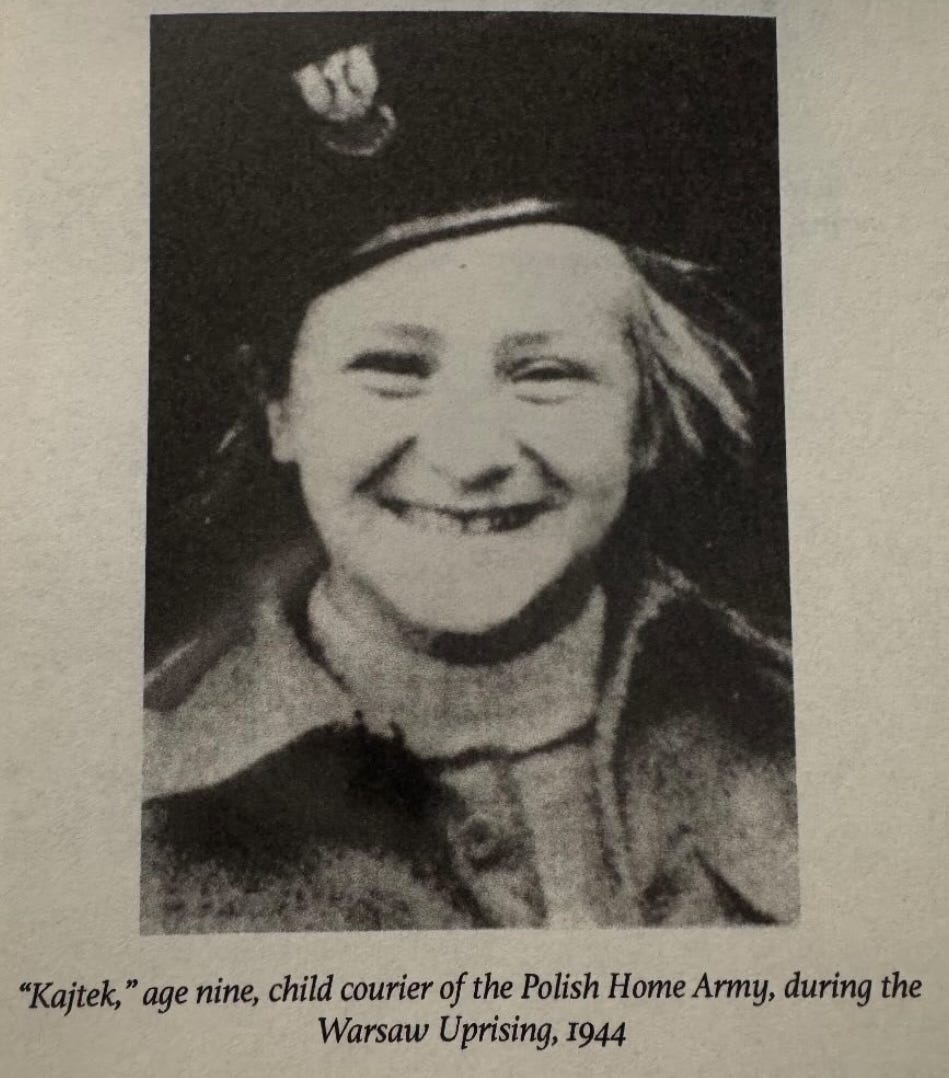
A citizen. A courier. A soldier. A boy wizard who fought evil. A Polish Catholic orphan who had been dead since 1919. A Jewish girl named Edna.
The paper is in front of me. The names, the ones they were allowed to write, are on it.
Janet Bond Brill, PhD, is the author of Little Edna’s War, based on her mother-in-law’s Holocaust testimony, published on January 27, 2026, on International Holocaust Remembrance Day. Order Now.