The Street and the Home, Part IV
Vienna, the Ostjude, and the Jewish Shadow
7: Hitler Destroyed Persona
And yet the archetypal reading, however illuminating, cannot be allowed to float free of history, because history supplies this essay’s most unbearable irony — perhaps its emotional center — and it would be a form of evasion to let psychological language soften it.
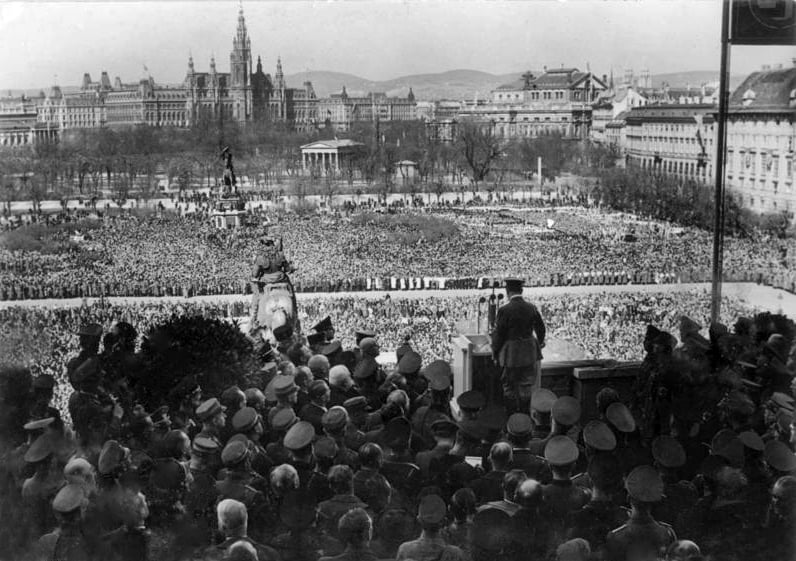
For all that mattered so intensely, internally, to Jewish Vienna — Reform against Orthodox, German against Yiddish, salon against shtibl, Zionist against Liberal, Hasidic against Assimilationist — none of it mattered to Adolf Hitler. The Nuremberg Laws did not ask whether a man prayed in the Stadttempel or a shtibl in Galicia, whether he wore a shtreimel or attended the opera in white tie, whether his family had been Viennese for four generations or had arrived, Yiddish-speaking, from Lemberg the year before. The racial bureaucracy of the Third Reich ran on a single, crude, exhaustive metric — one grandparent, two grandparents, three, four — that erased every gradation the community itself had spent a century constructing, defending, and, at times, weaponizing against itself.
I must complicate my own rhetoric here, because it would be more comfortable to say that the falsity of the assimilationist bargain was revealed only by catastrophe, in retrospect, when nothing could any longer be done about it. That is not quite true, and Bettauer is the proof. The classification system his 1922 novel imagines — a law under which Jews and Jewish descendants who remained in Austria were to be sentenced to death, applying not only to Jews and to baptized Jews but to the children of mixed marriages — anticipates the architecture of the Nuremberg Laws by thirteen years. (9) He was not a prophet. He was an observer with clear eyes, which is a less flattering and considerably more disturbing description, because it means the thing was already visible. Nor was it visible only to him. The novel went through more than fifty printings and sold on the order of a quarter of a million copies in its first year. (9) Vienna read it. Viennese Jews read it. The futility of the mask was a bestseller in the city while the mask was still being worn — and it was worn anyway, not out of stupidity, but because there was no other available strategy, and because a strategy one cannot replace is a strategy one goes on believing in. That, and not mere hindsight, is the tragedy I am trying to describe.
I want to state this in Jungian terms as well, because I think it sharpens the historical point rather than merely restating it. Jung insisted the persona is necessary — that every civilized self requires a mask through which to meet the social world. Hitler made persona irrelevant. Whether professor, rabbi, soldier, tailor, Hasid, atheist, or concert pianist, none of it could save you, because the mask could no longer function as a mask at all. History stripped everyone down to ancestry, indifferent to every carefully constructed self underneath. That is, in the fullest sense, a Jungian catastrophe: not merely mass murder, though it was that above all, but the violent, total negation of the very mechanism — cultivated identity, chosen self-presentation, the persona built over generations — by which Vienna’s Jews had believed they were purchasing safety. I have elsewhere refused, at length, the consolations of theodicy in the face of this event, and I refuse them here too. (25)
The irony is almost unbearable to sit with directly. The assimilated Viennese lawyer who might, in 1925, have crossed the street to avoid an Ostjude boarded, in 1942, the same transport as that Ostjude’s grandson. The rebbe from Galicia and the physician from the Josefstadt entered the same cattle car. Death, in the most literal and horrifying sense, democratized Jewish identity — collapsed every distinction the community had used to organize its own internal hierarchy of belonging and shame.
I want to put one name to that abstraction, because abstraction is how this material becomes bearable and therefore how it becomes false. Ida Jenbach, born Ida Jakobovits in 1868, trained as an actress at the Vienna Conservatory, wrote the screenplay that turned Bettauer’s novel into a silent film in 1924.(9) Her adaptation is itself an exercise in the art I have been calling camouflage: she moved the action out of Vienna to a fictional city called Utopia, blurred the party labels, and invented an ending in which the antisemitic councilman simply wakes up cured of his hatred — softening the satire into something a Viennese audience could laugh at and then go home from. She was an organizer as well as a writer. In the inflation winter of 1922, she cofounded the Filmbund, the union of the Austrian film industry, and she was the only woman admitted to the Austrian Directors Club. In 1941 she was deported from her Viennese home eastward toward Minsk and murdered there or nearby. The colleague with whom she had founded that union later supplied producers with the names of Jewish performers and crew. Her collaborator on the film joined the Nazi Party in 1940. No photograph of her is known to survive, and no record of her death.
Everything I have been arguing about the persona is contained in that paragraph. She softened the story so that Vienna could bear to hear it. She built an institution to protect the people she worked alongside, and those people identified her. The softening did not save her, the institution did not save her, and the erasure was thorough enough that we cannot even look at her face. Whatever the mask was for, it was not for this. There is a further, terrible symmetry in the fact that the ground itself was made to participate: the twentieth century inverted the ancient obligation to cover spilled blood into an industrial project of covering the evidence of having spilled it. (26)
I do not raise this to score a point against my own discomfort, as though the fact of the Shoah simply invalidates, by moral force majeure, every internal Jewish distinction that came before or has persisted since. Internal difference within a people is real, and pretending otherwise flattens Jewish history into something falsely uniform. But the historical record does force a certain humility onto any contemporary echo of the old hierarchy — including the flicker I felt on a Viennese street, inherited from a world whose entire operating assumption, that visible Jewish difference was dangerous and invisible Jewish assimilation was safety, was proven, in the most horrific way imaginable, to be false. Invisibility did not save my father’s Vienna. It could not have.
8: My Father’s Vienna
This is where the essay must become, without reservation, personal, because the encounter that occasioned everything above happened to me, on a specific street, on a specific day, following a specific grief.
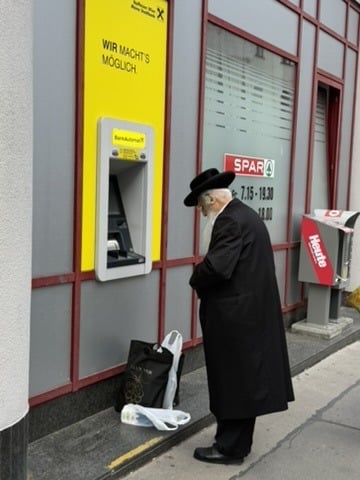
I had gone to Vienna in part to visit my great-grandfather’s grave, to stand where my father had once walked as a young man before the world that shaped him was destroyed. I visited Stumpergasse, where his synagogue had stood, and the apartment buildings where educated Jews once believed, with real conviction, that they had become Austrians in every way that mattered publicly. I expected the visit to be elegiac — grief, nostalgia, perhaps the settling that comes with closing a circle. What I did not expect was the jolt of seeing Hasidim walking those same streets, unhurried, unconcealed, entirely at ease in a city that within living memory had tried to murder every Jew within its borders regardless of dress, dialect, or degree of assimilation.
The cemetery itself had prepared me for none of this. I remember the quality of the light that afternoon — the flat, grey Central European light that makes everything look slightly underexposed, as though the city itself were reluctant to be seen too clearly. I remember the sound underfoot, gravel and broken stone, and the specific difficulty of finding a single legible name among rows of markers that had been vandalized, neglected, or simply erased by a century of weather and indifference. When I finally found the stone — my great-grandfather’s name still legible after more than a hundred years — I had expected to feel grief, and I did. What I had not expected was how quickly grief gave way to something more disorienting: the sense that I was not simply mourning a man I had never met but standing at the exact hinge point of a story whose later chapters he could not have imagined. He died in 1918, the year the empire itself died. He did not live to see what would happen to the world he had, in his own quiet way, believed to be stable.
It was perhaps two hours later, walking without any particular destination through the streets near the old Jewish quarter, that I saw the family — a father in a long black kapote, a broad-brimmed hat, walking with two young sons dressed in miniature versions of the same clothing, entirely unremarkable to everyone else on the street, entirely absorbed in whatever ordinary errand had brought them out that afternoon. I want to be precise about what happened in my body in that moment, because precision is the only thing that makes this essay worth writing rather than merely confessing. My first sensation was not judgment. It was a kind of vertigo — the specific disorientation of seeing something that should, by every logic I had inherited, be dangerous, being treated by everyone around it, including the family itself, as perfectly unremarkable. The vertigo lasted only a few seconds. What followed it, and what I am less proud of, was the flicker of embarrassment I have already described — gone almost as quickly as it arrived, but not so quickly that I could pretend, afterward, that it had not happened at all.
My first response was not chosen. It arrived before I had any say in the matter — a tightening, a flicker closer to embarrassment than to anger, and beneath that, something harder to name. Rather than suppress that response or perform an easy self-congratulation for noticing and disapproving of it, I have tried, in writing this essay, to interrogate it honestly. I asked myself, standing there: whose eyes am I seeing through?
My father’s, who spent a lifetime being a gentleman on the street and a Jew only at home? Vienna’s, whose whole cultural machinery once rewarded exactly that division? The Habsburg Empire’s, with its own hierarchies of the assimilable and the unassimilable? Europe’s, more broadly, whose long history of conditional tolerance always came with an asterisk attached to visibility? Or, finally and most uncomfortably, my own — entirely my own, formed by inheritance but no longer merely a repetition of it?
I do not think the honest answer is any single one of these. I think it is a chord, all of them sounding at once, and much of the work of this essay has been learning to hear the chord closely enough to distinguish its individual notes rather than simply reacting to the noise.
There is one note in that chord I did not hear at the time, and I have only recently been able to name it, because it does not belong to my inheritance at all. It belongs to the city.
The Vienna I was standing in was not the Vienna of 1925, and it was not the Vienna of 1938. It was the Vienna of the long postwar, which developed its own distinctive relation to the Jews it no longer had. After 1945 the city set about recovering “Viennese culture” — the theatre, the music, the journalism, the coffee-house nerve — all of it inseparable from a Jewish presence the city had helped to destroy and did not intend to examine. When the piano humorist Hermann Leopoldi returned to a Viennese stage in 1947, a critic greeted him as a piece of the old days coming back. (9) A piece. The vanished were readmitted not as people with histories of persecution but as heritage: props restored to a self-image, atmosphere recovered, the right song and the right joke and Vienna would be itself again. Balint’s phrase for this — absence as atmosphere — is exact. (9) Jews could be displayed, admired, even mourned, provided they stayed safely in the past. This is precisely the consolation I have argued elsewhere must be refused: the aesthetic recuperation of a catastrophe by the culture that produced it, offered as though it were mourning. (27)
I raise this because it changes what I think happened to me on that street. The Hasidic family walking an ordinary errand through an ordinary afternoon violated that arrangement entirely. They were not heritage. They were not atmosphere. They were living, unremarkable, and wholly present tense, and there was no compartment in postwar Vienna’s imagination of itself into which they could be filed. I had absorbed something of that imagination simply by arriving as a pilgrim. I had come to a cemetery, to a vanished synagogue, to apartment buildings emptied of the people who had believed in them. I had come, that is, looking for dead Jews. I found them. Two hours later I encountered living ones and could not immediately place them.
There is a further irony here that I want to name directly, because it reorganizes the entire emotional structure of the pilgrimage. My father escaped Vienna. The Hasidim of Galicia and the Pale, broadly speaking, did not escape; an overwhelming majority of that world was destroyed. Yet today, the Hasid walks freely through Vienna’s streets, and my father — dead now these many years — cannot. History has, in a sense that still unsettles me to write, reversed itself. The image I inherited — assimilated Jew as survivor, visibly Orthodox Jew as endangered relic — no longer matches the reality standing in front of me. The psyche, in other words, is lagging history. I was reacting to a Vienna that no longer exists, projected onto a Vienna that does.
Part IV of a five-part series. Notes and references appear at the end of Part V.