
The Hondius Hantavirus: A Chain of Errors in the Spread
The accountability question after the ship arrives
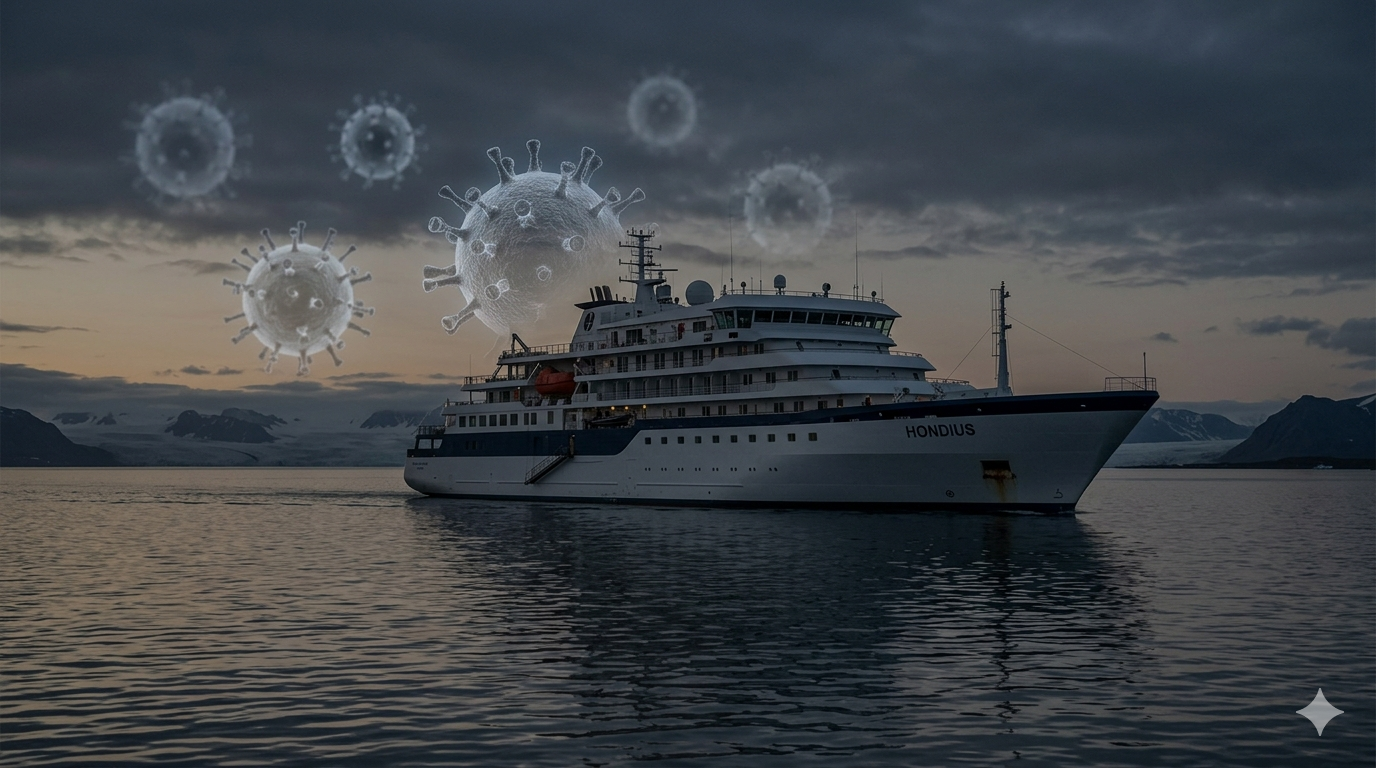
The MV Hondius is expected at the Port of Granadilla in Tenerife in the early hours of Sunday, May 10. The World Health Organization (WHO) reports six confirmed cases of Andes virus and two probable cases linked to the outbreak. Three deaths, two formally confirmed as caused by the virus. Fourteen Spanish passengers will disembark first. Seventeen American passengers will be evacuated by a U.S. Centers for Disease Control and Prevention (CDC) repatriation flight to Offutt Air Force Base in Omaha, then transported to the National Quarantine Center at the University of Nebraska Medical Center. A KLM (Royal Dutch Airlines) flight attendant who had brief contact with a deceased passenger tested negative on May 8. A probable case identified in Tristan da Cunha, where a passenger disembarked on April 14, awaits laboratory confirmation; he developed symptoms on April 28 and remains in isolation in stable condition. Twelve countries are tracing contacts. The case fatality rate of the Andes strain ranges between thirty and forty percent.
These facts frame the present article without being its subject. The subject is what should have happened on April 11, 2026, and what specific obligations of international maritime health law were applicable from that date forward.
The death that should have triggered everything
On April 11, a seventy-year-old Dutch passenger died in his cabin aboard the MV Hondius, ten days after departure from Ushuaia. He had developed symptoms on April 6: fever, headache, abdominal pain, and diarrhea, followed by progressive respiratory deterioration. The cause of death could not be determined on board.
No samples were taken.
The phrase belongs to Tedros Adhanom Ghebreyesus, Director-General of the WHO, who said it on the record at a press conference. “No samples were taken, and because his symptoms were similar to those of other respiratory diseases, hantavirus was not suspected.”
Twenty-one days passed between the death and the WHO being informed. The outbreak was first reported to the WHO on May 2. The organization formally confirmed the cluster on May 4, and the Andes strain was identified on May 6.
In those twenty-one days, the body remained on board for thirteen days before disembarkation at Saint Helena. The widow accompanied her husband’s body off the ship and boarded a commercial flight to Johannesburg the next day. Thirty passengers disembarked at Saint Helena and dispersed to twelve countries without quarantine. Four islanders from Tristan da Cunha boarded the Hondius for passage to Saint Helena during the April 13 to 14 stop. The ship’s doctor became infected and was confined to quarters by late April. A British passenger required intensive care in Johannesburg. A German woman died on board on May 2.
The legal framework that should have prevented this cascade is published, codified, and was specifically applicable to the vessel.
What the law actually requires
The International Health Regulations (IHR) of 2005, amended in 2014, 2022, and 2024 and currently in force since September 19, 2025, are legally binding on 196 countries.
Article 37 obliges the master of any ship arriving at the first port of call in the territory of a State Party to ascertain the state of health on board and to deliver a Maritime Declaration of Health (MDH) to the competent authority. The MDH form, codified in Annex 8 of the IHR, contains specific mandatory questions:
Has there been any death on board during the voyage other than by accident? Is there on board, or has there been during the international voyage, any case of disease which the master suspects to be of an infectious nature? Has the number of ill passengers during the voyage been greater than normal or expected? Are there any other conditions on board which may lead to infection or spread of disease?
Annex 8 also provides explicit clinical guidance for masters operating without dedicated medical assessment on board. They are instructed to regard fever persisting for several days, accompanied by prostration, decreased consciousness, glandular swelling, jaundice, or cough or shortness of breath, as grounds for suspecting infectious disease.
The Dutch passenger of the MV Hondius presented exactly that constellation. Fever from April 6. Progressive respiratory deterioration. Death on April 11. Under the literal text of Annex 8, this met the criteria for presumed infectious disease, regardless of whether definitive diagnosis was achievable on board.
Article 6 of the IHR requires each State Party to notify the WHO within twenty-four hours of any event that may constitute a Public Health Emergency of International Concern (PHEIC). The Annex 2 decision instrument requires notification when any two of four criteria are met: serious public health impact, unusual or unexpected occurrence, significant risk of international spread, or significant risk of international travel restrictions.
A respiratory death of unknown cause aboard a cruise ship carrying approximately 150 people of 23 nationalities, traversing multiple international ports, met three of those four criteria from April 11 forward.
Article 22 places responsibility on competent authorities at points of entry to supervise the embarkation, disembarkation, and movement of travelers, conveyances, goods, and human remains, including any decontamination or sanitary measures applied.
Article 28 establishes the obligations of conveyance operators regarding cooperation with public health authorities and implementation of recommended health measures.
These provisions applied to the Hondius from April 11 forward. The vessel is Dutch-flagged. Its first stop after the death was Tristan da Cunha on April 13 to 14, a British Overseas Territory. Its second was Saint Helena on April 24, also a British Overseas Territory under the supervision of the United Kingdom Health Security Agency (UKHSA). The widow’s onward travel involved Saint Helena, South Africa, and an aborted KLM transit. All four jurisdictions are States Parties to the IHR.
The missing link: Airlink Flight 4Z 132
International coverage has emphasized the KLM aircraft incident in Johannesburg on April 25. It has emphasized far less the flight that made that incident possible.
On April 25, the deceased passenger’s sixty-nine-year-old widow boarded Airlink Flight 4Z 132 from Saint Helena (HLE) to Johannesburg (JNB). The aircraft was an eight-year-old Embraer ERJ-190AR with registration ZS-YAD. It carried eighty-eight people: eighty-two passengers and six crew, the latter consisting of two pilots, two cabin crew, and two technicians. The flight departed at 14:21 UTC, made a refueling stop at Windhoek International Airport in Namibia, and arrived in Johannesburg at 21:15 South African Standard Time. Total elapsed time approximately six hours and fifty-four minutes. Direct flight time approximately four hours and forty-five minutes.
According to a public statement from Airlink, the carrier was unaware that any passenger on the flight was unwell at the time of operation.
The widow was not isolated. She was not in supervised medical evacuation. She was a paying commercial passenger on a regional jet. The crew did not wear personal protective equipment because they had no reason to suspect they needed any. The WHO has confirmed that her clinical condition deteriorated during the flight.
Eighty-eight people shared the cabin of an Embraer ERJ-190AR with a deteriorating Andes virus patient who would die the following day.
The decision to allow her boarding without notifying Airlink rests with the actors who knew her clinical history: Oceanwide Expeditions, which had observed her illness on board for at least two weeks, and Saint Helena port health authorities, who received her at disembarkation alongside her deceased husband’s body. Public statements from those parties on this specific question have not yet been issued.
The downstream consequences of that flight are now being traced. Eight French nationals who were close contacts on Flight 4Z 132 have been identified by French health authorities, with one displaying mild symptoms. A woman in the Spanish province of Alicante, also a passenger on the same flight, has developed symptoms consistent with hantavirus infection and is undergoing testing. South African authorities are coordinating contact tracing of the remaining passengers and crew. Airlink, on receiving notification on May 3 from South African health authorities, immediately shared the passenger manifest and seating allocations and independently contacted passengers.
The notification to Airlink occurred eight days after the flight and seven days after the widow’s death. During those days, eighty-six passengers and crew dispersed across continents without knowing they had spent nearly seven hours in a confined cabin with an actively infectious Andes virus patient.
The KLM incident, by contrast, played out differently. That same evening, the widow attempted to board KLM Flight KL592 from Johannesburg to Amsterdam, scheduled for 23:15. KLM cabin crew observed her clinical deterioration during boarding and refused her carriage before the aircraft departed. The flight left without her. She was taken to a Johannesburg hospital and died on April 26.
KLM’s decision was correct. Airlink’s exposure occurred precisely because no one informed the airline of what KLM observed for itself.
The unanswered questions
What is publicly documented. The death occurred on April 11. No samples were taken. The body remained on board until April 24. The ship continued its scheduled itinerary, including the Tristan da Cunha stop. On April 24, thirty passengers disembarked at Saint Helena and returned to their countries of origin. On April 25, Airlink Flight 4Z 132 transported the symptomatic widow to Johannesburg without isolation or notification. The widow attempted KLM boarding the same evening and was refused carriage. The WHO was first informed on May 2. Andes virus was confirmed on May 4.
What remains undisclosed in publicly available sources. Whether the master of the Hondius filed an MDH at Tristan da Cunha and Saint Helena. If filed, whether either form disclosed the death on board, the wife’s clinical condition, and the constellation of symptoms specified in Annex 8. Whether RIVM (Rijksinstituut voor Volksgezondheid en Milieu, the Dutch national institute for public health and the environment) was notified by Oceanwide Expeditions or by the master at the time of the death on April 11, when flag-state obligations under IHR Article 6 began. Whether Saint Helena port health authorities, under UKHSA supervision, reviewed the deceased, the widow, and the passenger manifest before authorizing the April 24 disembarkation. Whether any party informed Airlink, before or during the April 25 flight, of the widow’s clinical history and recent vessel of origin. Whether South African aviation health authorities cleared the widow for commercial flight on April 25.
These questions are not rhetorical. Each has a documentary answer that an independent investigation could establish in days. The answers have not been made public.
The cost of each delay
The counterfactuals are calculable.
If the master had filed an MDH at Tristan da Cunha on April 13 declaring the recent death, the wife’s illness, and a suspicion of infectious respiratory disease, port health protocols at the British Overseas Territory would have triggered notification to UKHSA, which is bound by IHR Article 6.
If samples had been taken from the deceased on April 11, the body could have been transported to a competent diagnostic facility at the next port. Polymerase chain reaction (PCR) testing for Andes virus requires forty-eight to seventy-two hours in adequately equipped centers.
If Saint Helena port health authorities had treated the body and the widow as suspected infectious disease cases on arrival, IHR Article 22 would have required supervised disembarkation and isolation of contacts. The dispersal of thirty passengers to twelve countries would have been prevented.
If any party had notified Airlink of the widow’s clinical history before April 25, Flight 4Z 132 would not have transported her as a regular commercial passenger. Eighty-six unsuspecting passengers and crew would not now require contact tracing across multiple continents.
Each counterfactual depends on the application of legal frameworks that already existed. None requires new regulations. None requires technology not currently available. Each depends only on the application of obligations established under treaty law since 2005.
What follows now
The window for prevention closed on April 11. The Hondius is no longer the question. The virus is.
Eighty-six passengers from Flight 4Z 132 are dispersing across continents. Thirty Saint Helena disembarkations are scattered across twelve countries. Four Tristan da Cunha residents returned to a community of fewer than three hundred. The widow’s seatmates are being identified one by one. The Tenerife evacuation begins at dawn.
The incubation period of Andes virus ranges from seven to thirty-nine days, with a median of approximately eighteen days. Public health guidance applies a forty-two-day monitoring window as a conservative threshold. The earliest exposure on Flight 4Z 132 was April 25. The earliest exposure from the Tenerife disembarkation will be May 10. The diagnostic horizon for the full epidemiological picture extends into early June for the Airlink contacts and into late June for the Tenerife evacuation.
Two tracks must now run in parallel.
The first is containment under existing law. Every IHR provision cited above remains in force. Article 6 still requires twenty-four-hour notification. Article 22 still places obligations on points of entry. Article 28 still binds conveyance operators. The same framework that should have stopped the cascade on April 11 is now the framework that must contain its consequences. The application of those obligations to every onward case, every secondary contact, every aircraft and ship and port handling a confirmed or suspected exposure, is no longer optional.
The second is documentation. The chain of decisions between April 6 and May 2 must be reconstructed in detail. If this outbreak ends as a contained cluster of a few dozen cases across several countries, the documentation matters because the next outbreak will follow the same template if the lessons remain unwritten. If this outbreak ends differently, the documentation matters more.
The worst case scenario does not require dramatization. If the Andes virus achieves sustained transmission in any dispersal node, if a secondary cluster emerges among the eighty-six Airlink passengers, the thirty Saint Helena disembarkations, or the Tristan da Cunha contacts, the question of who knew what on April 11 becomes a question of treaty law. The IHR is binding. Its breach by State Parties has consequences defined under the WHO Constitution and customary international law. Those consequences do not disappear because the breach was inconvenient, late to surface, or politically inconvenient to investigate.
For now, the magnitude is unknown. The next two weeks will narrow the range of outcomes. The protocols that were available on April 11 are still available today. The question is whether they will be applied to the cases ahead with more rigor than they were applied to the cases behind.
Closing
The Hondius arrives in Tenerife tomorrow morning. The virus has already left.
A Dutch couple died. A German woman died. A British passenger remains in intensive care. A ship’s doctor is infected. Twelve countries are tracing contacts. Eighty-six passengers from a single Airlink flight are being identified one by one. Eight French nationals are under monitoring. A Spanish woman in Alicante is symptomatic and being tested. Four islanders from Tristan da Cunha returned to a community of fewer than three hundred people. One probable case has emerged from that group.
The legal framework was published. The clinical criteria were specified. The notification timelines were codified. The protocols were available.
The question is which of them was applied, and which of them was not.