
Geopolitical Analyst: Bridging Somaliland & Israel to the world
The Hudson Backlash: What went wrong and what Somaliland must learn from it
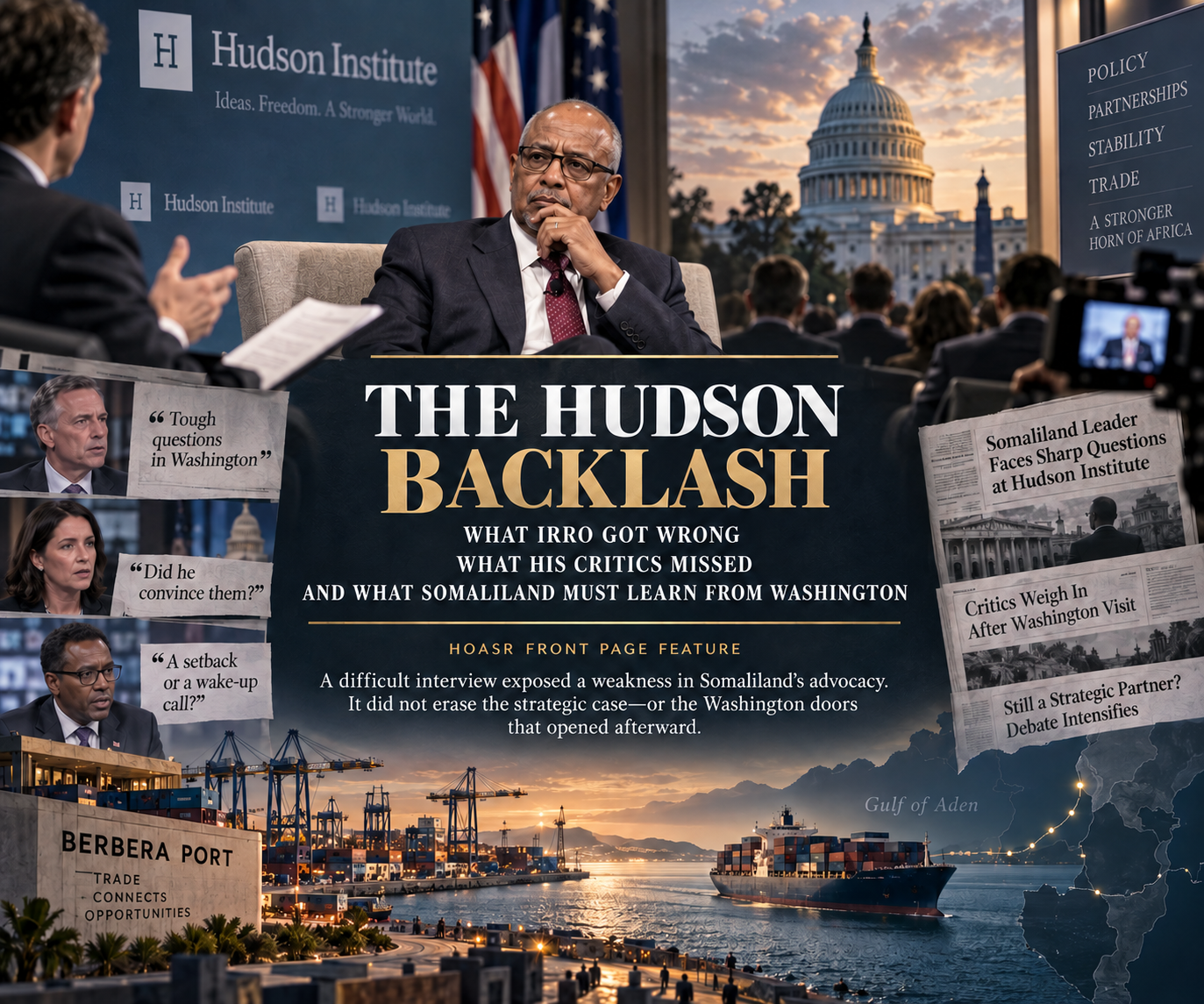
HOASR front-page illustration for “The Hudson Backlash: What Irro Got Wrong, What His Critics Missed, and What Somaliland Must Learn from Washington.” The artwork connects President Irro’s Hudson Institute appearance with congressional engagement, Berbera Port, maritime security and Somaliland’s wider campaign for United States recognition.
The controversy exposed a weakness in Somaliland’s unscripted advocacy. It did not erase the strategic case, and it should not obscure the Washington doors that opened afterward.
President Abdirahman Mohamed Abdullahi Irro’s appearance at Hudson Institute was supposed to consolidate Somaliland’s argument in Washington. Instead, several awkward answers in the fireside discussion became the story. A reply about critical minerals, a confusing comparison involving Sudan, and moments of laughter under pointed questioning were cut into short clips and circulated as evidence that the president had arrived unprepared for the most demanding stage of his recognition campaign.
Some of that criticism is justified. A president asking the United States to make a consequential diplomatic decision must be able to explain, in precise and practical terms, what his country offers and why recognition serves American interests. Irro’s prepared address contained much of that argument. His spontaneous answers did not always carry it with the same clarity. Washington rewards leaders who can move quickly from history and principle to capabilities, commitments and measurable value.
Yet the backlash has also become distorted. Critics have treated a difficult interview as if it cancelled the prepared speech, Somaliland’s record, the strategic geography of Berbera and every meeting that followed. It did not. In the days after Hudson, Irro met lawmakers positioned across foreign policy, China policy, security and financial affairs. His case also reached additional Washington policy institutions and a major international publication. The visit therefore cannot be judged from its worst sixty seconds.
The fair conclusion is more demanding than either celebration or ridicule. Hudson exposed a communications failure inside an otherwise serious diplomatic campaign. Somaliland should acknowledge the weakness, study it and correct it. Its critics, however, should also account for the policy substance and the access that survived the controversy.
The moment the message slipped
The most damaging exchange concerned critical minerals. Asked what Somaliland could offer, Irro said he was not a geologist and suggested the country might have almost everything. The remark was conversational, but it was strategically costly. The question invited a disciplined answer about verified deposits, exploration licenses, the limits of available geological data and the investment required to establish commercially recoverable reserves. Instead, the answer sounded speculative.
That weakness was avoidable. Earlier reporting had already quoted Irro describing Somaliland’s potential in lithium and other sectors, while also noting that exploration, investment and formal agreements were still developing. A careful answer could have separated known prospects from proven reserves. Washington officials understand uncertainty; they distrust exaggeration. Somaliland gains credibility when it states what has been confirmed, what remains under survey and what partnership could establish.
The Sudan exchange created a second problem. Irro appeared to describe Sudan as geographically distant before moderator Joshua Meservey challenged the premise. The issue was less the geography than the impression that the president had not fully prepared for a predictable question about regional conflict. Somaliland sits inside a connected Red Sea security system. War in Sudan affects migration, arms flows, maritime security, Gulf competition and diplomatic alignments across the Horn. A stronger response would have acknowledged those links before explaining Somaliland’s immediate priorities.
The third weakness was tone. Laughter can be natural in a long public conversation, especially when a speaker is working in a second language. But repeated laughter during difficult questions can be clipped and reframed as evasion. Political communication is often judged visually before it is judged intellectually. The delegation should have anticipated that every pause, joke and uncertain phrase would be extracted for hostile distribution.
These were not fatal errors. They were evidence of inadequate rehearsal for adversarial questioning. A keynote speech can be drafted, translated and refined. A fireside discussion tests whether the same argument has been reduced to a set of clear propositions that the speaker can retrieve under pressure. At Hudson, the distance between the prepared message and the unscripted performance became visible.
Why Meservey’s criticism deserves attention
The most useful criticism came from Joshua Meservey, not from partisan Somali outlets. After moderating the event, he argued in an i24NEWS discussion that Somaliland has not consistently explained why recognition advances American interests. Hudson later highlighted that interview on its own site. Meservey has long written in favor of closer American engagement with Somaliland, including a detailed case for recognition. His criticism should therefore be read as advice from within the pro-engagement policy community rather than evidence that he has abandoned Somaliland. Hudson’s interview page
His point goes to the heart of the problem. Somaliland often leads with its moral and historical case: the brief 1960 independence, the unratified union, the atrocities of the Barre era, the 1991 restoration of sovereignty and more than three decades of self-government. Those facts remain essential. But American officials do not make policy only by correcting historical wrongs. They ask what recognition would permit the United States to do, what risks it would create, what resources it would require and how the arrangement would advance American security and prosperity.
The answer should be concrete. Berbera can expand Western access near the Bab el-Mandeb and reduce excessive dependence on Djibouti. Somaliland can support maritime surveillance, logistics, counterterrorism and emergency response. Its relationship with Taiwan carries value in competition with China. Its ties with Israel can support a wider Red Sea security network. Its democratic transfers of power offer a more dependable political foundation than many alternatives. Each proposition still needs details, limits and implementation plans. A list of assets is not yet a strategy.
Where the harshest critics went too far
Cameron Hudson and several media accounts focused on Irro’s age, laughter and body language, with one widely circulated formulation comparing him to an “African Biden.” The substantive criticism about preparation is legitimate. The personalized comparison is not a serious measure of policy capacity. It encourages audiences to substitute mockery for analysis and tells us little about the decisions Washington should make.
The harshest commentary also flattened an eighty-seven-minute event into a handful of weak exchanges. Irro’s prepared remarks presented Somaliland as a partner on the Gulf of Aden, described Berbera’s strategic value and linked recognition to maritime security, counterterrorism, investment and competition with hostile powers. Hudson Institute itself framed the event around Somaliland’s possible role as a strategic American partner. Those arguments remained part of the record even when the president failed to restate them effectively in every answer.
The backlash further ignored the distinction between performance and proposition. A poor answer can weaken confidence in a messenger without disproving the underlying case. Berbera did not move farther from the Bab el-Mandeb because Irro mishandled a minerals question. China’s military position in Djibouti did not disappear. Houthi threats to shipping did not recede. Taiwan’s relationship with Hargeisa did not become less relevant. The strategic proposition must be tested against facts, costs and alternatives, not the entertainment value of a viral clip. Full Hudson event
The Washington record after Hudson
The strongest answer to claims that Hudson destroyed the visit is the sequence that followed. Irro met Representative John Rose and Representative John Moolenaar. Rose then raised Somaliland’s financial isolation with Treasury Secretary Scott Bessent during a House Financial Services Committee hearing and sought follow-up on the Somaliland Economic Access and Opportunity Act. Moolenaar chairs the House Select Committee on the Chinese Communist Party, making Somaliland’s partnership with Taiwan and resistance to Chinese pressure directly relevant to his work.
Irro also held meetings with House Foreign Affairs Committee Chairman Brian Mast and Senator Mike Rounds. Mast occupies one of the most influential congressional positions over the State Department and American foreign policy. Rounds has an established record of supporting deeper U.S. engagement with Somaliland through the Somaliland Partnership Act. These were not symbolic encounters with officials who had no connection to the issue. They linked Irro’s visit to existing legislative and oversight channels.
The president later engaged specialists associated with the Atlantic Council and the Foundation for Defense of Democracies. Those discussions reportedly returned to Red Sea security, maritime routes, regional stability and Berbera. The institutional spread is notable: Hudson offered a public platform; Congress supplied legislative and oversight contacts; Treasury was drawn into the financial-access question; other policy organizations extended the security debate.
Irro’s subsequent Semafor interview also stated the transactional argument more clearly. Somaliland was prepared to discuss port access, minerals and potential military facilities as part of a reciprocal relationship with Washington. The proposal requires careful negotiation and public accountability, but it answered the question that Meservey said Somaliland must answer: what does the United States gain? Semafor’s report
None of this proves that recognition is imminent. No reliable public confirmation has established a White House meeting, a presidential commitment or a change in formal U.S. policy. Congressional access is valuable, but it is not executive recognition. The responsible assessment is that Hudson caused reputational damage while the wider visit continued to produce meaningful contacts and policy movement.
What Somaliland must learn
First, the presidency needs a permanent strategic communications unit designed for international policy audiences. Before every major visit, it should build a concise briefing book covering the recognition case, regional conflicts, human rights, disputed territories, security capabilities, economic data, minerals, port access, Taiwan, Israel and relations with Somalia. Each claim should be sourced. Each vulnerability should have a direct answer.
Second, officials must distinguish potential from capacity. Somaliland can say it has promising mineral geology without claiming proven commercial abundance. It can offer Berbera as a platform while specifying what infrastructure already exists and what upgrades are needed. It can describe Coast Guard cooperation without overstating current reach. Precision strengthens the case because it allows American officials to see where partnership would produce measurable gains.
Third, the recognition argument must be translated into an American policy package. That package should identify possible basing and access arrangements, legal protections, investment rules, intelligence cooperation, maritime-security commitments, Taiwan-related technology partnerships and safeguards against third-party military influence. Washington should be able to see a sequence of decisions rather than a general appeal for friendship.
Fourth, the president and senior ministers need hostile-question rehearsal. The purpose is not to manufacture robotic answers. It is to ensure that every response begins with a clear proposition, supplies one or two supporting facts and ends with the policy relevance. Questions about Las Anod, Somalia, civilian casualties, elections, minerals, foreign bases and Israel should never surprise a delegation seeking recognition in Washington.
Fifth, Somaliland should resist the temptation to answer criticism with insults or denial. The most credible response is improvement. Meservey’s warning should be studied. Cameron Hudson’s substantive point about preparation should be separated from his age-based ridicule. Somali media narratives should be corrected with full video, transcripts and evidence. A state seeking recognition must demonstrate the institutional confidence to learn in public without allowing opponents to define the entire event.
A setback that can sharpen the campaign
Hudson was neither the triumph advertised by loyalists nor the collapse described by opponents. Irro delivered a serious prepared case and then lost control of parts of the unscripted conversation. The resulting clips exposed a weakness in preparation that Somaliland can no longer dismiss. Recognition diplomacy has entered a stage in which access alone is insufficient. Every appearance must convert Somaliland’s history, geography and partnerships into a disciplined account of American interest.
The critics also owe their audiences a complete accounting. Irro’s weak answers did not prevent meetings with Rose, Moolenaar, Mast and Rounds. They did not stop the financial-access issue from reaching the Treasury secretary. They did not prevent further policy discussions or a clearer transactional pitch in Semafor. The Washington campaign continued because the strategic case is larger than one interview.
Somaliland should treat the backlash as an expensive rehearsal for the next, more consequential encounter. If a White House, State Department or Pentagon meeting comes, the questions will be harder and the margin for imprecision will be smaller. The lesson from Hudson is straightforward: the country has assets Washington may value, but those assets must be presented with command, evidence and restraint. The next stage of the campaign will depend on whether Hargeisa can turn that lesson into institutional practice.
Related Topics
Related Posts