
The Ideological Currents in the United States and Their Impact on Israel
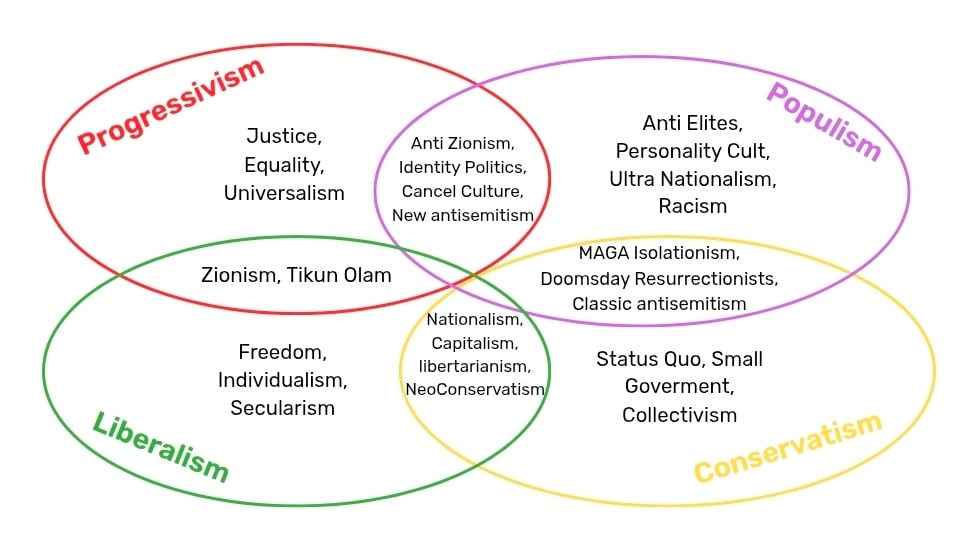
In the past decade, political discourse in the United States has become polarized, loud, and, at times, violent. Concepts that were once clear have become fluid and shifting according to the spirit of the times and political developments. Unprecedented polarization among the parties, loss of direction within them, demographic changes, the rise of social media, and above all the emergence of populism as a global phenomenon in response to globalization – of which Trumpism is the American manifestation – have reshaped the ideological landscape of the United States from the ground up.
American society has become an arena of collision where questions of identity, morality, democracy, and the future of Western society are all intertwined. The United States is the world’s largest democratic laboratory; what happens in Washington, New York, Texas, California, or Kentucky eventually reaches the West and Israel. Understanding these ideological currents is therefore not a theoretical or academic exercise but a key to understanding today’s political upheavals and how they affect us – both our own political processes and, especially, our understanding of Israel’s relationship with its traditional most strategic partner, which is changing before our eyes
Against this backdrop, the tension and intersections between the four major currents –liberalism, conservatism, progressivism, and populism – are essential for understanding the American political map. As they continue to shift, understanding their influence on the US, the world, and us in Israel is crucial for engaging with the political system and the public in the US.
The purpose of the following essay and its accompanying diagram is to bring order to conceptual chaos as a basis for discussing an effective action plan.
American Liberalism: Freedom in a Law-Governed State
American liberalism, in its traditional sense, has long been the backbone of the Democratic Party and of many politically independent Americans. It focuses on individual liberty, the rule of law, civil rights, secularism, and cultural pluralism. Liberal worldviews aim to protect a space in which individuals may live freely without coercion, under rules derived from the principles that shaped the modern nation-state – products of the French and American revolutions. In foreign policy, American liberalism sees a role for the US in leading and defending liberal democracies and human rights worldwide. On the two sides of American liberalism, currents are pulling in opposite directions.
On the right, there are two groups that originated as champions of liberalism but became Republican conservatives:
- Libertarians believe in a kind of “social Darwinism” where economic strength prevails and the state has no social or economic role; therefore, they have aligned themselves with the Republican Party, which has historically favored minimal government.
- Neoconservatives, who believe in promoting democratic freedoms through military force, became Republicans because they preferred a political home skeptical of diplomacy and international institutions.
On the left: Progressivism, which overlaps with liberals in their support of pluralistic freedom but places greater weight on socialist equality.
Despite these challenges to liberal understandings of freedom, the central threat to liberalism comes from the new right-wing populism, which has become dominant in the Republican Party. As a result, liberals now discover themselves fighting for the soul of American democracy.
American Conservatism: From Traditionalism to Nationalism
American conservatism traditionally found its home in the Republican Party. It valued stability, limited government power, communal and national collectivism, religion without coercion, moderate patriotism, and skepticism toward revolutionary change.
These were the core values guiding the party of Ronald Reagan and George H. W. Bush. Even George W. Bush operated within this framework before becoming deeply influenced by Christian Evangelicals –who sought to shape American society and its Supreme Court based on narrow New Testament biblical teaching– and by neoconservatives, who influenced him to use military force to spread democracy.
In the past decade, a radical transformation occurred within the Republican Party. Classical conservatives and even neoconservatives like Liz Cheney, as well as libertarians like Rand Paul, now struggle to find their place – like Revisionist Zionists in Israel who no longer vote Likud. Under the influence of Trump’s cult of personality, American conservatism shifted from historical traditionalism toward populist nationalism. Some conservatives unwilling to abandon their values are known as Never Trumpers, and some formed the Lincoln Project, a group with the aim of reaffirming traditionally conservative principles without buying into the Trump mania.
American Progressivism: Between Universal Justice and Identity Politics
American progressivism has long rested on values of equality, social justice, civil rights as a global principle, and political activism – ranging from Frederick Douglass, one of the earliest anti-slavery activists, through Rosa Parks and Martin Luther King Jr., to modern movements for women’s rights and LGBTQ+ rights. The struggle was American but universal in spirit, seeking to broaden freedom for all people.
Recently, however, the fringes of progressive thought have undergone a major shift. In the realm of the populist left – fundamental view of systemic discrimination evolved into an identity-based discourse, where inclusion was replaced by moral purity.
Instead of the sort of nuanced conversation that had historically been key to progressive ideology, “cancel culture” is now deployed against those seen as deviating from activist norms or as inherently privileged. This approach has sometimes led to anti-Zionism or anti-Israel sentiment and, in some cases (though rarely, despite common belief in Israel), to antisemitism.
Despite this, most progressives are not part of the “woke” fringe. For example, the Progressive Caucus in Congress has roughly 100 members, the overwhelming majority of whom support Israel’s right to be a democratic and secure nation-state for the Jewish people. Even within the “Squad,” some members are non-Zionists, and while they are often strongly critical of US backing of right-wing Israeli governments, they are not anti-Zionists.
American Populism: Rage Against Elites and State Institutions
American populism exists on both the right and the left, sharing major features: primal emotions and simplistic slogans over rationality and scientific evidence.
On the right, populism demands a strong leader battling the so-called “Deep State,” sees immigration and DEI as a threat, and fosters mistrust in institutions, traditional media, academia, and science.
A large majority of the Republican base today consists of two main populist strands:
- Evangelical populism – a puritan Christian agenda opposing abortion rights and LGBTQ+ identities that supports hawkish pro-Israel policy framed through apocalyptic theology.
- MAGA isolationism (“America First”) – which contains elements of white supremacy, Christian nationalism, and conspiracy theories, often with antisemitic undertones. This segment rejects the democratic rules that governed America for decades and poses immense challenges, including concerns if the next elections will be free and fair, especially when it moves from the margins to the White House.
On the left, it manifests as moral purism, cancel culture, anti-capitalist, and anti-colonial rhetoric lacking historical nuance – sometimes including anti-Zionism and antisemitism. On many American college campuses and in other progressive circles – especially following the horrors of the Gaza war (which many Israelis did not fully see due to selective media coverage and collective denial) – Israel is portrayed as a symbol of oppressive Jewish supremacy or “white colonialism,” ignoring the Jewish people’s historical connection to their land and the Jewish experience, which was the opposite of privileged
For the most part, left-wing populism remains marginalized within the Democratic Party, while right-wing populism has become mainstream within the Republican Party under the Trump Administration.
Surprisingly (or not), these two populisms can feed each other, as described by the concept of the “Horseshoe Theory.” For example, President Trump and New York’s new mayor, Mamdani, come from opposite ideological poles – Trump is an authoritarian bigot and Mamdani is an immigrant, universalist/democratic socialist – but both rely on populist foundations to rally their bases: challenging institutions, provoking elites, and appealing to raw emotion.
The United States as the Major Arena of Friction
The core struggle today is no longer between liberals and conservatives but between liberal democracy – which accommodates conservative and progressive shades – and destructive populism. It is a struggle between complexity and simplification, between principled values and their cynical manipulation. Neither traditional liberalism, historical conservatism, moderate progressivism, nor reasonable patriotism threatens American democracy. The danger comes from the populist sphere, on both the left and the right, where a single simplistic idea wipes out complexity and dismantles institutional balance.
The American Jewish Community
For most American Jews, liberalism and progressivism have long been a natural home. These frameworks allowed them to hold both Jewish and Zionist identities while remaining committed to American constitutional values – without fearing accusations of dual loyalty. The idea that citizens may have multiple identities aligns with a liberal, open, tolerant society that does not require abandoning ties with one people or nation to fully belong to another as well.
Moreover, the fundamental liberal principle of separating religion and state protected American Jews from the Christian right, which seeks to transform the US into a state privileging white Protestants.
Many American Jews gravitated to liberal-progressive spaces that align with the Jewish idea of tikkun olam (“repairing the world”). Progressivism, which demands not only freedom but improvement and advancement toward a model society, resonates deeply for many American Jews.
As a minority group, American Jews – often immigrants or children of immigrants – have succeeded in achieving the American dream while standing in solidarity with other minorities and immigrants who have not been as fortunate. Many American Jews support DEI, even when nowadays they do not need the preferences afforded by DEI. This mindset is why intellectual Milton Himmelfarb said, “Jews earn like Episcopalians but vote like Puerto Ricans.” The iconic 1965 image of Rabbi Heschel marching alongside Martin Luther King Jr. symbolizes this ethos.
For American Jews, threats come from all forms of populism – from progressive populism, which breaks from universalism and leads to anti-Zionism and sometimes antisemitism, and from right-wing populism, which abandons civic nationalism in favor of tribal ultranationalism fueled by suspicion of difference and dangerous conspiracy theories and also spawns antisemitism.
American Jews span a wide spectrum of views. There are conservatives and neoconservatives, as well as anti-Zionists. But the vast majority – except for the Orthodox minority (most of whom vote Republican) – find their place between liberalism and progressivism and vote Democrat. This is a political space where equality and Zionism do not conflict, where universalism and particular communal identity coexist. This is a space where both progressive and centrist Zionists can coexist in liberal harmony.
The Jewish establishment – legacy organizations like federations and others – often represents a more conservative stance than the public they claim to represent, because they remain stuck in the paradigm of uncritical alignment with increasingly right-wing Israeli governments. Meanwhile, however, younger American Jews do not see their values reflected in the Israeli right. This growing chasm is unsustainable. As the older generation of Jewish donors disappears, federations risk losing standing and resources because their conservative positions have alienated a significant number of Jews from the younger generations.
The widening gap between Jewish organizations, which Israelis rely on to act as a gauge for the American Jewish community, and the broader American Jewish community hinders Israeli policymakers’ understanding of the American political reality. Israelis often mistakenly believe that these organizations represent most Jews.
Some surveys are misleading as well when they define “Jewish identity” according to Orthodox criteria, even though most American Jews are non-affiliated, Reform, Conservative, or Reconstructionist.
Key Takeaways
Israel has a vital long-term interest in deeply understanding the tectonic shifts within American politics and their implications both for American Jewry and Israel.
Official Israel must advance its core interests with both political parties, as was done before the Netanyahu government abandoned bipartisan engagement. It must avoid the temptation of aligning with right-wing populism, which may appear supportive to right-wing Israelis due to their hostility toward our enemies, but whose isolationism might ultimately abandon Israel – as it is abandoning Ukraine and Europe.
Equally important, Israeli policy must not force American Jews into a competition between their communal identity and support for Israel on the one hand and association with populist forces – many of which are tainted by antisemitism – on the other.
The Zionist left and Israeli political center, which claim to be liberal, must recognize that most American Jews – and many non-Jewish liberals and progressives – are our true partners in the Zionist struggle for democracy and peace as manifested in our Declaration of Independence, even if they are sharply critical of Israeli governments’ conduct in recent decades.
We must ally with them, not abandon them like our government and some opposition leaders do.