
Russian-American-Israeli Palestinian. Palestine is Israel.
The Illegitimate Middle East Project
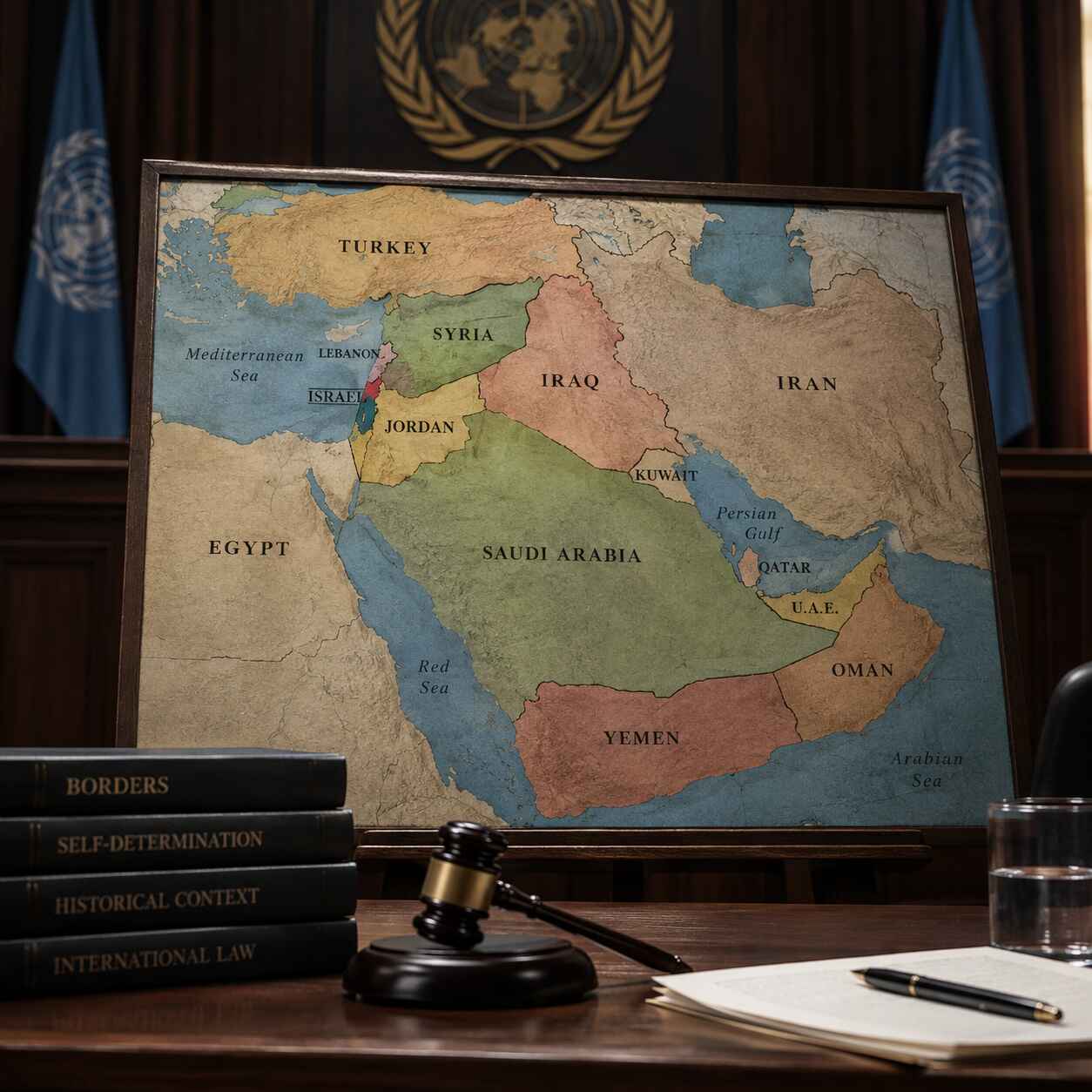
The Middle East on trial: if Israel’s legitimacy is open to debate, why should the rest of the region’s borders be beyond scrutiny? Image © Ivan Bassov, 2026. Licensed under CC BY 4.0.
If Israel Has No Right to Exist, Then No One Has
Israel has a problem. According to its enemies, it is an artificial colonial construct, an illegitimate state imposed on the region by foreign powers, an obstacle to the self-determination of UNRWA clientele, and a “Zionist entity” whose very right to exist remains perpetually open to debate.
Its historical connection to the land? Disputed. Its legitimacy? Questioned. Its borders? Denounced. Its national aspirations? Treated as an exceptional case requiring extraordinary justification.
Very well. Let us take these arguments seriously.
Not just for Israel. For the entire Middle East.
After all, if historical grievances can invalidate a state, if colonial involvement taints its legitimacy, if borders drawn by foreign powers are inherently suspect, and if ethnic and national identities take precedence over existing political arrangements, why should Israel be the only country subjected to this examination?
Welcome to The Illegitimate Middle East Project.
The Map Is Not Sacred
Let us begin with a simple observation: the political map of the modern Middle East is not an eternal arrangement handed down by nature. It emerged from the collapse of empires, European imperial interests, diplomatic agreements, wars, mandates, and subsequent struggles for power.
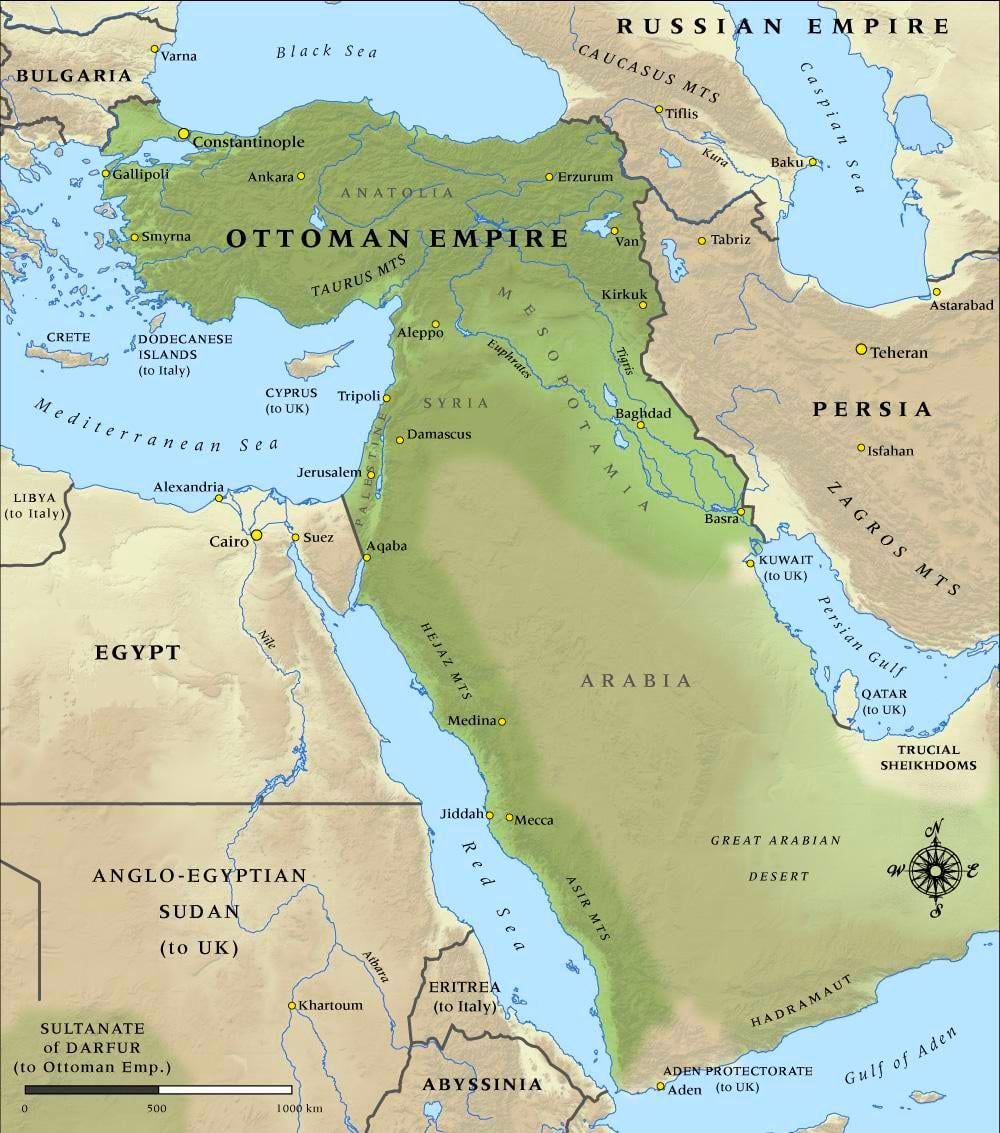
The Sykes–Picot Agreement of 1916 is one prominent symbol of this history. Britain and France negotiated spheres of influence in Ottoman territories during the First World War. The borders and political arrangements that eventually emerged were more complicated than Sykes–Picot alone, but the episode illustrates a basic fact: external powers played a consequential role in shaping the region’s modern political order.
Yet the resulting borders of Arab states are often treated as though they were inscribed in stone by the hand of history itself.
Why?
If colonial involvement is sufficient to disqualify a state’s legitimacy, many countries should have some explaining to do. If borders must reflect the distribution of ethnic groups, linguistic communities, religious populations, and national aspirations, the Middle East offers no shortage of unresolved cases.
And if a people’s right to self-determination cannot be denied merely because another state already controls the territory it claims, then the question becomes unavoidable: whose self-determination counts, and whose existing borders are treated as inviolable?
Ziophobes might find this line of inquiry uncomfortable. That is precisely why it is worth pursuing.
A Kurdish State? Naturally. And Why Stop There?
Consider the Kurds, a people with a distinct national identity spread across parts of Turkey, Iraq, Iran, and Syria.
Kurdish aspirations for self-determination have long collided with the territorial integrity of several existing states. Iraqi Kurdistan enjoys substantial autonomy, while the prospect of an independent Kurdish state remains contested.
The Kurdish question presents a genuine conflict between competing principles: national self-determination, state sovereignty, regional stability, and the rights of people living in territories where identities overlap.
Now imagine applying the rhetoric routinely deployed against Israel.
The borders are artificial. The national community has been divided. Foreign powers helped shape the regional order. A people has been denied its national aspirations. The existing arrangement is therefore unjust and must be reconsidered.
Sound familiar?
If these arguments establish an unquestionable right to question Israel, why do they suddenly become complicated when applied to the states surrounding it?
And the Kurds are hardly the only possible example. Amazigh communities have their own cultural and political aspirations across North Africa. Assyrians have longstanding historical ties to parts of the region and concerns about their survival as a distinct community. The Sahrawi people of Western Sahara have an unresolved claim to self-determination.
These cases demonstrate that the relationship between peoples, borders, and political legitimacy is far more complicated than the simplistic formulas routinely deployed against Israel suggest.
Perhaps the principle should be applied consistently.
Or perhaps consistency is not the point.
No Border Is Beyond Discussion
If the Arab state system is an artificial formation whose internal national and ethnic divisions undermine the legitimacy of its borders, then perhaps the regional map should be reconsidered.
If governments cannot establish a common national identity acceptable to all their populations, perhaps their political arrangements deserve scrutiny.
And if a state is a collection of communities held together by borders drawn for reasons unrelated to their national aspirations, perhaps those borders are not the final word.
If Israel’s enemies are entitled to question the legitimacy of the regional order, their own arguments furnish a framework for questioning that order as well.
One might even call it the Bassov Principle:
No border is beyond discussion. No state is exempt from historical scrutiny. And no national claim deserves automatic priority merely because it has already acquired international recognition.
It is a remarkably simple principle.
It also has the unfortunate property of applying to everyone.
The New Doctrine: Nobody Gets an Exemption
Let us take this principle seriously.
First, every state must justify its borders. No map is sacred simply because diplomats once drew it, armies once defended it, or international organizations subsequently recognized it.
Second, every people has a legitimate interest in its national identity and political future. Kurdish aspirations cannot be dismissed merely because existing states oppose them. Nor can the aspirations of other communities be ignored whenever they complicate the interests of established governments.
Third, historical injustice cannot be invoked selectively. If the circumstances surrounding a state’s creation are grounds for questioning its legitimacy, the same standard must be available for examining other states. If historical continuity matters, it must matter consistently as well.
Fourth, no one gets to convert a controversial essay into an official national doctrine merely because the resulting accusation is politically useful.
Under this doctrine, the entire Middle East becomes an open seminar in historical legitimacy. Every border can be examined, every national claim debated, and every government asked to explain why its preferred territorial arrangement should prevail over competing aspirations.
It would be an exhausting exercise.
It might also be instructive.
Most importantly, it would expose the absurdity of pretending that one country alone must continually prove its right to exist while the political arrangements of its neighbors are exempt from equivalent scrutiny.
A Modest Proposal for the Next International Conference
Imagine the United Nations convening a conference on the legitimacy of the Middle Eastern state system.
Israel’s delegation would arrive prepared to defend the Jewish people’s historical connection to their homeland, the legitimacy of Jewish national self-determination, and the right of the State of Israel to exist in security.
Then the chair would turn to the rest of the room.
Turkey, what is your answer to the Kurdish question?
Iran, how do you reconcile your territorial integrity with the national aspirations of the peoples within your borders?
Iraq, does the existence of an autonomous Kurdish region settle the question of Kurdish self-determination?
Syria, how should its diverse communities be accommodated within a single political state?
And what of the Amazigh, the Assyrians, and the Sahrawi?
The conference might also ask the international community why it sometimes treats existing borders as inviolable principles of international law and, at other times, treats them as obstacles to historical justice.
The answers would not be simple.
Nor should they be.
The point is not that every state should be dismantled or that every ethnic community should receive its own country. Such a prescription would be neither practical nor just. Mixed populations, minority rights, economic interdependence, security concerns, and the dangers of forced displacement all matter.
The point is that the legitimacy of a state cannot be determined by historical and political criteria devised specifically to delegitimize one particular state.
If national self-determination matters, it matters beyond Israel.
If colonial history matters, it matters beyond Israel.
If borders can be questioned, they can be questioned beyond Israel.
And if the answer to every difficult case is that existing states have rights, established borders deserve respect, and unilateral redrawing would be dangerous, then perhaps Israel deserves to have those principles applied to it, too.
Israel’s New Security Doctrine
On October 18, 2026, Benjamin Netanyahu outlined an updated Israeli national security doctrine shaped by the war that followed October 7, 2023. Its stated priorities included preemptive action against emerging threats, stronger defenses, greater military and technological independence, and new regional alliances.
The rationale is not difficult to understand. October 7 exposed the catastrophic cost of assuming that an enemy could be contained. Israel’s reassessment places greater emphasis on initiative: identifying threats early, disrupting them before they become existential, and retaining the capacity to act when others will not.
Ziophobes offer a more sweeping interpretation: that the doctrine is not merely about preventing attacks, but about reshaping the regional order by exploiting ethnic and sectarian divisions, weakening neighboring states, and turning their fragmentation into an instrument of Israeli security.
The distinction matters. A doctrine that prioritizes preemption does not, by itself, establish a policy of dismantling neighboring states. That broader claim requires evidence of its own.
One need not endorse the accusation to explore its consequences.
Israel’s enemies may have opened a rather larger question than they intended.

Apply the Principle Consistently
Let us return to the accusation.
If Israel’s new security doctrine is, as its enemies allege, a plan to exploit ethnic divisions, destabilize neighboring countries, and reshape the Middle East to serve Israeli interests, let us follow that argument to its logical conclusion.
If the existing Arab state system is neither natural nor permanent, we can examine its colonial-era boundaries, the national aspirations that cross them, and the communities whose self-determination remains unresolved. We can ask whether a political map inherited from imperial history deserves the presumption of legitimacy that Israel’s enemies so often deny the Jewish state.
Consider the Kurds, whose national aspirations span Turkey, Iraq, Iran, and Syria. Consider the Amazigh, the Assyrians, and the Sahrawi. Their circumstances and political claims differ, but they raise a common question: why should existing borders automatically prevail over the national aspirations of some peoples, while Israel’s own national legitimacy remains perpetually on trial?
Those who insist that Israel’s very existence is illegitimate often invoke principles that, applied universally, would put much of the existing international order under scrutiny.
They cannot have it both ways.
Either historical circumstances, national aspirations, and the origins of borders are legitimate subjects for debate, in which case Israel is not uniquely disqualified—or the existing international system deserves a degree of respect that should extend to the Jewish state as well.
So, to those who keep demanding that Israel justify its right to exist, here is a modest question:
If Israel must prove that its existence is legitimate, who appointed you the guardians of everyone else’s legitimacy?
If the Middle East’s borders are to be put on trial, by all means, let us begin.
Just don’t be surprised when Israel is no longer the only country in the dock.
—
See Also
Related Topics