
The Imperative for Climate Week 2026
The Mediterranean Energy Paradox: How Financial Inequality is Derailing the Clean Transition
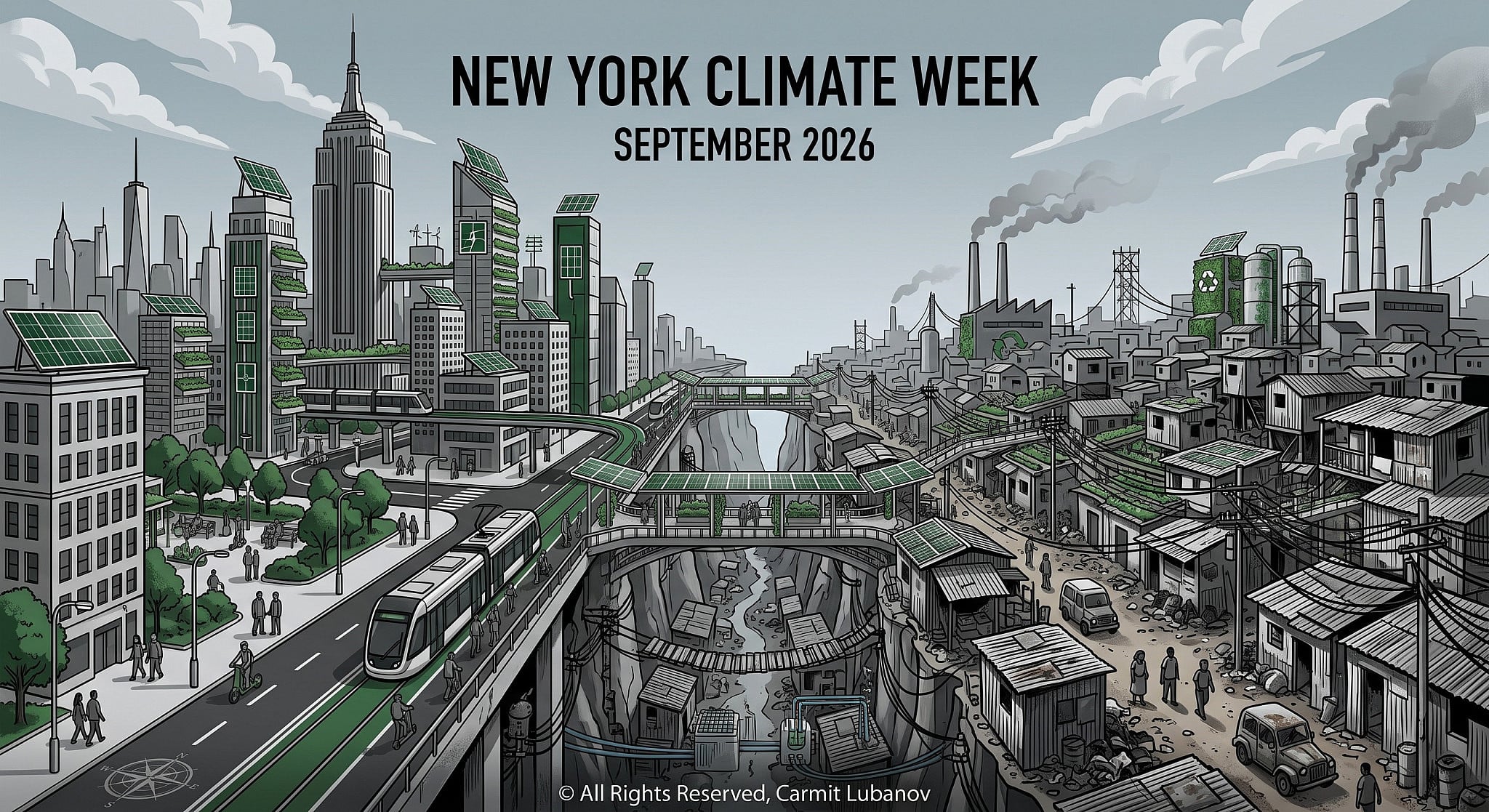
Ahead of Climate Week NYC & the 81st UN General Assembly (September 2026), as world leaders convene in New York for Climate Week 2026, the global dialogue is dominated by three imperative pillars: modernizing grids to absorb the exponential power hunger of artificial intelligence, sustaining clean technology investments, and moving from aspirational pledges to tangible action.
Yet, beneath this unified agenda lies a structural fracture. Across the Mediterranean basin—a recognized climate change hotspot warming 20% faster than the global average—the transition to a low-carbon economy is widening macroeconomic disparities rather than closing them. The barrier is neither resource scarcity nor lack of political will; it is an acute, quantifiable system of climate capital inequality.
The Capital Cost Penalty: Sun-Rich, Finance-Poor
The physical geography of clean energy favors the Southern and Eastern Mediterranean. Morocco, Egypt, and Jordan boast world-class solar irradiance and wind yields capable of producing electricity at an underlying Levelized Cost of Energy (LCOE) as low as $28–$36 per megawatt-hour (MWh)—substantially lower than northern European averages ($40–$54/MWh).
However, renewable energy infrastructure is up to 85% upfront capital expenditure. Because of sovereign risk premiums, macroeconomic volatility, and underdeveloped local bond markets, the Weighted Average Cost of Capital (WACC) for clean energy projects in North Africa ranges between 8.5% and 13.5%. By contrast, developers in Germany, France, and the Netherlands secure capital at a WACC of 2.3% to 4.5%.
This disparity creates a punishing financing penalty: financing the exact same solar park in Egypt or Jordan costs more than double what it does in France. Southern Mediterranean states are penalized not for their resources, but for their balance sheets.
Grid Capex and the Looming AI Demand Shock
Electrification cannot succeed without physical networks. Northern and Western European economies invest between $240 and $340 per capita annually into grid modernizations, digital dispatching, and high-voltage direct current (HVDC) transmission. In contrast, Jordan, Morocco, and Egypt invest between $18 and $34 per capita. As a result, Southern grids suffer severe curtailment—clean power plants are frequently forced offline simply because the infrastructure cannot wheel the power.
Compounding this strain is the rapid growth of artificial intelligence and enterprise compute clusters. In data-heavy economies like Sweden, the Netherlands, and the United States, digital infrastructure now accounts for 5.5% to 9.0% of total grid demand, driving massive domestic capital allocation. If the Global North captures the productivity dividends of AI while consuming vast amounts of global energy, while the Global South remains constrained by brittle grids and energy poverty, regional socio-economic divergence will accelerate.
Actionable Instruments for Regional Parity
These findings and the analyzed geopolitical recommendations are included in a new research report by the Mediterranean Climate Justice Think Tank and will be published in full ahead of Climate Week next month.
In brief, bridging this divide requires replacing transactional climate aid with integrated regional market mechanisms:
- Multilateral WACC Compression Facilities:
International Financial Institutions (IFIs) and European donors must pivot from direct project loans to sovereign first-loss guarantees and currency-hedging facilities. Compressing the cost of capital in North Africa by just 300 basis points would unlock tens of billions in private institutional capital.
- Cross-Mediterranean Subsea Interconnectors:
Accelerating bidirectional HVDC subsea interconnectors (such as Egypt–Greece and Israel–Cyprus–Greece) allows Europe to import low-cost southern solar during peak demand while providing Southern Mediterranean utilities with firm export revenues to reinvest in domestic distribution.
- Compute-for-Kilowatt Mandates:
Regional policy should require multinational cloud and AI operators expanding in the Mediterranean to fund 1.5 MW of local grid-scale renewable capacity and local distribution upgrades for every 1.0 MW of compute capacity installed.
The Imperative for Climate Week 2026
Climate justice is no longer a moral abstraction—it is an economic and stability imperative. If the Mediterranean is to remain stable and prosperous, the financial architecture governing clean tech must be overhauled.
When ministers and investors convene in New York in a short time, the real benchmark of leadership will not be another set of net-zero targets, but concrete mechanisms that lower the cost of capital and build resilient grids where the sun actually shines.