
The Inquiry Israel Needs and Its Government Fears
Agranat in Reverse: What an October 7 Inquiry Will Find
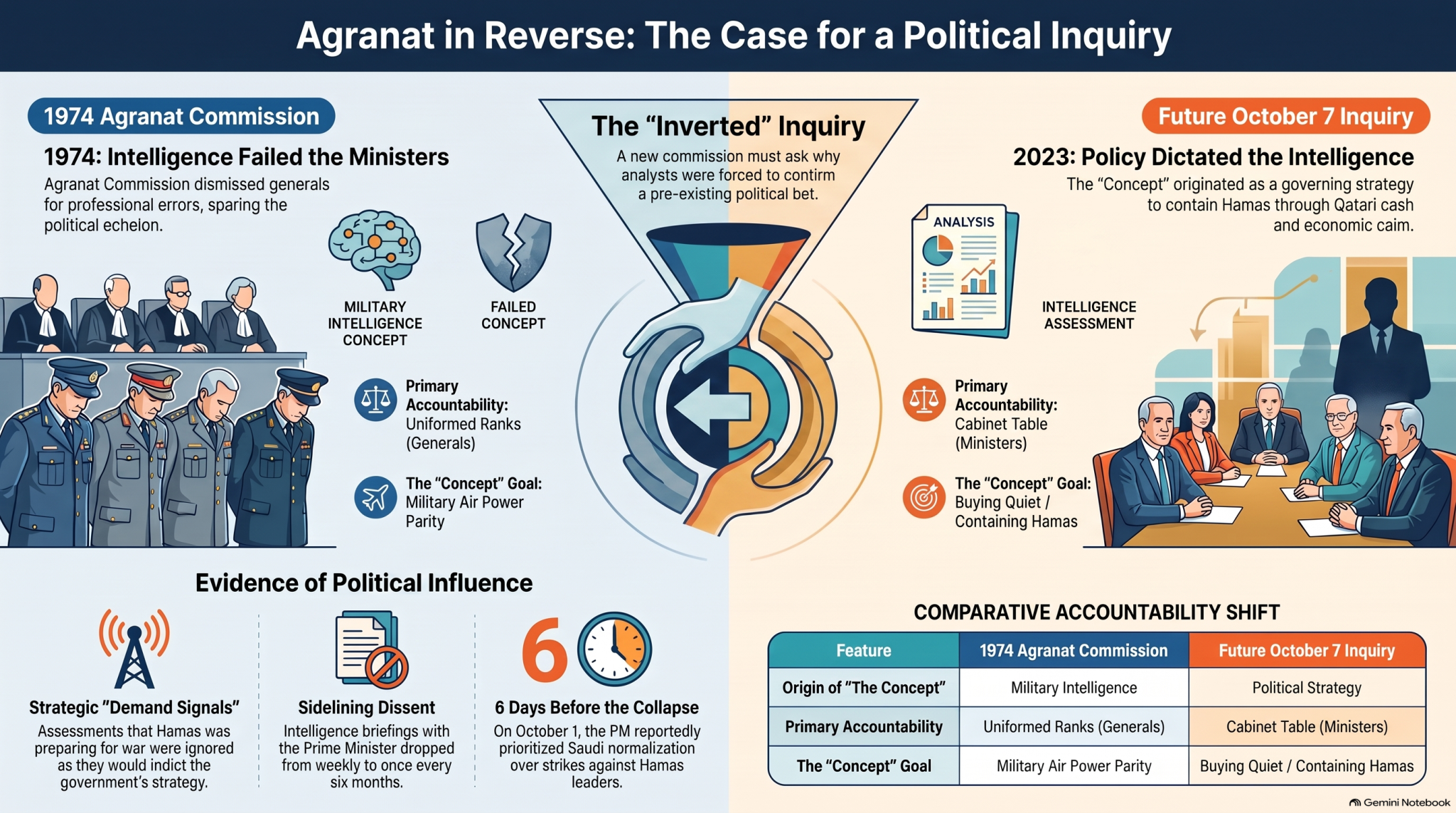
When a state commission of inquiry into October 7 finally convenes, it will not produce a sequel to the Agranat Commission. It will produce its inversion. In 1974, Agranat found an intelligence establishment captured by a mistaken “Concept,” dismissed the generals, and declined to judge the ministers who led them. The October 7 inquiry will find that the Concept did not originate in Military Intelligence at all. It originated at the political level, as a governing strategy toward Hamas. Intelligence absorbed that strategy, echoed it back, and was never permitted to challenge it. Agranat’s question was why the analysts got it wrong. The new commission’s question will be why the analysts were asked to get it right in only one direction.
That is why the fight over whether such a commission will exist, who will sit on it, and who will write its mandate has consumed nearly three years. It is not a procedural dispute. It is a dispute about which of the two stories the commission will be allowed to tell.
Start with what Agranat actually did. Its interim report in April 1974 recommended removing Chief of Staff David Elazar and Military Intelligence chief Eli Zeira, among others. It explicitly declined to rule on the parliamentary responsibility of ministers. Moshe Dayan, the defense minister, walked away formally cleared. Golda Meir resigned anyway, not because the commission required it but because the public refused to accept a verdict that stopped at the uniformed ranks. The lesson Israel drew was an intelligence lesson. It created a devil’s advocate unit, reformed its estimate process, and diversified its sources of assessment. The lesson it did not draw was that a government can build a Concept of its own and then ask intelligence to confirm it.
October 7 is what that unlearned lesson looks like fifty years later.
The IDF’s own investigations have already done the work Agranat did. They named the Concept: the belief that Hamas was deterred, invested in governing Gaza, and interested in economic calm rather than war. They documented the dismissal of the Jericho Wall attack plan as aspirational, the warnings from the border observers, the Unit 8200 analyst who was waved off, and the ambiguous signals of the final night. As an account of intelligence failure, it is largely complete. A state commission that simply repeats it would add little.
What the military probes could not examine is where the Concept came from. For more than a decade, Israeli policy toward Gaza rested on a strategic bet: that Hamas could be contained, bought quiet with Qatari cash and work permits, and kept in power as a counterweight to the Palestinian Authority. This was not an intelligence assessment. It was a political choice. Once made, it created a demand signal. An assessment that Hamas was deterred was also an assessment that the policy was working. An assessment that Hamas was preparing for war would have been an indictment of the government’s strategy. Intelligence organizations are not immune to knowing which answer the building wants.
The evidence now emerging points precisely here. According to The New York Times, a transcript of an October 1, 2023, meeting shows that Netanyahu told senior security officials that any Israeli action in Gaza could undermine the prospects of Saudi Arabia establishing diplomatic relations with Israel, a deal he believed was close to being finalized. The same report says he told officials their goal should be to preserve calm in Gaza, and objected when they argued for considering strikes against senior Hamas officials directing attacks in the West Bank. That is the Concept stated by its owner, six days before it collapsed.
Then there is the warning that, if the reporting holds, never reached the professionals at all. Haaretz reported this month that in a 45-minute conversation ten days before the massacre, UAE President Mohammed bin Zayed warned Netanyahu that Yahya Sinwar was planning a major operation against Israel. According to that report, the prime minister responded that he believed Hamas intended to operate in the West Bank, and both former Shin Bet chief Ronen Bar and former Chief of Staff Herzi Halevi said they had not been informed of the warning. Netanyahu denies the call took place. He says the National Security Council and his military secretary reviewed his call log for those days and found no trace of it. Two sources who spoke to The New York Times have since corroborated the account. I do not know which version is true. Neither does anyone else, which is exactly the point. Only a body with subpoena power, access to classified records, and independence from the people under examination can establish it.
The relationship between the prime minister and his intelligence chiefs will be the third strand. In leaked recordings, former Military Intelligence chief Aharon Haliva described how meetings between the prime minister and the head of the Intelligence Directorate, once weekly, declined to monthly, then every two months, and finally once every six months. A Concept does not need to be imposed by order. It can be sustained simply by making sure that dissenting assessments rarely reach the room where decisions are made.
The strongest objection deserves a direct answer. The defenders of the political echelon argue, not unreasonably, that ministers are consumers of intelligence, not producers. If the professionals said Hamas was deterred, a prime minister was entitled to believe them. On this view, the failure belongs where Agranat placed it in 1974: with the generals and analysts who are paid to warn. “No one woke me up” is the short form of this argument.
It fails on its own terms. The objection assumes information flowed in one direction, from intelligence to government. The record suggests it flowed in both. The government set a strategy, defined calm as the objective, and made its priorities explicit, including Saudi normalization. It then received assessments consistent with that strategy and, reportedly, sidelined information that was not. When the consumer of intelligence is also the author of the premise that intelligence is asked to test, the distinction between producer and consumer collapses. Agranat could maintain that distinction in 1974 because the Concept about Egyptian air power was genuinely a military judgment. The Concept about Hamas was never purely military. It was policy with an intelligence label on it.
This is also why the current maneuvering matters so much. A Likud bill would bar current or former Supreme Court justices, former attorneys general, Shin Bet chiefs and senior security and legal officials from serving on the panel. A panel led by the prime minister was set up to define the mandate of a government inquiry. A commission designed by the political echelon will look where Agranat looked, at the ranks below the cabinet table, and it will find what the IDF has already found. The effort to control the mandate is itself the strongest evidence of what an independent mandate would uncover.
The question will soon pass to the voters. The High Court announced on Wednesday that it will not rule on petitions to establish an independent state commission until after the October election. Opposition leaders Gadi Eisenkot, Naftali Bennett, Avigdor Liberman and Yair Golan have jointly pledged to establish a state commission as one of the first acts of a government they lead. Whatever one thinks of those parties, the choice before the electorate is not whether there will be accountability. It is which version of accountability Israel is prepared to hear.
Agranat taught Israel that intelligence can be captured by an idea. A real October 7 inquiry will teach the harder lesson: the idea can come from the top, and a government can make its own Concept look like an intelligence estimate. In 1974, Israel removed the generals and assumed it had fixed the problem, and the problem came back. If the October 7 inquiry stops at the same altitude, it will come back again. The only commission worth convening is one empowered to look upward, and that is precisely why it has not yet been convened.