
The Inverse of Holocaust Remembrance

Lithuania insists it safeguards Holocaust remembrance. The record shows the exact inverse: preservation of reputation over truth.
The screenshot accompanying this article reflects a public statement by the Lithuanian Foreign Ministry asserting that the state safeguards Holocaust memory. That claim must be evaluated not by ceremony or rhetoric, but by institutional conduct.
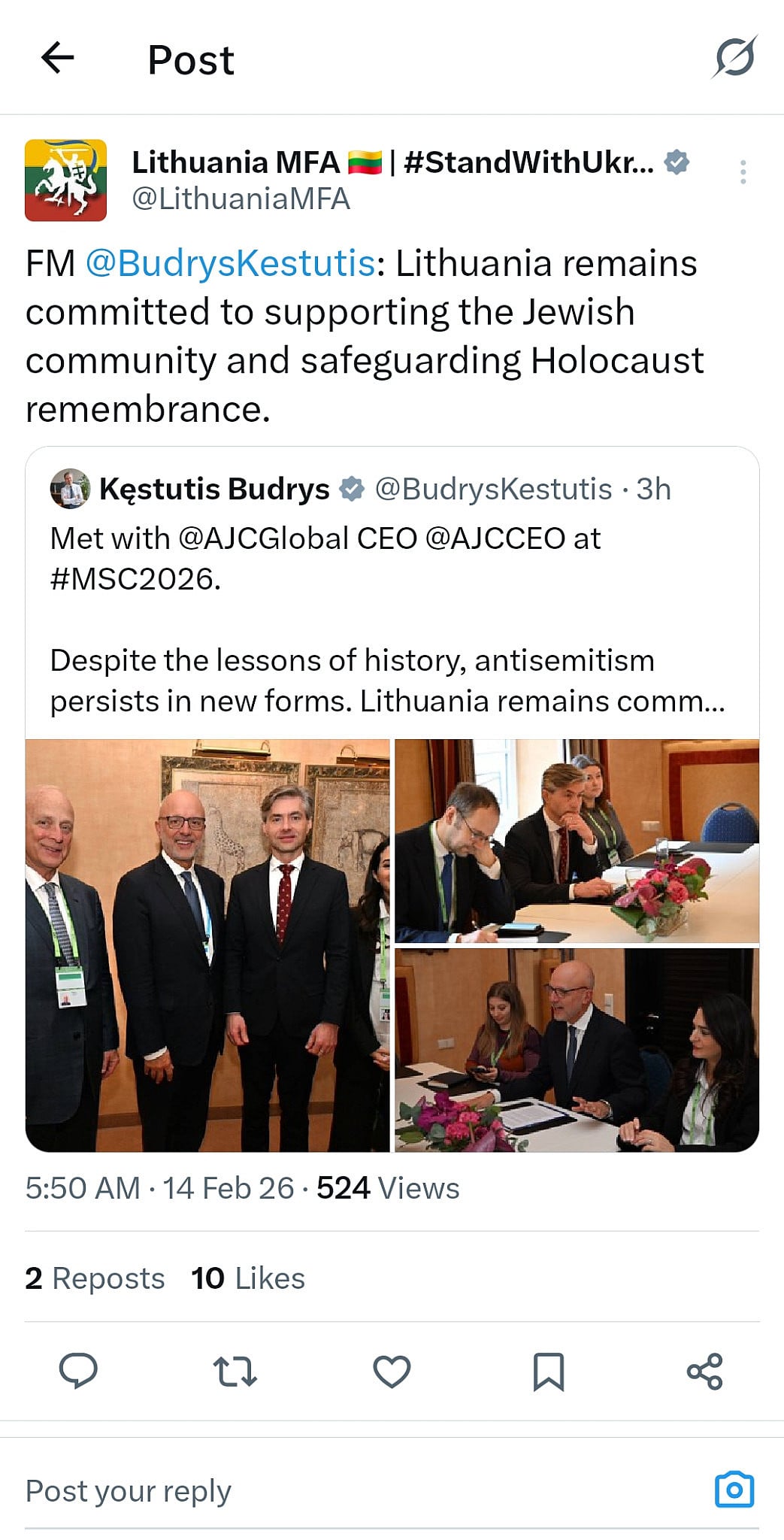
Safeguarding Holocaust remembrance requires minimum conditions. It requires accurate attribution of local participation in genocide. It requires removal of public honors for individuals whose documented administrative actions facilitated persecution and extermination. It requires judicial willingness to adjudicate evidentiary merits. It requires correction after documentary notice. Without those elements, remembrance becomes declarative rather than substantive.
Lithuania does not meet those conditions.
Public emphasis repeatedly centers on approximately 900 recognized rescuers — roughly 0.04 percent of Lithuania’s wartime population. Recognition of rescuers is proper and necessary. But when that figure becomes the dominant narrative lens, while the remaining 99.96 percent of society — including the civil administration, police battalions, municipal authorities, and auxiliary structures that implemented isolation, dispossession, and mass murder — are not subjected to equivalent institutional scrutiny, the effect is statistical substitution. Commemoration is foregrounded. Structural participation is backgrounded.
That imbalance is measurable.
State-sanctioned honors remain in place for individuals whose documented roles involved the administration of ghettos, facilitation of expropriation, or coordination of anti-Jewish measures. Where documentary evidence has been formally submitted identifying such roles, corrections have not followed. Honors remain. Institutional framing remains. Persistence after notice is dispositive.
The Genocide and Resistance Research Centre of Lithuania, a state-funded body responsible for historical interpretation, continues to structure narratives in which implicated individuals are framed primarily through anti-Soviet resistance credentials, with Holocaust participation treated as secondary, contextual, or administratively technical. This method does not deny the Holocaust. It reorganizes identity to preserve reputational continuity.
Judicial outcomes reinforce that continuity. Challenges to public honors have repeatedly stalled on procedural grounds — standing doctrines, finality principles, jurisdictional constraints — without courts reaching the evidentiary merits of documented conduct. Procedure has functioned as insulation. Substantive adjudication has not occurred.
The International Holocaust Remembrance Alliance defines Holocaust distortion to include the minimization of the scope or mechanisms of genocide, the shifting of responsibility away from local actors, and the presentation of collaborators primarily as victims or heroes. IHRA membership carries an obligation to combat such distortion and to ensure accurate historical attribution.
If a member state maintains public honors for documented participants, structures institutional narratives that subordinate local participation, and declines to correct inaccuracies after formal notice, the compatibility of that conduct with IHRA standards warrants examination. Membership is not symbolic. It implies adherence to defined principles. Standards that are not applied uniformly diminish institutional credibility.
This pattern — public commemoration combined with structural insulation from accountability — reflects a broader dynamic analyzed in my forthcoming book, Recognition Without Reckoning: Sovereignty, Continuity, and the Architecture of Historical Evasion. A state may participate fully in international remembrance frameworks while preserving internal narrative continuity that protects reputational foundations. Recognition proceeds. Reckoning does not.
Lithuania declares that it safeguards Holocaust remembrance. The institutional record demonstrates selective emphasis, procedural insulation, narrative minimization, and persistence after documentary notice.
That is not safeguarding memory.
It is its inverse.