
CFO | Empower Society for Good I Author
The Inversion of October 7
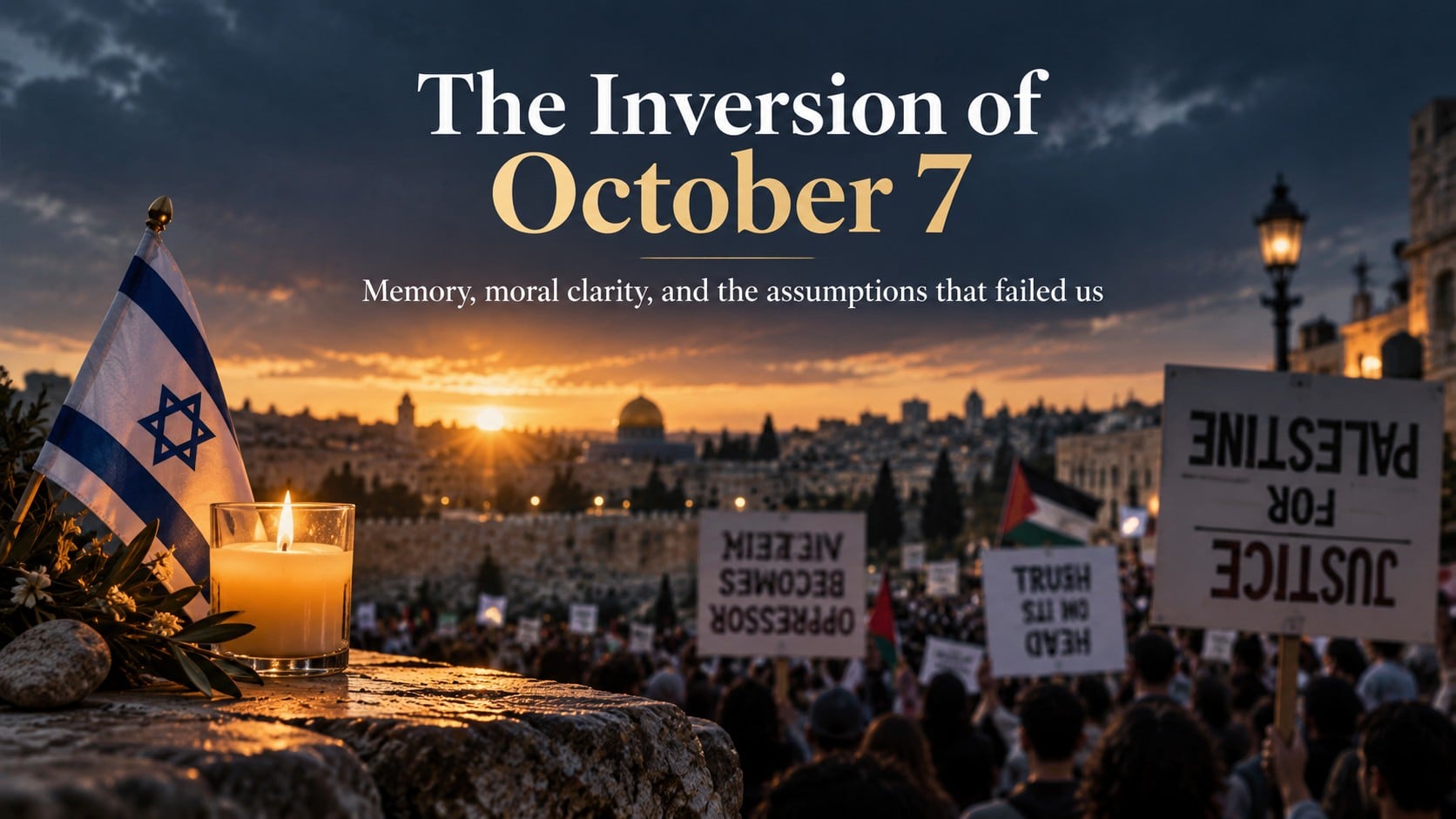
As we approach another October 7, the inversion is almost unbearable.
According to Israel’s Diaspora Affairs Ministry, 262 pro-Palestinian demonstrations and anti-Israel events were identified across 37 countries around the October 7 anniversary period, with 75 events planned for October 7 itself.
That fact alone tells us something profound.
October 7 should be a day of memory: the day Jewish families were slaughtered, children kidnapped, women brutalized, communities burned, and Israel was forced to confront the worst massacre of Jews since the Holocaust. And yet around the world, the anniversary has become a date for anti-Israel demonstrations, pro-Palestinian rallies and slogans that often erase the massacre itself.
That is not merely political protest. It is narrative inversion.
The victims disappear. The aggressor becomes the symbol of resistance. The Jewish state, attacked in its homes and communities, becomes the accused. And the world asks Israel to explain itself while barely asking what kind of ideology could celebrate or justify October 7 in the first place.
To understand how we arrived here, we have to unpeel the layers: the denial of what happened, the Israeli misconception about Hamas’s intent, the ideology beneath the violence, the older rejection embedded in Palestinian political history, and the way the world has turned Jewish self-defense into its moral scandal.
Emily Damari, a British-Israeli survivor and former hostage, recently called out the denial and distortion of October 7. “It was not an accident,” she said. It was a planned terrorist attack in which innocent people were murdered, raped, injured and kidnapped from their homes.
That sentence matters because it restores moral clarity. Before there is policy, before diplomacy, before debate about what Israel should or should not have done after October 7, there must be truth about what happened on October 7. It was not a misunderstanding. It was not a spontaneous protest. It was not resistance in any morally defensible sense. It was planned barbarism.
A Jerusalem Post analysis put the Israeli failure sharply: for years, Israel knew Hamas had the capability to breach the border, attack communities, fire rockets and take hostages. What failed was not only the assessment of capability. It was the assessment of intent. Hamas was believed to be deterred, interested in preserving its rule in Gaza, and unlikely to risk the devastating Israeli response that a major assault would invite.
That assumption collapsed at 6:29 a.m. on October 7, 2023.
But the great misconception was not only that Hamas was deterred. It was that the conflict could be managed as if it were mainly about material conditions, borders and grievances, while ignoring the ideological rejection of Jewish sovereignty that has been present from the beginning.
This is one of the painful lessons of October 7: a society can become very sophisticated and still misunderstand the nature of the threat in front of it. We can build intelligence systems, border fences, economic arrangements, diplomatic language, humanitarian frameworks and security doctrines. All of these matter. A serious country needs them. But there are moments when the problem is not only technical, military or economic. It is ideological. It is civilizational. It is a story problem.
That is what struck me also in a recent Jerusalem Post interview with Sebastian Gorka. He said: ‘Terrorism cannot always be explained away as poverty, lack of education or political disenfranchisement. Those factors may matter, but they do not explain everything. Sometimes ideology comes first.’
That is an uncomfortable thought for liberal societies. We prefer to believe that every conflict can be managed by improving conditions, finding incentives, reducing friction and creating arrangements. We want to believe that if people are given enough economic opportunity, political recognition and practical benefit, they will choose life over death, prosperity over destruction, coexistence over fanaticism.
But October 7 forced us to confront something darker. Hamas did not massacre Israelis because of a missing economic package. They were not ‘occupied’. They had the ability to govern themselves. There must be another explanation for why it burned families, kidnapped children and celebrated cruelty. It acted from a worldview. A worldview in which Jewish sovereignty is intolerable. A worldview in which murder can be sanctified. A worldview in which death, martyrdom and humiliation of the enemy become sacred tools.
October 7 was not only a security failure. It was a failure to understand ideology, and the world’s response has become a failure to protect truth.
That is the inversion of October 7.
Inversion is when the murdered become the accused, the ideology of murder becomes “resistance,” and the Jewish right to self-defense becomes the world’s moral scandal.
History matters here, and the 1964 Palestinian National Charter is revealing.
It was written before Israel controlled the West Bank or Gaza. At that time, the West Bank was under Jordanian control and Gaza was under Egyptian control. Yet the Charter did not call for a Palestinian state alongside Israel in those territories. It defined Palestine, within the boundaries of the British Mandate, as an indivisible territorial unit. It declared the 1947 Partition Plan and the establishment of Israel illegal and void. It denied the Jewish people’s historic and national claim to the land, reducing Judaism to a religion and denying that Jews constitute a people with national identity.
Most tellingly, Article 24 stated that the PLO did not exercise sovereignty over the West Bank, Gaza or the Himmah Area. In other words, the original grievance was not that Israel was occupying those territories. Israel was not yet there. The grievance was the existence of Israel itself.
After 1967, the language of the conflict changed. The world increasingly came to speak as if the whole issue began with the territories Israel captured in the Six-Day War. But the older rejection did not disappear. It was revised, repackaged and internationalized.
That is why the phrase “Free Palestine” cannot be treated as innocent without asking what it means. A peaceful state beside Israel? Or the undoing of Israel? Coexistence? Or replacement?
The issue is not Palestinian humanity. Palestinians deserve dignity, decent leadership, security, prosperity and a future not built on hatred. But the ideology that has too often driven the conflict is not merely a demand for land. It is a rejection of Jewish sovereignty in any part of the land.
There is a temptation to say this is simply about territory: borders, settlements, Jerusalem, the Temple Mount, sovereignty. Of course land matters. Jerusalem matters. The Temple Mount matters. But October 7 showed that the conflict cannot be reduced to land alone.
There is a deeper ideological and religious war taking place. In its harshest form, it is not only saying, “We want a state.” It is saying, “The Jews cannot be sovereign here.” Jewish sovereignty in Jerusalem, in Judea and Samaria, and in the Land of Israel itself becomes an intolerable theological and historical contradiction. If the Jews are here, if the Jewish people have returned, if Israel lives, then an entire ideology has to confront the possibility that its story is wrong.
That is what we have tried so hard not to see.
For decades, Israel and the West tried to shrink the conflict into something more manageable. We tried land formulas, economic arrangements, security coordination, withdrawals, peace processes, disengagement, work permits, containment, deterrence and quiet. Some of these efforts were sincere. Some were necessary. But again and again, the underlying ideology remained.
Then came the intifadas. Then came terror waves. Then came rockets. Then came October 7. And still the world struggles to absorb the message: this is not only a dispute over where to draw a line on a map. It is also a battle over whether the Jewish people have any legitimate place in our ancient homeland at all.
That is what makes October 7 so frightening. It exposed not only a military failure, but a failure of imagination. We did not want to believe that such hatred was still alive at that scale, with that depth, with that patience. We did not want to believe that behind the language of grievance and resistance there could be a worldview willing to murder, rape, kidnap and celebrate.
And the most disturbing question, the one I almost hate to ask, is this: what if October 7 had not happened?
What if one more layer of planning had failed? What if the border had held? What if the surveillance warnings had been properly acted upon? What if the attack had been stopped at the fence? It should have been stopped. It should never have happened.
But if it had not happened, would the hatred have disappeared? Or would it simply have remained underground, growing stronger, waiting for the next opportunity, perhaps for an even larger massacre?
There is no comfort in that question. October 7 was not a miracle. It was a catastrophe. But it tore away the illusion that the problem had been contained. It revealed the depth of the ideology. It showed the world something we should have understood earlier.
And then came the second catastrophe: much of the world did not recoil from that ideology. It absorbed it, excused it, explained it away, or turned it against Israel.
And the avoidance is revealing. The world speaks endlessly about Palestinian statehood as if it is the single moral test of civilization. But where is the same urgency for the Kurds? For the Yazidis? For the victims of civil wars and mass slaughter across the Middle East, Africa and elsewhere? Why is the Jewish state, alone among the nations, treated as the obstacle to world morality?
This is the old sickness in a new language. The Holocaust is inverted. October 7 is inverted. Jewish self-defense is inverted. Zionism, the national liberation movement of the Jewish people in their ancestral homeland, is recast as colonialism. And the Jewish people are once again asked to apologize for surviving.
For years, parts of Israel’s leadership treated Gaza as a problem to be contained. Allow money in. Expand work permits. Maintain quiet. Avoid escalation. Keep the border technologically secure. Manage Hamas as the address. Let the system hold.
But systems can hold only when the assumptions underneath them are true. If the ideology remains unchanged, if the hatred is being educated, preached, funded and celebrated, then the system is not solving the problem. It is buying time while the problem deepens.
In that sense, Hamas achieved something terrible. Not a military victory in the simple sense. Gaza has suffered terribly. Hamas has brought devastation on its own people. But in the battle over the world’s imagination, Hamas managed to unleash a global wave of hatred, boycotts, sanctions, campus hostility, diplomatic pressure and inversion of Israel’s story.
That is why this is so hard to fight. Israel can fight tunnels, rockets and battalions. It is much harder to fight a lie that has become fashionable. It is harder to fight a world that looks at Jewish victims and sees only Israeli guilt.
This is not only an Israeli security question. It is a question for any decent society.
A good society cannot survive by administration alone. It needs moral clarity. It needs to know what it stands for. It needs to know what it will tolerate and what it will not tolerate. It needs the courage to name evil without becoming evil itself.
The old assumptions are no longer enough. “Quiet” is not peace. Economic benefit is not reconciliation. International approval is not morality. Technical control is not victory. And management is not meaning.
Israel did not only misread Hamas. It misread the limits of management. Some problems are not solved by better arrangements. They require a battle of ideas, a recovery of identity, and a society confident enough to tell its own story.
That is the work after October 7.
We have to double down on moral clarity, on our story, and our history to this Land We have to confront violent ideology.
This is not only a diplomatic argument. It is a battle over memory, morality and meaning. If we lose the story, we will not win the policy. If we allow October 7 to be inverted, we will not understand what happened to us, or what is being asked of us now.
Related Topics