
Middle East Analyst
The Iran War and the Collapse of the Gaza International Stabilization Force
Netanyahu’s Predictable Strategy
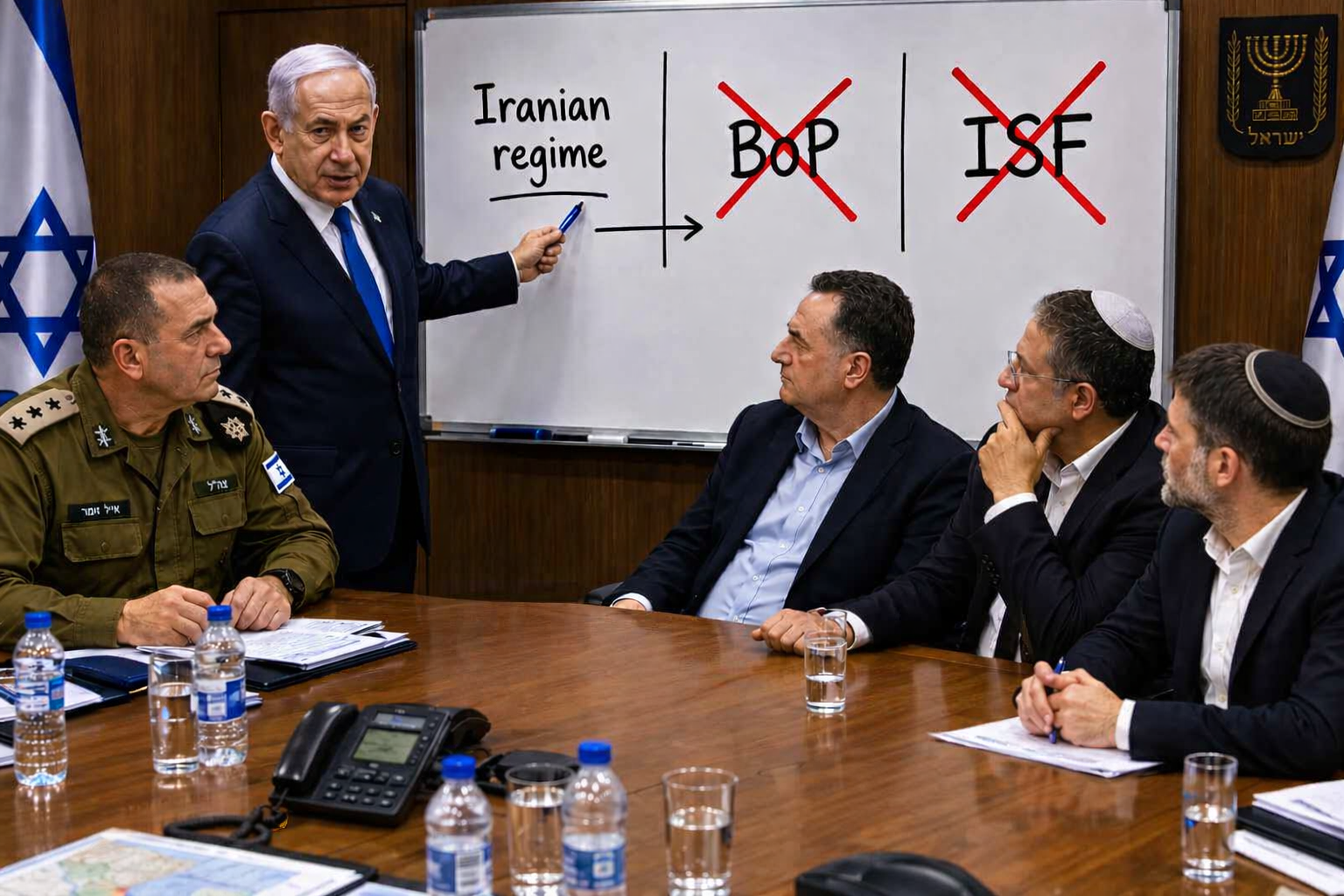
When UNSC 2803 established the Gaza Board of Peace, I assessed that Prime Minister Benjamin Netanyahu would not openly reject the resolution outright, but would instead seek to constrain, delay, or hollow out its implementation while avoiding direct confrontation with Washington. That assessment now appears increasingly consistent with the observable trajectory of events surrounding both the Board of Peace and the International Stabilization Force (ISF).
The Board of Peace framework was not merely a humanitarian mechanism or diplomatic exercise. It represented the first internationally backed structure with the potential to transition Gaza away from indefinite Israeli military control and toward some form of internationally supervised political stabilization. Even though the framework was vague, fragile, and dependent on difficult regional compromises, it carried an implication Netanyahu had resisted for years: that Israel’s postwar freedom of action inside Gaza might eventually become constrained by an internationally legitimized governance and security structure.
Netanyahu’s resistance to key elements of the framework was visible from the beginning. He opposed the inclusion of Turkey and Qatar in the executive structure of the Board of Peace and reiterated immediately before passage of UNSC 2803 that Israel’s opposition to Palestinian statehood “on any territory” remained unchanged. That statement was not incidental. The possibility of a future Palestinian political pathway was central to how Muslim-majority governments justified participation in the stabilization effort to their domestic audiences.
Although Netanyahu ultimately joined the Board of Peace after pressure from President Trump, subsequent Israeli behavior suggested tactical accommodation rather than substantive support. Israel reportedly insisted that any stabilization force operate in close coordination with Israeli military structures rather than as an independent mechanism capable of exercising meaningful political autonomy inside Gaza. Reporting from +972 Magazine citing a senior Arab official further alleged that Israel pressured Azerbaijan to withdraw from the ISF effort altogether. Even if some individual reports remain difficult to independently verify, the broader pattern is difficult to ignore: Israel repeatedly constrained the political conditions necessary for the stabilization architecture to become operational.
At the same time, Netanyahu had spent decades advocating confrontation with Iran. Long before the current war, Iran’s nuclear and missile programs had become the defining strategic focus of his regional worldview. The February 28 strikes did not emerge from a sudden crisis alone, but from years of sustained Israeli pressure on Washington to adopt a more confrontational posture toward Tehran.
These two strategic tracks — opposition to an independent Gaza stabilization framework and support for confrontation with Iran — should not necessarily be viewed as separate developments.
The viability of the Board of Peace depended not simply on diplomatic agreements, but on political legitimacy within Muslim-majority societies. The ISF could not function credibly if it appeared to be merely an auxiliary force operating on behalf of Israel or the United States. That legitimacy problem was always the mission’s greatest structural vulnerability.
Indonesia’s participation was therefore indispensable. Jakarta’s commitment of roughly 8,000 personnel formed the operational backbone of the ISF, but Indonesia’s importance was not merely military. As the world’s largest Muslim-majority country, it provided the mission with the Islamic political legitimacy no Western country could supply. Its participation signaled that the force could plausibly be framed as an international stabilization effort rather than a multinational cover for continued Israeli control over Gaza.
The remaining contributors were politically useful but operationally marginal. Kosovo pledged approximately 20 personnel. Albania offered limited headquarters support. Morocco discussed police participation. Kazakhstan proposed medical and support elements. Bosnia-Herzegovina prepared a small contingent. Collectively, these contributions created the appearance of multinational participation, but none could substitute for Indonesia’s central role.
Once the Iran War began on February 28, however, the political foundations of the entire framework began collapsing almost immediately.
The war transformed participation in the Board of Peace into a domestic political liability across much of the Muslim world. Governments that might previously have justified participation as part of a humanitarian stabilization effort suddenly faced the perception that they were cooperating with the same coalition simultaneously conducting military operations against Iran. The political distinction between Gaza stabilization and broader regional alignment with the United States and Israel rapidly eroded.
Indonesia became the clearest example of this dynamic. Jakarta suspended deployment discussions within days of the outbreak of the conflict. Indonesian officials publicly cited both the escalating regional war and paralysis within the Board of Peace process itself. Once Indonesia froze participation, the ISF effectively ceased to exist as a deployable force. Other contributors quietly stalled, retreated into procedural ambiguity, or disappeared from the process altogether. The force remained alive on paper, but its operational core had collapsed.
This does not prove that Netanyahu supported confrontation with Iran primarily in order to destroy the Board of Peace architecture. Internal intent cannot be established with certainty from public evidence alone, and Netanyahu clearly believed unrest inside Iran presented a historic strategic opportunity. But the broader range of incentives mattered, and the secondary consequences of the Iran War were highly foreseeable.
Netanyahu almost certainly understood that large-scale confrontation with Iran would intensify anti-Israeli and anti-American sentiment across Muslim-majority societies. He also likely understood that the Board of Peace depended precisely on cooperation from those same societies. The political contradiction was obvious: governments being asked to stabilize Gaza alongside Washington and Israel would simultaneously be expected to defend participation while images of war with Iran dominated regional media and public discourse.
Under those conditions, the Iran War created a major secondary strategic benefit for Netanyahu even if the campaign itself failed to achieve decisive objectives.
If the war succeeded strategically, Iran would be weakened, destabilized, or regionally degraded — a historic outcome from Netanyahu’s perspective. But even if the campaign produced only stalemate or mixed results, the regional backlash would still likely cripple the Board of Peace and ISF framework. In effect, the conflict with Iran placed the Gaza stabilization architecture under pressures it was unlikely to survive.
The evidence increasingly suggests that Netanyahu viewed any genuinely independent postwar governance mechanism inside Gaza as a long-term constraint on Israeli operational freedom. A successful ISF deployment backed by Muslim-majority states and international legitimacy could eventually create pressure for Israeli withdrawal, political transition, and external oversight structures Israel would not fully control.
The Iran War effectively solved that problem.
By politically poisoning participation for the one indispensable Muslim-majority contributor — Indonesia — the regional conflict undermined the only operationally viable mechanism capable of implementing Phase II of UNSC 2803. Reconstruction stalled. Governance transition stalled. The Board of Peace became increasingly theoretical rather than operational.
The result is that Gaza now remains trapped in strategic limbo: no reconstruction, no stabilization force, no functioning political transition mechanism, and no credible pathway out of indefinite military control.
Short-Term Gains vs. Long-Term Losses
Short-term strategic advantage and long-term strategic success are not necessarily the same thing. The destruction of the ISF framework did not solve the underlying problem of Gaza governance. It merely eliminated the only internationally backed mechanism that had even a plausible chance of transitioning Gaza away from indefinite war, occupation, and political paralysis.
Many Israelis may view the collapse of the Board of Peace as preferable to accepting an international framework that could eventually constrain Israeli military freedom of action. Netanyahu himself may calculate that preventing the emergence of an independent stabilization mechanism is strategically safer than risking a postwar structure Israel cannot fully control.
But history rarely treats the indefinite absence of political resolution as a stable equilibrium.
A Gaza trapped permanently between military occupation, humanitarian collapse, and political vacuum is unlikely to produce long-term Israeli security. More often, such conditions produce radicalization, recurring violence, regional instability, and the gradual erosion of the legitimacy military victories are intended to protect.
On May 28, Netanyahu ordered the IDF to seize 70 percent of Gaza while signaling that the operation could expand further. The timing is unlikely to be accidental. As reports increasingly suggest that the Trump administration may be preparing to end the Iran War through a negotiated framework many Israelis perceive as achieving few of the war’s original objectives, Netanyahu faces growing political pressure heading into September elections.
Under those conditions, deeper and potentially open-ended reoccupation of Gaza may become not merely a military policy, but a political necessity for Netanyahu himself — the remaining arena in which he can still claim a visible and tangible form of victory after the strategic ambiguity of the Iran campaign.
But such a course could carry historic costs. The collapse of the Board of Peace and ISF framework has already eliminated the only internationally backed mechanism that offered even a plausible pathway away from indefinite conflict in Gaza. A large-scale permanent Israeli reoccupation would likely deepen Israel’s diplomatic isolation, intensify tensions with key partners, and accelerate perceptions that Israel no longer seeks a viable political end state at all.
Over time, that trajectory could place the U.S.-Israel strategic partnership under strains unprecedented in its modern history. For decades, the relationship rested not only on military cooperation and shared interests, but also on the assumption — however imperfectly realized — that Israeli military operations ultimately served a broader political vision compatible with regional stabilization and eventual conflict resolution. If that assumption collapses, the long-term strategic consequences for both countries may prove far more serious than many currently assume.
The first casualty of the Iran War was not just Iranian infrastructure. It was the international plan to stabilize Gaza. And the strategic consequences of that loss may destabilize the region long after the Iran war itself fades from the headlines.
Related Topics
Related Posts