
Urban sociologist and geopolitical commentator
The Islamabad Memorandum
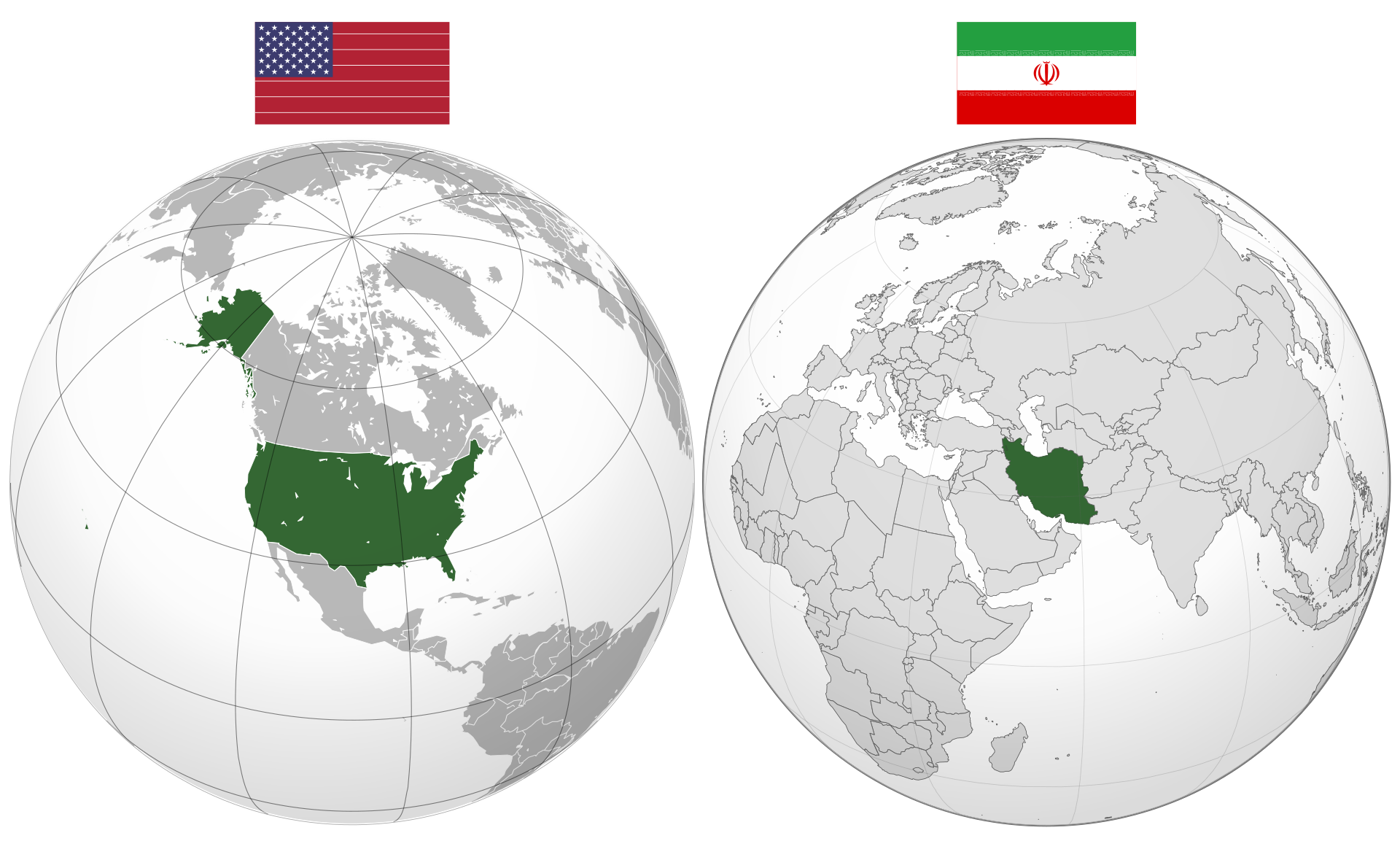
United States & Iran: orthographic projection (Source: Wikimedia Commons)
The Cartography of American Retreat and Israel’s Existential Reckoning – A Geopolitical Analysis
History has a habit of disguising turning points as diplomatic events. The 1783 Treaty of Paris did not merely end the American Revolutionary War; it announced that Britain’s unipolar dominance of the Atlantic world was over. The 1956 Suez Crisis did not merely force a Franco-British withdrawal from Egypt; it confirmed that American hegemony had replaced European imperial primacy. The Islamabad Memorandum, initialled electronically under Pakistani facilitation between Washington and Tehran, may belong to this class of events: a document whose surface meaning is a ceasefire, but whose deeper meaning is a civilizational recalibration.
The surface story is one of coercive diplomacy succeeding: American naval power in the Gulf, crippling sanctions, and the credible threat of further escalation extracting from Tehran a framework it would not previously have accepted. That story is accurate, as far as it goes.
It does not go very far.
The Afghan Shadow and the Architecture of American Restraint
To understand the full meaning of what happened in Islamabad, one must begin not in the Persian Gulf, but in Kabul, and even further back, in the war councils and think-tanks where American strategic doctrine underwent its quiet, largely unacknowledged revolution.
The Afghan withdrawal of August 2021 was presented to the world primarily as a humanitarian and political catastrophe: the images of desperate crowds at Hamid Karzai International Airport, the swiftness of Taliban consolidation, the abandonment of people who had staked their lives on American commitment. These images were real, and the moral reckoning they demand is legitimate. But beneath the humanitarian narrative was a strategic confession that the American establishment was reluctant to make publicly.
The confession was this: the United States had discovered, at a cost of approximately $2.3 trillion and over 2,400 military lives, that the projection of land power into the greater Central Asian-South Asian theatre had become strategically untenable, not primarily because of the Taliban, but because of China.
This is the dimension that has been almost entirely absent from mainstream commentary on both the Afghan withdrawal and the Islamabad Memorandum.
When American strategic planners examined the Afghan theatre by the mid-2010s, they confronted a geometry they had not adequately anticipated. China’s Belt and Road Initiative had systematically surrounded Afghanistan with economic and infrastructure dependencies: Pakistan to the south through CPEC, Central Asian states to the north through connectivity projects, Iran through investment relationships. The PLA was not fighting in Afghanistan. It did not need to. It was constructing the encirclement.
A prolonged American land presence in Afghanistan thus risked becoming a strategic liability of the first order: an exposed garrison in a landlocked country, surrounded by states with deepening Chinese economic relationships, with its supply lines running through Pakistan, a country whose own strategic orientation had been steadily drifting toward Beijing. The nightmare scenario was not a Taliban offensive. It was a Chinese-facilitated strategic siege that would drain American resources, distract attention from the Indo-Pacific, and demonstrate to the world that Washington could be pinned down and bled by patient, indirect pressure.
The withdrawal was, in this light, less a defeat than a strategic triage, painful, chaotic in execution, but arguably rational in conception.
The Islamabad Memorandum is the next chapter of the same story.
When Washington looked at the Iran situation and calculated its options, the ghost of Afghanistan was present in every scenario review. A ground war against Iran, a country three times the size of Afghanistan, with a population reaching 90 million, a far more sophisticated military and proxy network, mountainous and urban terrain designed for asymmetric warfare, and relationships with Russia, China, and dozens of proxy forces across the region, would have been a strategic catastrophe of incalculable dimensions. It would have been Afghanistan multiplied by a factor that no responsible military planner was willing to accept.
More critically, it would have happened simultaneously with the most dangerous period in the Taiwan Strait since the Korean War. China’s window of military advantage relative to the United States, or more precisely, the window during which Beijing’s military modernization is most advanced while American countermeasures are still being deployed, runs roughly from the mid-2020s to the early 2030s. An American military embroiled in a land war in Iran during precisely this window would have represented an invitation to Chinese adventurism that no sane American strategist could accept.
Washington therefore pursued what it could pursue: the instruments of offshore power. The naval blockade, carrier strike groups, submarine deployments, the quiet but unmistakable message that the Strait of Hormuz and the broader Gulf waterways were under American maritime veto, combined with the full architecture of financial warfare: sanctions, secondary sanctions, exclusion from dollar-clearing systems, technology denial. These instruments are formidable. They are also limited. They can impose enormous pain. They cannot achieve the totality of victory that land power, at its most effective, can deliver.
The Islamabad Memorandum is, therefore, not the maximum of what American power could theoretically achieve. It is the maximum of what American power was prepared to deploy, and that distinction is perhaps the most significant strategic fact of the current era.
From Hegemony to Offshore Suzerainty – The Anatomy of a Strategic Transition
The United States is not declining in any simple sense. Its military remains without peer competitor in almost every conventional domain. What has genuinely changed is the geography of American willingness: the map of places and circumstances where Washington is prepared to commit the full instrument of national power, including ground forces in sustained combat operations.
That geography has contracted dramatically.
During the Cold War, American ground forces fought in Korea and Vietnam, theaters chosen precisely because they were important symbolic demonstrations of credibility in the global struggle against Soviet power, regardless of their intrinsic strategic value. During the unipolar moment of the 1990s and early 2000s, America intervened in Panama, Somalia, Haiti, Bosnia, Kosovo, Afghanistan, and Iraq, a range of interventions so geographically diverse as to suggest an almost unlimited appetite for land engagement.
That appetite is now gone. It was consumed by Iraq and Afghanistan, not so much by the military failures themselves, which were real but not unprecedented in American history, but by the dawning recognition that the opportunity cost of those interventions had been China’s largely undisturbed rise to near-peer status.
What has replaced the old doctrine might be termed offshore suzerainty: a system of dominance that does not require American boots on foreign soil to exercise itself, relying instead on the combination of naval supremacy, air power, space and cyber capabilities, financial system leverage, intelligence operations, and the management of local partners and proxies. It is a doctrine with deep historical roots: it resembles, in many ways, the British approach to empire in the 18th and 19th centuries, when London maintained global dominance through naval supremacy, commercial relationships, and selective land interventions, avoiding the permanent garrisoning of continental territories wherever possible.
The difference is that British offshore suzerainty was relatively unchallenged in its heyday. American offshore suzerainty operates in an environment where China, Russia, Iran, and a constellation of non-state actors have each developed specific capabilities designed to exploit the seams and limitations of exactly this model.
Iran’s strategy, in particular, represents a sophisticated counter to offshore suzerainty: the network of proxy forces, Hezbollah in Lebanon, various Shia militia groups in Iraq and Syria, the Houthis in Yemen, Palestinian Islamic Jihad, is explicitly designed to impose costs on American partners and extend Iranian influence in ways that cannot be addressed by naval power or financial sanctions alone. The proxies live in the seams of offshore suzerainty. They are the strategic answer to a doctrine that avoids direct land engagement.
The Islamabad Memorandum represents, in part, an American acknowledgment that it could not destroy this proxy network through the instruments it was prepared to deploy. It could degrade it, pressure it, impose costs on its Iranian patron, but not eliminate it. And elimination, in the Iranian case, would have required a land campaign that Washington had already decided, for the reasons analyzed above, it was unwilling to conduct.
This is the quiet concession embedded in the document. The world’s most powerful military negotiated a framework rather than achieving a victory, not because it lacked the theoretical capacity for victory, but because the cost of that victory, measured in strategic distraction from the Indo-Pacific, was deemed unacceptable.
Pakistan’s Improbable Moment – The Geopolitics of the Facilitator
The choice of Pakistan as the venue and facilitator for the Islamabad Memorandum deserves more analytical attention than it has received.
Pakistan is, by most conventional measures, a country in managed crisis: an economy perpetually dependent on IMF lifelines, civil-military tensions that have defined and deformed its politics for decades, a jihadist challenge it has never fully resolved, and a neighborhood that includes two nuclear rivals, India and Afghanistan, and a superpower patron-competitor in China. And yet Islamabad has pulled off something that Ankara, Doha, Muscat, and Baghdad could not: it has positioned itself as the indispensable broker between Washington and Tehran at a moment of maximal regional tension.
How?
The answer lies in Pakistan’s unique and paradoxical position in the regional order. Pakistan has, simultaneously, maintained functional relationships with both the United States, its historical patron, its largest export market, a country that has provided it with tens of billions of dollars in security and economic assistance, and with Iran, with which it shares a 900-kilometer border, significant Shia populations on both sides, and a complex but enduring relationship built on necessity and occasional solidarity.
More crucially, Pakistan has deepened its relationship with China to a degree that gives it a communication channel into Beijing’s calculations, and China, whatever its public posture, has a profound interest in Gulf stability because of its energy dependence on the region.
Pakistan, in other words, sits at the intersection of multiple competing strategic relationships: Washington, Beijing, Tehran, and the Gulf Arab states all have reasons to view Islamabad as a channel rather than an obstacle.
The irony is exquisite: a country that the American strategic establishment had increasingly written off as a problematic client, too close to China, too tolerant of jihadist networks, too unreliable in its commitments, has demonstrated a diplomatic utility that none of America’s traditional Middle Eastern partners could provide.
Whether Islamabad can leverage this moment into durable strategic rehabilitation is uncertain.
Israel’s Geometry of Despair
For Israel, the Islamabad Memorandum is not a diplomatic event. It is a strategic earthquake. Israeli strategic doctrine rests on four pillars, each of which the Islamabad Memorandum has disturbed in a different way.
The First Pillar: Qualitative Military Edge
Israel has historically maintained an overwhelming qualitative military advantage over its regional adversaries: in training, technology, intelligence, and operational sophistication. This advantage was guaranteed, informally but reliably, by American policy, which has ensured that Israel’s military capabilities remain superior to any combination of its neighbors.
The Islamabad Memorandum does not directly alter this balance. But the framework it creates, which may lead to sanctions relief, normalization of Iranian regional presence and gradual reintegration of Tehran into international economic relationships, will, over time, allow Iran to modernize its military, fund its proxy network more generously, and acquire technology currently denied it. The qualitative edge does not disappear overnight. But the MoU sets in motion a process that could erode it.
The Second Pillar: American Commitment as Ultimate Guarantee
American support for Israel remains the stated policy of both major American political parties. But it complicates the commitment in two ways.
First, it demonstrates that Washington and Jerusalem do not define the Iranian threat identically. For the American strategic establishment, Iran is one challenge among several, although important, but ultimately manageable through the instruments of offshore suzerainty. For Israel, Iran under its current ideological dispensation represents something closer to an existential threat: a state whose leadership has articulated, repeatedly and in explicit terms, the goal of Israel’s elimination, and which has developed the proxy network, missile capabilities, and nuclear program to pose a credible danger to Israeli survival.
When strategic interests diverge, commitments weaken. The Islamabad Memorandum has made that divergence visible in ways it had not previously been.
Second, it reveals the limits of Israeli influence over American decision-making at moments of maximum American strategic pressure. Israel lobbied intensely against the framework. Its concerns, that sanctions relief would fund the proxy network, that the nuclear question was insufficiently resolved, that the agreement legitimized Iranian regional presence, were well-known in Washington. They were noted. They were not decisive.
This is a new experience for Israeli decision-makers, and it is a profoundly unsettling one.
The Third Pillar: Preventive Action and the Escalation Ladder
Israeli strategic doctrine has historically embraced preventive military action as a legitimate and necessary instrument. The Islamabad Memorandum creates an almost impossibly difficult environment for the continuation of this doctrine.
Unilateral Israeli preventive action against Iranian nuclear or military facilities, undertaken in the context of an active American-Iranian diplomatic framework, would place Washington in an almost impossible position: forced to choose between its commitment to Israel and its investment in the Memorandum, between its regional partnership and its broader Indo-Pacific strategic posture. The political costs to the US-Israel relationship of such action would be severe. The risk of regional escalation, Iranian retaliation, Hezbollah activation, Houthi missile strikes on Israeli territory, would be uncontained by a framework that Israeli action had just violated.
Yet the alternative, that is, acquiescence to an Iranian nuclear program that the Memorandum does not resolve, is, from the Israeli perspective, a form of slow-motion existential risk.
Israel is caught between two intolerables: acting and facing catastrophic diplomatic isolation and potential multi-front war, or not acting and watching the window for preventive action close as the Memorandum gradually reduces the pressure on Tehran.
The Fourth Pillar: Time and the Compression of the Strategic Window
This brings us to perhaps the most important dimension of the Israeli predicament: time.
Iranian strategic doctrine has always understood that time is its ally. Iran is not trying to win a conventional military victory over Israel or the United States. It is trying to survive long enough for the strategic environment to shift in its favor, for American domestic politics to constrain forward commitments, for technology to equalize the military balance, for the proxy network to achieve sufficient reach and capability to deter Israeli action, and for the nuclear program to reach a threshold beyond which preventive action is no longer operationally feasible.
The Islamabad Memorandum has, from the Israeli perspective, handed Iran a substantial installment of this time.
Israeli planners think in decades, but they act on windows. The window for decisive unilateral action against Iran’s nuclear program, measured by the operational feasibility of strikes, the diplomatic tolerance of major powers, the American willingness to provide intelligence and overflight cooperation, and the manageable probability of regional escalation, has never been wider than the narrow aperture it occupies. The Islamabad Memorandum may have closed it further.
The Multipolar Horizon – What Comes After Offshore Suzerainty
The American unipolar moment, i.e., roughly the period between the Soviet collapse in 1991 and the Global Financial Crisis of 2008, with an argument for extending it to the Afghan withdrawal of 2021, was characterized by a specific set of structural conditions: an American economy that represented roughly 25 percent of global GDP, an American military that outspent the next ten countries combined, a dollar-dominated financial system without a credible alternative, and a political class sufficiently united on the broad architecture of liberal international order to sustain it.
Each of these conditions has eroded, not catastrophically, but meaningfully.
China now represents, in purchasing power parity terms, an economy roughly comparable to America’s. Even as the dollar remains dominant, de-dollarization is advancing, and political divisions have made American alliance management more difficult. Offshore suzerainty therefore faces a central weakness: it depends on credibility, and credibility erodes unless reinforced by a demonstrated willingness to impose costs.
The Islamabad Memorandum may be strategically rational, avoiding a costly regional war while preserving resources for the Indo-Pacific. Yet it also communicates that, when faced with a prolonged and expensive conflict, the United States will ultimately prefer a negotiated framework to decisive resolution. In geopolitics, actions matter more than intentions. The Memorandum is an action, and its message will be read accordingly.
Beijing’s interpretation may prove the most consequential. Taiwan is not the Persian Gulf, but the underlying question is identical: will the United States bear the full costs of the hardest confrontation if a less costly alternative exists? The Islamabad Memorandum offers one answer, and not one Beijing is likely to find especially deterrent.
Conclusion – The Document That Rewrote the Map
The Islamabad Memorandum will be remembered less for its 14 points than for the strategic shift that made them possible. Historians may see it as marking the moment the United States completed its transition from decisive hegemonic intervention to offshore suzerainty: preserving influence through coercion, proxies, and frameworks rather than occupation or outright victory. It reflects not the end of American power, but the end of the form of power that Israel relied upon, Iran feared, and the international order understood.
Whether this new model sustains American leadership or accelerates its erosion will be decided elsewhere, in the Taiwan Strait, the Arctic, space, cyberspace, and future Middle Eastern crises the Memorandum has postponed rather than resolved.
For Israel, the result is greater isolation and urgency. The Memorandum seeks regional stability, yet it may intensify pressure on the actor most likely to disrupt it, making its deepest irony that the pursuit of peace could increase the risk of future conflict.
Related Topics