
Middle East Analyst
Trump Looking for an Off-Ramp
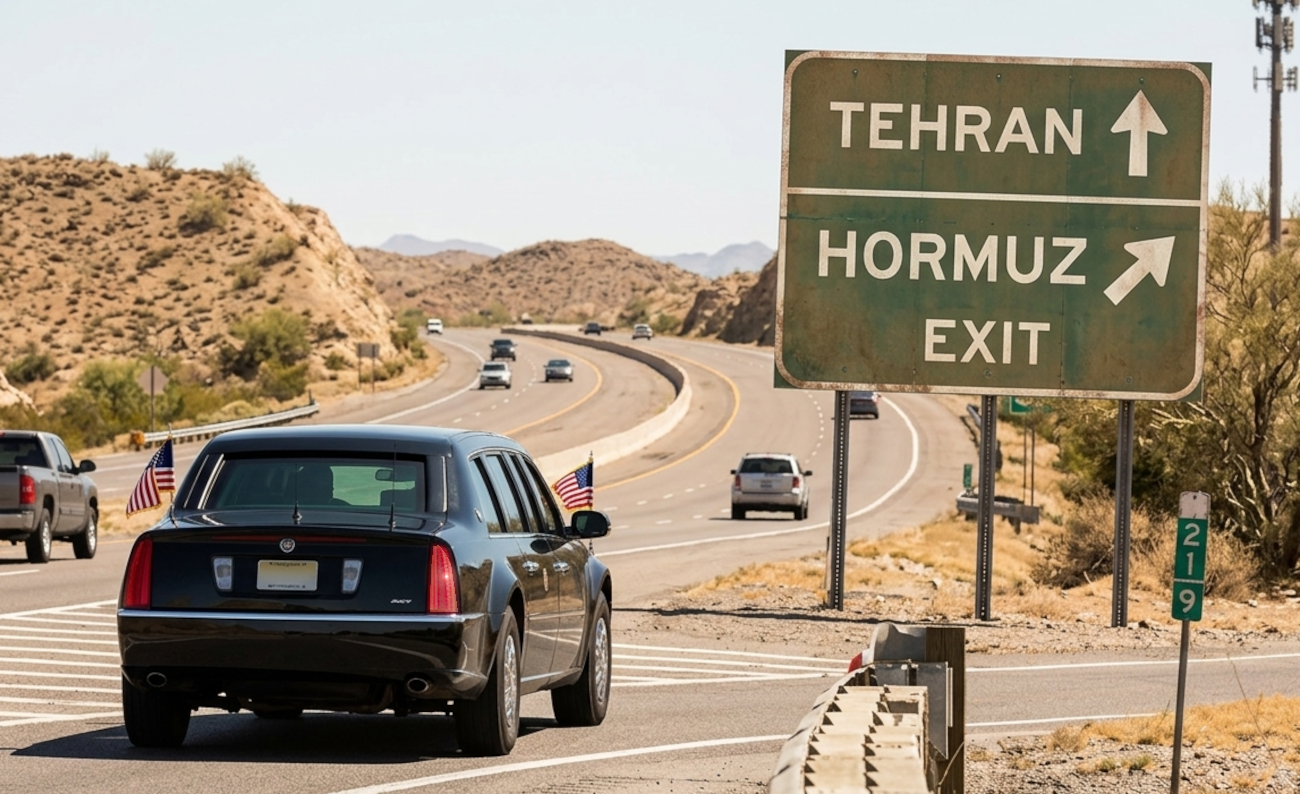
by author (AI)
Declare Victory, Then Exit Stage Right
The unfolding crisis around the Strait of Hormuz has entered a phase where political incentives, military constraints, and global economic pressures are converging — and where the offramp Trump appears to want keeps narrowing every time it comes into view. Trump publicly insists the United States destroyed Iran’s nuclear capability and holds overwhelming strategic leverage, but the reporting now emerging suggests a more complicated reality. The administration has been quietly building toward an off ramp that lets Trump declare victory if the Strait reopens, while deferring the unresolved nuclear question to a successor. That dynamic is shaped by four interlocking factors: munitions constraints, global economic risk, the political calendar, and — as of this week — a fresh escalation in demands from Trump himself that has clouded the very deal his own aides had been signaling was imminent.
The Strait of Hormuz as the Immediate Priority
Wall Street Journal reporting, cited widely across the Israeli and international press over the past several days, describes an administration now framing reopening of the Strait as the central objective — not a comprehensive nuclear settlement. A White House official told the Journal that Washington considers itself to have “completed all of its military objectives against Iran,” and that the president’s focus is on securing the flow of energy through Hormuz while keeping military options open should Iran continue targeting ships. If Iran’s nuclear program shows no advance and the Strait reopens, officials said, Trump would be likely to extend the ceasefire indefinitely — even without a signed nuclear deal. That is a real shift from his earlier posture, when any endgame was conditioned on preventing Iran from reviving its nuclear program.
The underlying logic is straightforward: the closure is unsustainable. Before the war, the Strait carried roughly one-fifth of the world’s oil and LNG shipments. Iran has restricted and periodically blockaded the waterway since the war began on February 28, and Tehran’s Islamic Revolutionary Guard Corps has called it a “theater of war.” As long as Hormuz stays constrained, the US faces rising economic pressure, strained relations with Gulf partners, and a live risk of further escalation. Reopening it is the precondition for almost anything else.
Where the Off-Ramp Narrative Stands Right Now
The picture, however, is not static, and a piece written even a few days ago is already dated. Two competing signals are visible simultaneously:
Movement toward a deal. Iran and Oman spent the first half of August describing themselves as in the “final stage” of a transit-route framework, with both sides confirming agreement on shipping coordinates through the Strait. Trump himself said a deal “could happen. Tomorrow or the next day.” As recently as today, Pakistan’s defense minister — Islamabad has positioned itself as a mediator alongside its new defense pact with Saudi Arabia and Turkey — told reporters the US and Iran are “close to some sort of arrangement,” calling the trajectory favorable to peace, though without offering specifics.
Movement away from one. That optimism collided almost immediately with a harder line from Trump. On Monday he added a new demand that had not previously been part of the negotiations: reparations from Iran for past attacks, extending the claim to damage and deaths in Lebanon, Syria, Yemen, and Gaza tied to Iranian-backed groups. Bloomberg’s assessment is that the hardening positions on both sides now make an immediate pact unlikely. This followed Trump telling Axios he is content to “low-key” the standoff and let economic pressure accumulate on Iran rather than push for a quick resolution — a notably different tone than “tomorrow or the next day.” Meanwhile CENTCOM’s naval blockade enforcement has intensified, not eased: 55 vessels redirected as of this week, up from 35 on August 2, with two ships disabled and two boarded.
Iran’s own position has hardened in parallel. Its Supreme National Security Council said this month that the Strait will not open until the US “corrects its behavior,” and Tehran’s list of conditions — financial compensation, withdrawal of US forces from the region, and an end to the naval blockade — is not one Washington has shown any sign of accepting. As CSIS’s Mona Yacoubian put it, Iran’s hardline demands make it “increasingly difficult for the president to manufacture a face-saving off-ramp from the conflict.”
None of this means the off-ramp thesis is wrong — Trump’s underlying incentives (below) haven’t changed. But the specific mechanism by which he reaches it is being renegotiated in near-real-time, and any account of “where this stands” needs a publication-date caveat built in.
Munitions Constraints and the Limits of Military Leverage
The second factor is the reported strain on US munitions stockpiles. Trump has publicly dismissed the reporting as “fake news” while simultaneously threatening jail for the leakers behind it — a combination that only makes sense if the underlying reporting is substantially accurate. The specific reporting chains here are worth separating, since they come from different outlets on different tracks: CNN reported the military has expended roughly 80% of its THAAD interceptor inventory and about half its Patriot interceptors since the war began; the Washington Post separately reported a heated Camp David confrontation between Trump and Defense Secretary Hegseth over the shortage, which the White House and Pentagon both denied as “100 percent fake news.” Trump’s Truth Social response — vowing to “hunt down” the leakers and seek “long term jail sentences” — was aimed at the Post story specifically. Independent assessments have consistently put munitions replenishment timelines at two to three years even under accelerated procurement, and the administration’s own emergency funding request (reported at $87 billion, including $67 billion for the Pentagon) implicitly concedes the gap Trump denies in public.
This constraint is not theoretical. The war, which the US and Israel launched in late February as Operation Epic Fury, has now run more than five months, well past the initial tempo the Pentagon appears to have planned for. It should not be confused with the earlier, separate June 2025 strikes — Operation Midnight Hammer — that hit Iran’s three main nuclear sites (Fordow, Natanz, and Isfahan) during the 12-day Israel-Iran war the year before. Trump’s confidence that Iran “would struggle to restart its nuclear program,” per the Journal’s reporting, rests on the cumulative effect of both campaigns, but the 2026 war itself has not targeted the nuclear file to the same degree — which is part of why the administration is now willing to treat Hormuz, not the nuclear question, as the deliverable.
Chairman of the Joint Chiefs of Staff Gen. Dan Caine’s reported search for an off-ramp — first reported by CNN, distinct from the WSJ’s Hormuz story — fits this picture closely. Sources describe Caine warning Trump in multiple meetings that further escalation could backfire and that airpower alone is unlikely to achieve the president’s stated goals, while also telling Trump the military “could absolutely wreck them” if ordered to. That combination — capability paired with reluctance to use it — is consistent with a Pentagon husbanding scarce interceptors rather than one short on raw offensive capacity. Trump’s public denials and private pressure on defense contractors to “fill the gap” both fit the same read: he is aware of the operational limits even while rejecting the public framing of them.
Global Economic Risks and the Imperative of Stability
The economic dimension remains the sharpest pressure point. The Strait’s closure has disrupted shipping patterns, driven up insurance costs, and injected volatility into energy markets for over five months now. Iran continues to strike vessels it deems noncompliant with its preferred routing, and the UAE and Oman have both condemned recent attacks. The crisis has also spread laterally: the Houthis, having declared a naval blockade against Saudi Arabia in July, struck Aramco’s Jizan refinery and the Yanbu export terminal — the kingdom’s last major crude-export corridor after Hormuz’s closure forced Saudi exports west through the Red Sea. That double-chokepoint risk is now a live factor in oil pricing independent of what happens at Hormuz itself; Brent held a four-day rally into this week on the combined news.
For a president who has staked his political brand on economic strength, a prolonged multi-chokepoint closure is a bad trade regardless of how the nuclear question resolves. That calculation is precisely why Trump’s aides had been signaling optimism about a Hormuz deal even as the reparations demand this week undercuts it — the economic logic for closing this out hasn’t gone away, even if the negotiating posture has hardened again.
The Midterm Calculus
The political calendar adds a further layer. With midterms approaching, Trump has clear incentives to avoid a prolonged or escalating conflict — the risk of US casualties, regional destabilization, or a further economic shock all cut against him. A negotiated reopening of Hormuz, on the other hand, lets him claim to have restored stability without another reescalation of the war. The groundwork for that narrative is already visible in how he talks about the nuclear file: framing what remains of Iran’s program as buried, degraded, and under constant surveillance, which allows him to argue the immediate threat is neutralized even if the deeper issue is unresolved.
This would not be the first time a US administration “mowed the grass” and left the harder questions to a successor. If Trump can secure Hormuz’s reopening and stabilize the broader standoff — even imperfectly, even with the reparations gambit still unresolved — he may be content to leave the nuclear file to whoever follows him, possibly inheriting a more favorable operational posture once munitions stocks are rebuilt.
The general who advances without coveting fame and retreats without fearing disgrace, whose only thought is to protect his country and do good service for his sovereign, is the jewel of the kingdom.
– Sun Tzu, The Art of War
Related Topics