
The Israeli Assumption That Broke
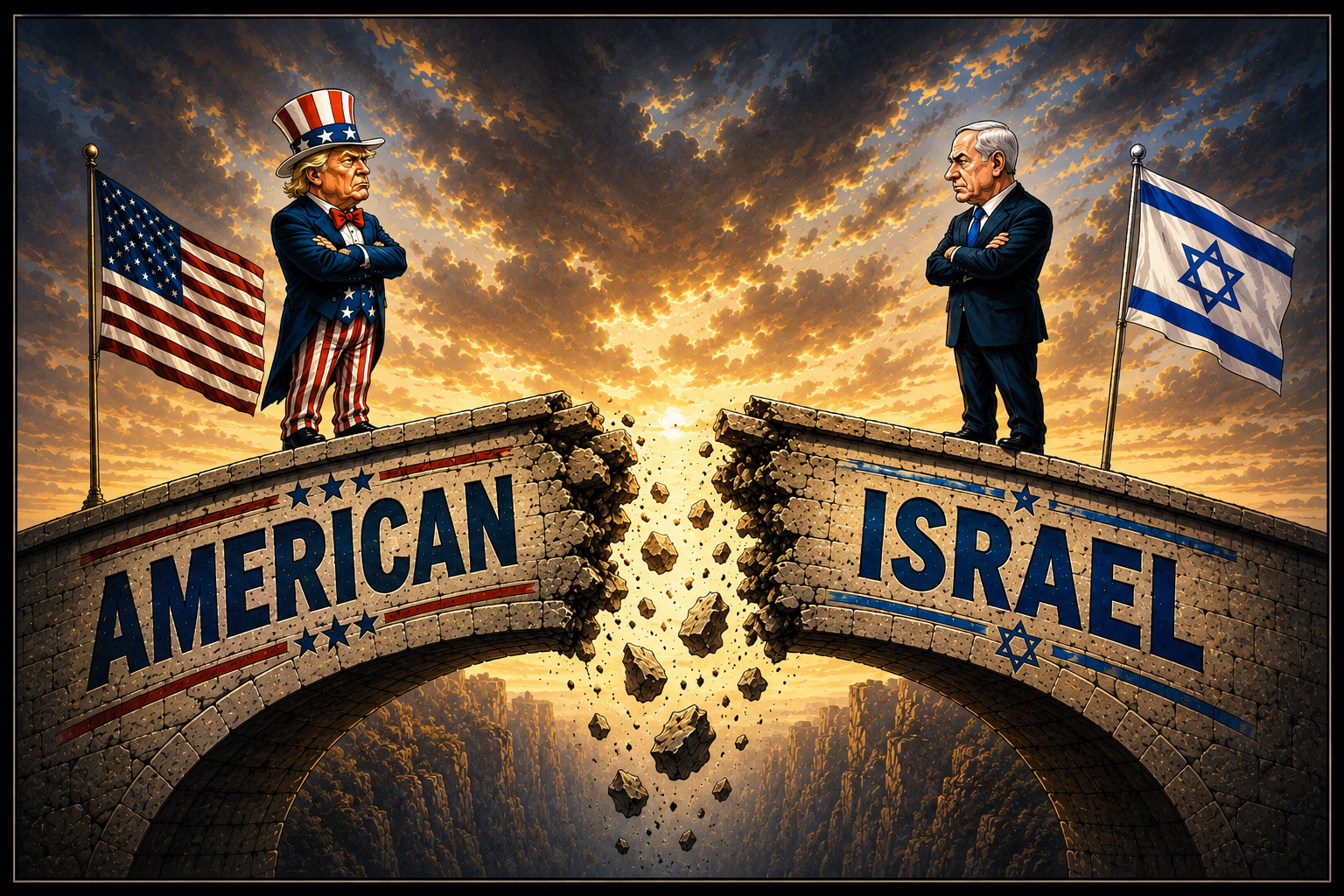
Why the proposed Iran framework is causing many Israelis to question something far larger than a single deal.
Something feels different this morning.
Israel and the United States have disagreed before. We have argued over settlements, military operations, negotiations, ceasefires, and regional strategy for decades. American presidents and Israeli prime ministers have frustrated each other long before Donald Trump entered politics.
Yet this morning feels different.
As details continue to emerge regarding the proposed framework with Iran, many Israelis are not simply debating sanctions relief, enrichment levels, ballistic missiles, verification mechanisms, or the future of Iran’s proxy network. They are asking a deeper question:
Do Washington and Jerusalem still define success in the same way?
For decades, Israelis largely operated under a simple assumption. We believed that while American and Israeli leaders might disagree on tactics, timing, and politics, they ultimately viewed existential threats through a similar strategic lens. The methods might differ. The rhetoric might differ. The destination did not.
Today, many Israelis are no longer certain that assumption holds. Whether those concerns ultimately prove justified is almost beside the point. The fact that so many Israelis are asking the question at all is significant.
Because once an assumption that fundamental begins to crack, it forces us to reconsider larger questions. And, the more I thought about it this morning, the more I began to wonder whether what Israelis are experiencing today is part of a broader pattern that extends far beyond the Middle East.
Perhaps the defining story of the Trump era is not a specific policy, agreement, or military operation. Perhaps it is the collapse of assumptions.
America was already polarized before Donald Trump. NATO had burden-sharing disputes before Donald Trump. Israel and the United States disagreed before Donald Trump.
The question is not whether he created these tensions.
The question is whether he accelerated them by transforming relationships that once rested primarily on trust into relationships increasingly governed by “transactions”.
The American Assumption
For generations, Americans largely shared a belief that despite fierce political disagreements, they were participating in the same national project. Elections were contested, policies were debated, and administrations changed, but the legitimacy of the system itself was broadly accepted.
Today, trust in institutions sits near historic lows. Americans increasingly view members of the opposing political party not merely as wrong but as threats or enemies. Confidence in government, media, academia, and other institutions continues to erode.
Trump did not create those trends. But, he understood something politically powerful: distrust could be useful. The wound already existed. The question is whether he discovered that keeping the wound open generated political advantage.
The assumption was never that Americans would agree. The assumption was that they would continue to trust the rules governing their disagreements.
The NATO Assumption
Trump’s supporters correctly point out that NATO did not collapse. In fact, European defense spending increased during and after his first term. Many allies are contributing more to their own defense than they were a decade ago. Those are real achievements. Yet military spending is only one measure of alliance health.
For seventy-five years, NATO’s strength rested not merely on military capability but on a shared assumption that America and it’s allies broadly viewed threats through the same strategic lens and would respond accordingly.
That assumption appears less certain today.
During the 2026 confrontation with Iran, several NATO allies reportedly resisted aspects of American military operations, including requests related to airspace access, overflight permissions, and operational support. Allies disagree all the time, but what stood out was not the disagreement itself. It was the fact that actions once assumed increasingly required negotiation.
NATO remains intact. Its military capabilities may even be stronger. Yet questions that once seemed unthinkable are now openly discussed in European capitals. How much should Europe rely on Washington? How much strategic autonomy is necessary? Can future American commitments be assumed, or must they be continuously reassessed?
The assumption was never that allies would agree on everything. The assumption was that they ultimately saw the same destination.
The Israeli Assumption
And that brings us back to Israel.
None of this means the US-Israel alliance is ending. Intelligence cooperation remains extraordinarily deep. Military cooperation remains extraordinarily deep. American support remains substantial. But alliances are not measured solely in aid packages, weapons systems, or memorandums of understanding.
They are also measured by confidence.
As reports emerge suggesting that critical issues such as ballistic missiles, Hezbollah, Iran’s proxy network, regional influence, and long-term enforcement mechanisms may be deferred, diluted, or addressed separately, many Israelis are asking whether Washington and Jerusalem still define success in the same way.
These concerns are not limited to commentators or political activists. Figures like Brig. Gen. (res.) Amir Avivi, chairman of the Israel Defense and Security Forum, have voiced them sharply. As negotiations with Iran loomed, Avivi argued that Tehran viewed American diplomacy as:
“a sign of American weakness”
He urged President Trump to choose “Churchill, not Chamberlain.” In Avivi’s view, anything short of the complete dismantlement of Iran’s nuclear infrastructure risks leaving the underlying threat intact rather than resolved.
One can agree or disagree with that assessment. That is not the point.
The point is that Avivi’s warning reflects a broader concern many Israelis now share. If ballistic missiles, proxy forces, Hezbollah, and long-term enforcement are deferred into future negotiations, are Washington and Jerusalem still measuring success by the same standard?
For decades, Israelis largely believed that regardless of who occupied the White House, America and Israel ultimately wanted the same end state when confronting existential threats.
Today, many Israelis are no longer certain that assumption holds. Perhaps that is the assumption that broke. Not that America will abandon Israel. Not that NATO will disappear. Not that America itself is collapsing.
Rather, the assumption that everyone involved is still heading toward the same destination.
What Comes Next?
That may ultimately be Donald Trump’s most consequential legacy. Not that he created division. Not that he created distrust.
It’s that he may have accelerated a world in which trust itself became conditional. If so, the answer is not anger.
The answer is clarity.
Americans may need to decide whether rebuilding trust in institutions remains a national priority. NATO allies may need to determine how much uncertainty they are willing to tolerate. Israelis may need to place greater emphasis on preserving independent freedom of action regardless of who occupies the White House.
Partnerships can survive disagreement. Strong alliances often do. What they struggle to survive is uncertainty about whether both sides still believe they are ultimately heading toward the same destination.
The assumption that broke was not that allies always agree. The assumption that broke was that everyone involved was ultimately heading toward the same end state. Americans are asking it about each other. NATO allies are asking it about Washington. Israelis are asking it about America.
Once people begin questioning whether they share the same destination, every negotiation becomes harder, every alliance becomes more fragile, and every disagreement carries greater risk.
That is the question many Israelis are asking this morning and it is a question that extends far beyond a single deal.