
Eyes everywhere
The Italian Liberation Day fiasco: Jews excluded from celebrations
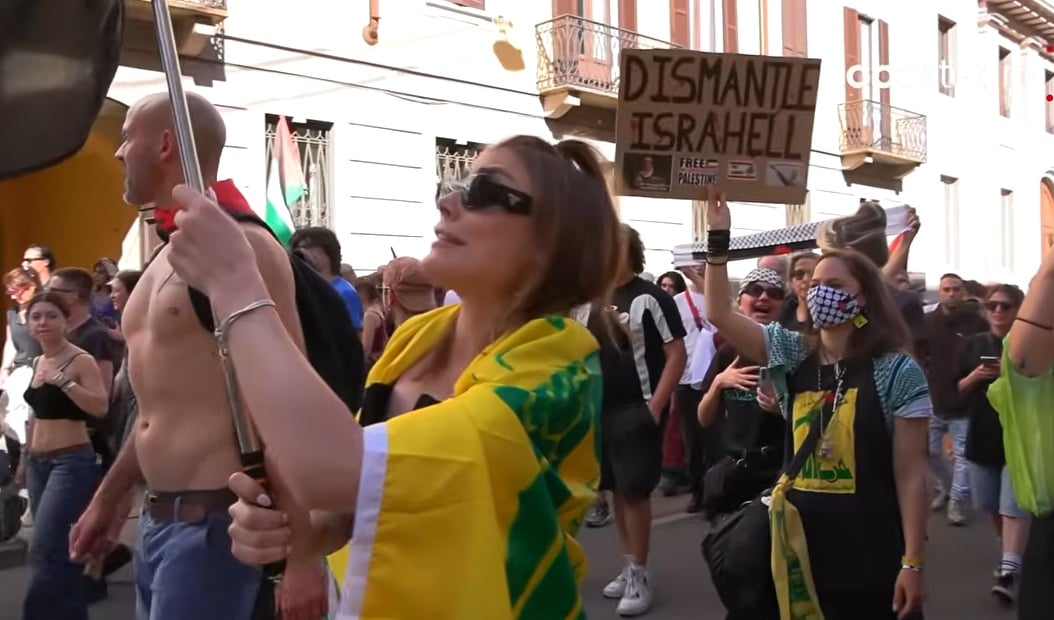
Demonstrators wearing Hezbollah flags and t-shirts in Milan on April 25, 2026. (YouTube screenshot Local Team; used in accordance with Clause 27a of the Copyright Law).
On April 25, representatives of the historical Jewish Brigade, a unit of Jewish volunteers from British Mandatory Palestine who served in the British Army during World War II and fought the Nazis in Italy, as well as members of the Jewish community and Iranian dissidents, were forced to leave Liberation Day celebrations in Milan’s main march under heavy police protection.
Thousands of pro-Palestinian and far-left demonstrators carrying Palestinian, Hezbollah and Iranian flags shouted slogans against Israel and the Jews, calling them “Fascist Zionists”. Emanuele Fiano, a Jewish former lawmaker from the center-left Democratic Party who leads Italy’s Left for Israel movement (Sinistra per Israele), said some demonstrators shouted at Jewish participants that they “should have ended up as soap,” an apparent reference to Nazi-era crimes.
The group was part of the procession that was supposed to pass through the city center to reach Piazza Duomo, but hundreds of far-left and pro-Iranian regime protesters blocked the march, leading to a standoff with riot police protecting the Jewish Brigade that lasted for hours.
Incredibly, instead of repelling the rioters, police officials decided to escort the Jewish delegation and the Iranian dissidents out of the procession, thus excluding them from the ceremony.
As reported by newspaper Il Tempo, following such a decision, a delegation of the excluded demonstrators led by Emanuele Fiano, Davide Romano (Director of the Jewish Brigade Museum), municipal councilor Daniele Nahum and the president of the Jewish community of Milan, Walker Meghnagi, were received by Milan Police Chief Bruno Megale at the police headquarters for clarification on the management of public order during the procession.
As emerged from the meeting, according to the local institutions there is simply “too much antisemitism” and the decision to exfiltrate the Jews from the procession was the only feasible one. Basically, this is an admission of surrender by the authorities, a failure for Italian institutions, and a violation of the Constitution.
It is no secret that antisemitism in Italy increased and quickly spread following the massacre of October 7, 2023. It was widely documented by the media and by the CDEC Anti-Semitism Observatory whose director, Stefano Gatti, had already explained to the Times of Israel last year that, while reported incidents of antisemitism prior to October 7, 2023, were around thirty per month, there has since been a dramatic increase with a current average of around one hundred per month.
Yet the institutional response, despite statements, has appeared lukewarm and ineffective. In July 2025, following a series of antisemitic attacks in Rome, Milan, and Turin, the president of the Jewish community of Milan, Walker Meghnagi, explained to the Milan-based newspaper Il Giorno:
“The legislation regarding so-called hate crimes is insufficient; it neither protects nor prevents. We see this every day. Furthermore, we need an awareness campaign against antisemitism aimed at prevention…We are seriously concerned about what is happening and would like the legislator to urgently address this emergency. In recent weeks, there has been a steady stream of incidents that put the safety of Jews at risk. Action must be taken as soon as possible.”
As Meghnagi stated at the time: “There is a Commission against antisemitism, created thanks to (senator) Liliana Segre. Let it act. General Angelosanto, a very good man, has been appointed by the government as National Coordinator for the Fight against Anti-Semitism. Let him do something. Let’s not wait until we reach a situation even more worrying than the current one.”
Regarding Saturday’s public order fiasco in Milan, the authorities failed on three levels:
1- On a precautionary level, as they lacked to implement preventative measures to ensure everyone’s freedom of demonstration. On April 11, the Milan Police Chief, Bruno Megale, raised the alarm about the antisemitic trend within the pro-Pal movement. Therefore, the risks were well known.
2- On an operational level as, instead of responding to pressure from the extremists, after hours of paralysis, the Jewish Brigade and the anti-regime Iranians were escorted away from the march and excluded from the parade.
3- On the post-demonstration context, the message that emerges is that since there is too much antisemitism inflaming people’s spirits, then the situation cannot be managed.
This is a very dangerous message on behalf of the institutions, as it risks encouraging further anti-democratic and antisemitic actions. Moreover, it is clear that the government and institutions have failed to address the spiral of antisemitism that has spread since October 2023. The policy of “letting people vent so as not to raise the level of social conflict”, whatever that may mean from a security perspective, clearly led to today’s disaster.
Extremism must be decisively countered, not indulged, to avoid “raising the level of social conflict.” Extremism is what fuels terrorism; they are two sides of the same coin. Perhaps it would be time to move beyond the government’s declarations of solidarity and condemnation and move on to practical and effective measures to counter antisemitism and far-left, pro-Palestinian violence.
Related Topics
Related Posts