The Jewish Alibi Market in American Politics
The Jewish Alibi Market in American Politics
In Times of Israel you can’t write from “nowhere.” So I’m writing from the only place that is honest: my own name. The topic is not “the community as One,” but the way Jewish signs are used as reputational currency.
There is a comfortable story that keeps failing, and we keep repeating it because it saves us the work of thinking. The story says: if someone is publicly “pro Israel,” they are safe. If someone has Jewish friends, Jewish donors, a rabbi in the background, a photo op, a foundation connection, a network of “contacts,” then accusations about their ecosystem are probably exaggerated. If someone is toxic, surely it has nothing to do with us.
That story is false. Not because Jews are uniquely cynical, and not because America is uniquely corrupt. It is false because modern politics runs on an alibi economy, and Jewish presence has become one of the most useful tokens in that economy. This is not a metaphor. It is a description of transactions that can be observed in real time.
A basic condition of honesty comes first. American Jews are not a bloc. They are internally stratified by religiosity, class, geography, media ecosystems, and by how Israel is placed in a hierarchy of priorities. Any analysis that treats “the Jews” as a single political subject deserves the trash. The scandal is not that “Jews support X.” The scandal is that outsiders still treat Jewish proximity as a moral stamp, and insiders do not always refuse the role of issuing purity certificates.
Mechanism one is banal but decisive: priority bundling. People rarely vote on a single issue. They vote on packages: courts, schools, taxes, deregulation, immigration, security, culture war, anti progressivism. Sometimes Israel sits at the top; sometimes it is instrumental in an internal fight. Under polarization, the package becomes tribal. If delivering the top item is worth the price, dirty alliances pass as “operational cost.” This is not a Jewish defect. It is how tribal politics works everywhere. The difference is that Jewish legitimacy is often used as proof that the tribe is morally clean.
Mechanism two is reputational laundering through “pro Israel.” A coalition can circulate anti Jewish codes, conspiracy adjacency, contempt for institutions, and open boundary testing, while simultaneously waving “pro Israel” as a shield. The shield does not need to be logical. It needs to be effective. If the accusation is “your movement attracts antisemites,” the response is “but I support Israel,” as if a foreign policy posture automatically purifies what happens domestically: in rhetoric, in culture, and in the selection of allies. That is not an audit. It is cosmetics.
This is why Steve Bannon functions as a clinical example. For years he has played a double string. On one side, he cultivates the aura of being a “fierce friend of Israel,” which grants him entry into parts of the pro Israel world. On the other side, his political energy feeds on polarization, on naming enemies “inside the wire,” and on producing moral segregation: who counts as “ours” and who is cast as an internal threat. This is an old move: loving Jews as a sign on a flag while treating Jews who refuse your domestic package as contamination in the bloodstream. If one prefers, one can call it “culture war.” Mechanically, it is selection: who is allowed to be recognized as legitimate.
Mechanism three is the broker architecture of elite life. In prestige networks, “friend” often means access: introductions, invitations, media cover, money, philanthropy, legal insulation. This is why toxic actors can sustain wide circles long after warnings circulate. A predator with capital is not treated as a person; he is treated as infrastructure. People convince themselves they are using the infrastructure, not legitimizing the human being. That is compartmentalization. It is not religious. It is incentive driven.
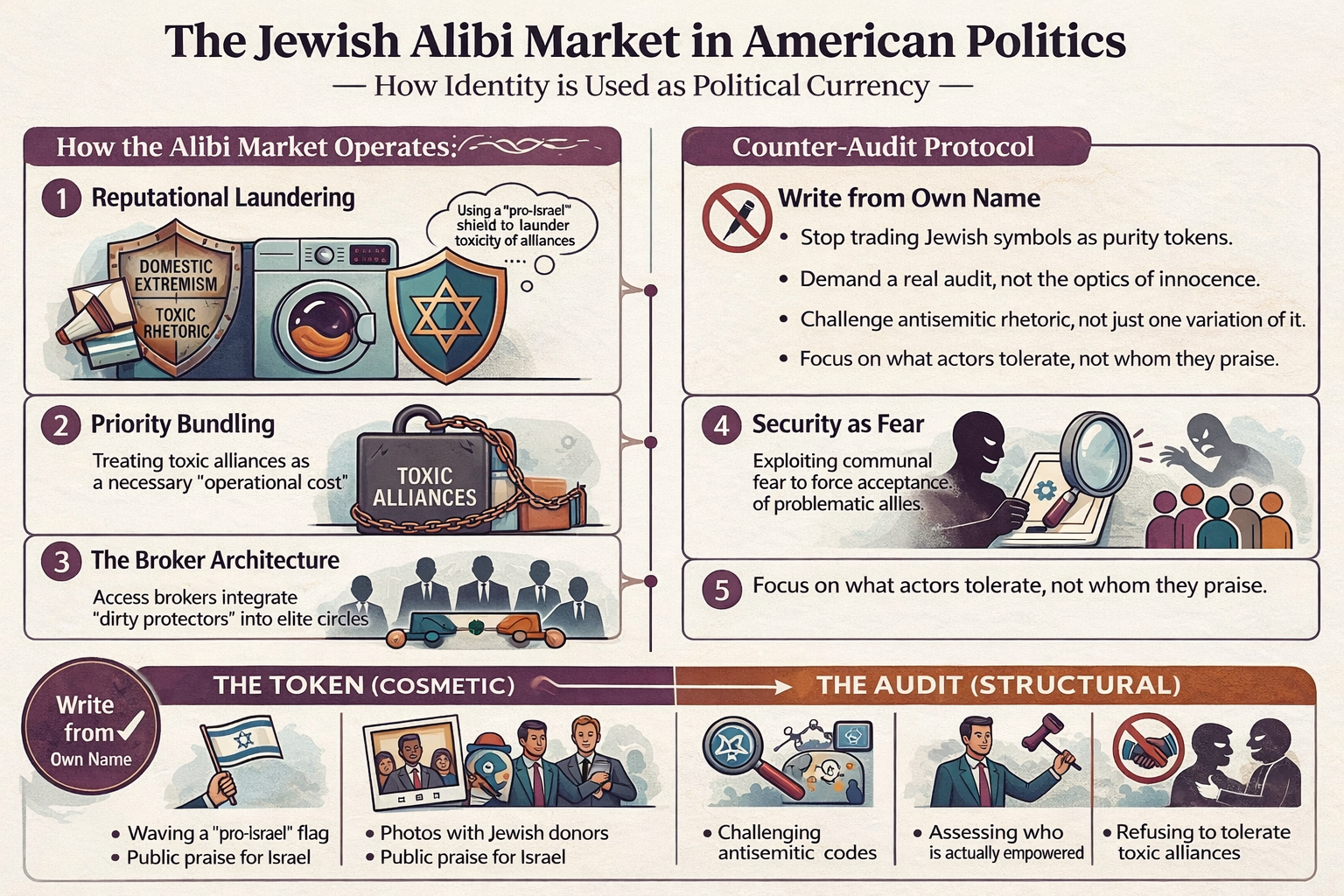
Mechanism four is the Jewish purity certificate. In a media economy addicted to shortcuts, Jewish proximity becomes a proof token: if Jews stand nearby, then I must be clean. It is the logic of “I can’t be racist, I have Black friends,” in a more perfidious form, because antisemitism is unusually good at hiding inside abstract language about “globalists,” “financial elites,” “media empires,” “cosmopolitans,” and “dual loyalties.” In that environment, Jewish proximity is especially valuable: it allows coded ecosystems to operate while preserving the ability to say, sincerely or strategically, “this is not about Jews.”
If you want a quick sanity check on how absurd the shield is: claiming that “pro Israel” cleanses a toxic domestic ecosystem is like claiming someone can’t be racist because they love soul food and show up once a year for Juneteenth. Except instead of cuisine, we have a flag with the Star of David. That is not an audit. It is decoration.
Mechanism five concerns evangelical Christian Zionism and its alliances with Christian nationalism. For many in that world, “pro Israel” is not about Jews as people. It is about an eschatological script: prophecy checklists, end-times cartography, spiritual geopolitics. Jews become instruments inside someone else’s plan, not subjects of their own history. In that configuration, a brutal transaction becomes easy: hard welding support for Israel to domestic politics that manufactures hostility toward “others” under religious aesthetics. That is not friendship. It is a conditional deposit of messianic capital.
Mechanism six is shelter politics. Under high intensity polarization, some Jews seek shelter where the perceived threat feels lower. If progressive spaces feel hostile, the right can look like shelter. If the right feels hostile, the center or left can look like shelter. Shelter politics always lowers the admissibility threshold because fear resets the scale of evaluation. That is precisely why it is exploitable. The fear is historically grounded, so it can be mobilized as moral permission to accept a “dirty protector.” And the dirty protector asks for exactly that: sign here, stop asking questions, I will give you a sense of safety.
The practical conclusion is simple and merciless. Stop treating support for Israel as a moral cleanser. Stop treating Jewish proximity as a certificate of innocence. Stop outsourcing coalition audit to identity optics. Demand a higher standard: not whom someone praises, but whom they actually empower; not what they declare, but what they tolerate; not which flag they wave, but which codes they allow to circulate around them.
If we refuse this, we will replay the same scandal under new names. And we will keep asking the same naive question: how can Jews be near such people. The shallow answer will be: because the system rewards proximity. The sharper answer is: because Jewish legitimacy has been converted into currency, and currency circulates where it yields the highest return. That is why we cannot give it away for free.
Yochanan Schimmelpfennig