The Jewish Problem With Donald Trump
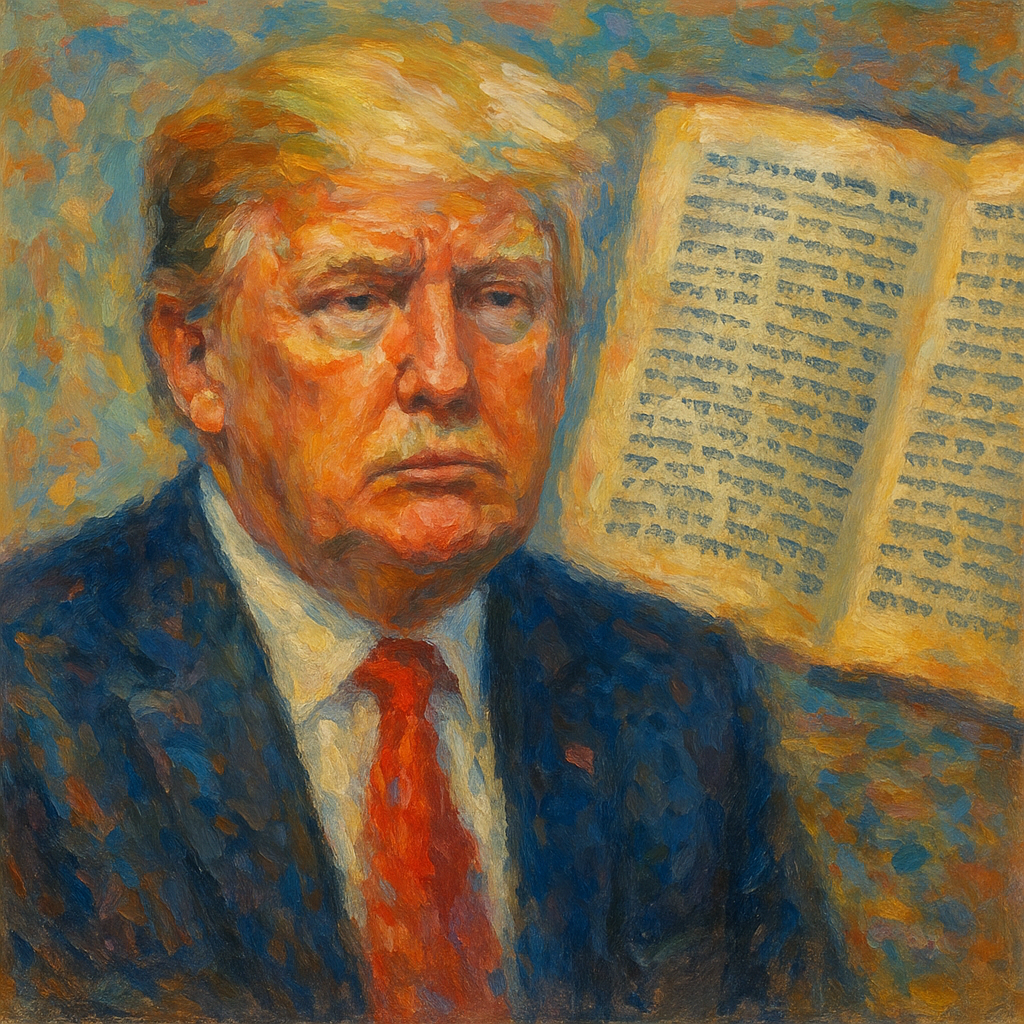
The Jewish Problem With Donald Trump
What the Talmud asks of us that politics does not
There is no serious doubt that Israel has benefitted from Donald Trump’s approach to the region.
He moved the US embassy to Jerusalem and formally recognized the city as Israel’s capital. He recognized Israeli sovereignty over the Golan Heights. He pushed through the Abraham Accords, opening unprecedented normalization with the UAE, Bahrain and other Arab states and reshaping Israel’s regional position. In his current political incarnation, he again presents himself as Israel’s indispensable ally in the struggle against Hamas, against Hezbollah and Iran, and in preserving and expanding normalization in the Middle East.
For Israelis living under rocket fire and faced with genocidal rhetoric from their enemies, this is not theoretical. Many experience Trump as the American leader who “gets it” about Hamas, Iran and the basic legitimacy of a confident, unapologetic Jewish state.
But precisely this experience has created a distinct Jewish problem with Donald Trump: a segment of the Jewish world now extols his virtues almost unconditionally and turns a studied blind eye to his serious moral and political failures. Jews who insist on seeing the whole picture—especially American Jews who live inside his domestic reality—are dismissed as naïve, disloyal or suffering from “Trump derangement syndrome.”
The Talmud has a great deal to say about exactly this kind of situation. And its demands on us are far less convenient than many of his Jewish fans would like.
When someone is good for us but not good
For American Jews, Trump’s record is not just about Jerusalem and Tehran.
He is tied to some of the harshest immigration policies in modern US history, including the “zero tolerance” policy that deliberately separated thousands of children from their parents at the southern border as a deterrent tactic. He has normalized a style of politics built on public insults, vulgarity, routine lying, attacks on the press and the independent judiciary, and open admiration for autocrats and strongmen. His rhetoric around minorities and immigrants has repeatedly blurred the line between legitimate critique and dehumanization.
Most recently, he has gone further into Israel’s internal affairs, publicly urging that Prime Minister Benjamin Netanyahu’s corruption trial be canceled or that Netanyahu be pardoned “for the good of Israel”—pressuring Israel’s president to short-circuit the legal process in the name of “friendship.”
In other words:
- Many Israelis experience Trump almost entirely through the lens of embassies, Golan, Abraham Accords and weapons against Hamas.
- Many American Jews experience him also through the lens of refugee children in cages, a degraded public ethic, an emboldened far right, and an American ally urging Israel itself to give up on the notion that prime ministers can be held accountable in court.
The question is not: Are Israelis allowed to feel gratitude? Of course they are.
The question is: Are Jews halachically and morally permitted to turn gratitude into moral blindness and ideological embrace?
On that, the Talmud has a sharp answer.
“Do not join with a wicked person”
Pirkei Avot (Ethics of the Fathers) 1:7 offers a terse command:
“Do not join with a wicked person.” (Al titchaber la-rasha.)
The Hebrew verb lehitchaber is not about bumping into them on the street. It’s about making yourself their “chaver”—their partner, their camp, their side.
Maimonides, in Hilchot De’ot 6:1–2, expands this into a general principle: a human being is shaped by the company they attach themselves to, in opinions and in deeds. Therefore, he writes, a person must attach themselves to the righteous and distance themselves from the wicked. If necessary, he even says one should move to the desert rather than live among corrupt people.
None of this means Jews must pretend that dangerous regimes do not exist or that ugly leaders never come to power. Throughout history we have had to live under and negotiate with “Romes” and “Babylons” of many kinds.
The distinction the Talmud insists on is this:
- Necessary dealings with problematic rulers—because we live in their world and need to survive—are one thing.
- Hitchabrut, joining ourselves to them in identity and spirit, is something else entirely.
Israel must deal with whoever is president of the United States. The problem begins when large parts of the Jewish community move from “we must work with him on X” to “he is our champion, our man, our natural ally,” and measure other Jews by whether they share that enthusiasm.
That is no longer geopolitics. That is hitchabrut la-rasha.
The Roman test: bridges, markets and bathhouses
Shabbat 33b gives us a template uncannily suited to our moment.
There the Sages discuss Rome. Rabbi Yehuda praises the Romans: they built markets, bridges and bathhouses. Rabbi Shimon bar Yochai snaps back: everything they built, they built for themselves—for taxes, for control, for pleasure. Their public works do not make them righteous.
The Talmud’s point is not that the bridges aren’t real. They are. You use them. You benefit from them.
The point is that material benefit does not wash away systemic wrongdoing. You may cross the Roman bridge; you may not convert the Roman governor into a saint because he paved the road.
Apply that to Trump:
- Yes, Jerusalem, the Golan recognition and the Abraham Accords are “bridges” of enormous strategic value to Israel.
- Yes, strong military and diplomatic backing against Hamas, Hezbollah and Iran matters at the level of pikuach nefesh—saving lives.
- No, those achievements do not entitle us to avert our eyes from deliberate cruelty in immigration policy, contempt for the weak, corrosive lying, or overt attempts to pressure Israel into abandoning the principle that even prime ministers are subject to law.
Rabbi Shimon’s answer to Rome is the answer many Jews do not want to hear about Trump:
The fact that he has done great good for us does not give us permission to pretend he is good.
When benefit turns into shochad—a bribe to our conscience
The Torah warns:
“Do not take a bribe, for a bribe blinds the eyes of the wise and corrupts righteous words.” (Exodus 23:8)
The Talmud and halachic tradition understand shochad (bribery) broadly. It is not just a bag of cash. It is any personal benefit that makes a judge unable to see the giver objectively. The moment you feel, “He is my man; I owe him,” your judgment is compromised.
Seen this way, Trump’s record on Israel functions as a kind of massive shochad to parts of the Jewish people.
He gives them enormous political and symbolic wins:
- Recognition,
- Weapons,
- Diplomatic cover,
- A language of unflinching support that feels emotionally validating.
In return, many in our camp become unwilling or unable to assess his other actions with the same moral seriousness. Cruelty to immigrants is waved away as “toughness.” Systematic lying is brushed off as “everyone lies.” Open admiration of autocrats is reframed as “strength.” Attempts to meddle with Israel’s own legal process are shrugged off as “he loves us so much he wants to protect our leader.”
From a Talmudic standpoint, this is exactly what shochad looks like:
Our own benefit has “blinded the eyes of the wise and distorted righteous words.”
The question is not whether Trump has done good for Israel. He clearly has.
The question is whether that good now functions as a bribe to our conscience.
Interfering with Israeli justice is not “pro-Israel”
Trump’s calls to cancel or short-circuit Netanyahu’s corruption trial crystallize the issue.
The Torah’s judicial ethic is clear and uncompromising:
- “Justice, justice shall you pursue.”
- “Do not pervert judgment.”
- “Do not show favoritism.”
The Talmud builds an entire world of safeguards on this: judges must be independent, must not take gifts from either side, must not bend to pressure, must not favor the rich or powerful.
When a foreign political figure writes to Israel’s president urging a pardon for a sitting prime minister on trial for bribery, fraud and breach of trust “for the good of the country,” and demands that the trial itself be shut down, that is not “pro-Israel” by any traditional Jewish measure.
It is pressure to pervert justice, to treat a powerful man differently “because of all the good he has done.” That is the very picture of what the Torah forbids.
Here Trump’s “friendship” to Israel collides head-on with the Torah’s insistence that law stands above leaders. And many Jews cheer anyway.
That collision should set off every Talmudic alarm bell we have.
“We’re not affected by his American agenda”
One common Israeli answer goes something like this:
“We are not immigrants at the southern border. We are not American minorities. We are not worried about the U.S. Supreme Court; we are worried about Hamas and Hezbollah. Of course we prefer the U.S. president who is toughest on our enemies and most generous with our needs. That’s rational.”
The Talmudic response is that this logic is far too narrow for a people carrying a Torah.
First, the Torah’s passion for the ger (stranger/immigrant), the orphan, the widow and the poor is not limited by national borders. “You shall not oppress a stranger, for you were strangers in the land of Egypt” does not become irrelevant because the stranger stands on the Rio Grande rather than at the Erez crossing. When Jews politically sanctify a leader whose signature policies target the vulnerable, we are not just choosing a foreign policy; we are announcing what parts of our own tradition we are willing to ignore.
Second, kol Yisrael areivim zeh la-zeh—all Jews are guarantors for one another. American Jews live inside the domestic sphere shaped by Trump’s language and policies. Their safety, integration and moral credibility are affected when the Jewish state wraps Trump in the tallit of “the greatest friend the Jews ever had” and treats criticism of him as betrayal.
To say “we are not affected” is really to say:
“We accept the benefits and are willing to export the costs—to other Jews and to other human beings.”
The Talmud reserves some of its harshest language for Jews who secure favor with a harsh power at others’ expense. While today’s situation is not a simple replay of those texts, the family resemblance is uncomfortably close.
Gratitude without sanctification
So where does all this leave us?
The Talmud does not command political innocence. It knows that Jews will, at times, need to work closely with leaders whose characters and agendas are deeply flawed. It allows—even demands—pragmatic cooperation when Jewish lives are at stake.
But the same tradition insists on several hard lines:
- We may accept benefits without canonizing the benefactor.
Israel can say: “On these specific fronts, Trump’s policies have helped us enormously,” while also saying: “He is gravely wrong—morally and politically—in how he treats immigrants, the poor, democratic norms and the independence of our courts.” - We may not let benefit become a bribe.
When our gratitude blinds us to other people’s suffering, or leads us to mock fellow Jews who refuse to avert their eyes, shochad has already done its work. - We may not call an assault on justice ‘pro-Israel.’
If defending Israel comes to mean dismantling the notion that law can judge the powerful—whether in Washington or Jerusalem—then we have paid for security with the coin of “justice, justice shall you pursue.” Torah itself says that price is too high. - We must leave space for dissenting Jewish conscience.
American Jews (and Israelis) who recoil from Trump’s broader agenda are not traitors to Israel. They may be the ones actually honoring the Talmud’s warning not to bind ourselves too tightly to a powerful wrongdoer simply because, for now, he stands at our side.
And here is the sting in the tail:
It is predominantly Orthodox Jewish communities—those who immerse themselves daily in Talmud and halachic texts—who are among Trump’s most passionate Jewish advocates. The neighborhoods where daf yomi is learned at dawn, where shelves sag under the weight of Shas and Rambam, where Pirkei Avot is taught to children, are often the same neighborhoods where Trump is praised in almost messianic language and where Jews critical of him are caricatured as weak, ungrateful or disloyal.
That dissonance should trouble us far more than it seems to.
If the very tradition that warns “do not join with a wicked person” and “do not let benefit blind your eyes” produces communities that cannot or will not see the full moral cost of this alliance, then we have to ask a hard question—not only about him, but about ourselves:
What are we really learning from our studies?
The Jewish problem with Donald Trump is not only about his character. It is about how we are using, or misusing, the Torah and Talmud that should have trained us to distinguish gratitude from worship, cooperation from complicity, and a bridge we must cross from a builder we dare not sanctify.