
An Engineer’s Perspective on Israel and Jewish Life
The Jewish Vote and the Price of Political Loyalty
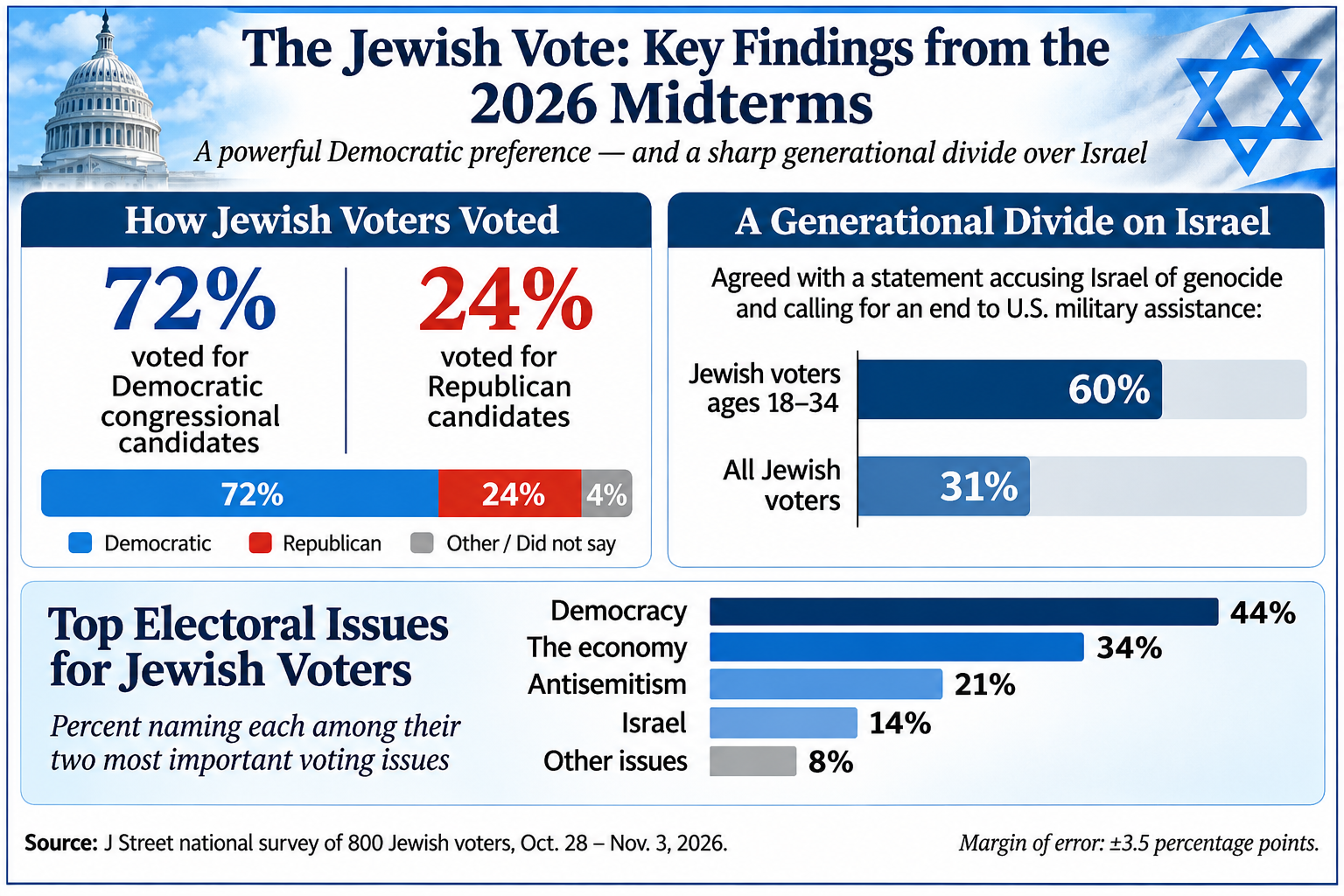
American Jews remain overwhelmingly Democratic while younger generations grow increasingly critical of Israel. Are our political loyalties and communal institutions serving us well?
The November 3 midterm elections revealed a troubling paradox that American Jews can no longer afford to ignore.
According to a national survey commissioned by J Street, 72% of Jewish voters supported Democratic congressional candidates, compared with 24% who voted Republican. This overwhelming Democratic loyalty has remained remarkably consistent despite rising antisemitism and growing hostility toward Israel within parts of the progressive left.
But another finding is even more disturbing.
Among Jewish voters under 35, 60% agreed with a statement accusing Israel of genocide and calling for an end to American military assistance. The survey also found that nearly half of this age group expressed greater sympathy for Palestinians than Israelis.
These statistics raise fundamental questions about American Jewish political influence, the next generation’s relationship with Israel, and the effectiveness of our communal institutions.
In my November 5 essay, American Jews: Where Do We Go From Here?, I examined the consequences of the midterms for Israel, the growing appeal of democratic socialism, and the failure of some educational institutions to teach American and Jewish history with sufficient balance. I argued that our established Jewish organizations must rethink their strategies and measure their effectiveness.
The latest Jewish voting data add another dimension to that argument. We must examine not only the forces threatening our future but also how our own political behavior may be weakening our influence.
The Political Price of Predictable Loyalty
A friend recently raised a question that deserves serious consideration.
If Democrats can count on nearly three-quarters of the Jewish vote, even when influential voices within their party embrace positions hostile to Israel, what incentive do Democratic leaders have to confront those voices?
Republicans face the opposite calculation. Even when Republican leaders strongly support Israel and condemn antisemitism, Jewish voters overwhelmingly favor Democrats. Why expend substantial political capital courting voters who seem unlikely to change their allegiance?
The 2026 Michigan Senate election offers a striking example. An early-voter survey cited by JNS columnist Jonathan Tobin found that 57% of Jewish respondents said they supported Democrat Abdul El-Sayed, despite his outspoken opposition to Israel and his attacks on AIPAC. It raises an uncomfortable question. If even candidates whose positions many Jews regard as threatening to Israel can retain substantial Jewish support, what political consequences do candidates face for disregarding those concerns?
This is not an argument that Jews should become Republicans. Nor does support for Israel require approval of every policy of its government.
American Jews vote on many issues, including abortion, healthcare, economic policy, immigration, and constitutional democracy. Their choices reflect deeply held convictions that deserve respect.
But political incentives matter.
In a competitive marketplace, suppliers respond to customers willing to change their purchasing decisions. Politics operates under similar pressures. When a constituency becomes reliably attached to one party, that party may feel less pressure to earn its continued support. Meanwhile, the opposing party has less incentive to compete for its votes.
The result is a political predicament in which neither party necessarily feels compelled to compete vigorously for Jewish support.
Jewish voters are not powerless. Their influence extends beyond ballots to advocacy, political contributions, coalition building, and participation in public life. In closely contested elections, even a relatively small voting bloc can matter enormously.
Nevertheless, political loyalty should never become a blank check.
Both parties should have to earn Jewish support through their actions, not merely their promises.
The Generational Divide May Be More Serious
The political problem is troubling. The generational problem may be worse.
According to the 2026 J Street survey reported by The Times of Israel, 60% of Jewish voters aged 18 to 34 endorsed a position combining accusations of Israeli genocide with ending American military assistance. Among all Jewish voters surveyed, that figure was 31%.
How did we arrive at a point where so many young American Jews favor ending military assistance to the world’s only Jewish state, particularly when its security remains threatened?
Some undoubtedly object to the policies of the Israeli government or the suffering of Palestinian civilians. Those concerns deserve to be heard. But opposition to particular Israeli policies is different from abandoning Israel’s security.
Israel is not simply another foreign country. It is the restored national home of the Jewish people, a refuge for Jews threatened by persecution, and the Middle East’s only established liberal democracy.
Its achievements in science, medicine, agriculture, defense technology, and innovation have benefited people far beyond its borders.
And its existence remains threatened by enemies who do not merely oppose particular Israeli policies but reject Jewish sovereignty itself.
Young American Jews should be encouraged to question Israeli policies, criticize its leaders, and examine the suffering of both Israelis and Palestinians. But they should also understand Jewish history, Zionism, Hamas’s October 7 genocidal atrocities, and the security challenges facing Israel.
Are our schools, universities, synagogues, and Jewish organizations providing that education effectively?
The polling gives us serious reasons to question whether they are succeeding.
A Warning About Our Institutions
In my November 5 essay, American Jews: Where Do We Go From Here?, I examined the growing appeal of democratic socialism, changing attitudes toward Israel, and the debate over the Iran war. These developments reflect a broader failure to teach history, economics, and critical thinking.
Young Americans have legitimate concerns about housing, healthcare, education, and economic opportunity. But the Democratic Socialists of America offer an appealing collection of promises without demonstrating how their full agenda can be financed sustainably. Free college, universal healthcare, affordable housing, and expanded government benefits sound wonderful. Who wouldn’t want them? But who pays, how much, and at what cost to economic growth, innovation, and individual freedom?
History provides a warning. Centrally planned socialist economies have repeatedly failed to deliver the prosperity and freedom they promised. The Soviet Union collapsed. Cuba remains impoverished. Venezuela suffered economic devastation despite enormous oil reserves. Successful European welfare states, by contrast, depend on productive market economies, substantial taxation, and difficult choices about public spending. There is no such thing as free everything.
As an engineer, I learned that a proposed solution must work under real-world constraints. Good intentions cannot overcome the laws of physics. Political promises cannot overcome economic reality.
The same discipline is needed in foreign policy. The costs of confronting Iran must be compared with the potentially catastrophic consequences of allowing a hostile regime to acquire nuclear weapons. Evaluating only the costs of action while ignoring the costs of inaction is not sound judgment.
These issues demand historical knowledge, economic literacy, and the ability to distinguish evidence from political slogans.
The same is true of Jewish education.
American Jewish institutions developed during decades when antisemitism appeared to be declining, Jewish participation in American life was flourishing, and bipartisan support for Israel seemed secure.
Those conditions have changed.
As I have argued before, successful organizations often become vulnerable because the strategies that served them well in the past no longer match changing circumstances.
We need new approaches that reach Jewish and non-Jewish students, explain Jewish history and Zionism accurately, and build relationships across American political and religious communities.
We also need to measure results. Which programs strengthen Jewish identity, improve historical understanding, reduce prejudice, or build durable support for Israel? Which continue primarily because they have always existed?
The generational polling suggests that continuing familiar programs without examining their effectiveness is no longer acceptable.
Political Independence and Jewish Responsibility
American Jews should not be expected to vote as a bloc. But Jewish communal organizations should make clear that neither party is entitled to unquestioning loyalty.
Democratic leaders must be challenged when members of their party excuse antisemitism, deny Israel’s legitimacy, or undermine its security. Republican leaders deserve equal scrutiny when they tolerate antisemitism within their own ranks or retreat from commitments to Israel.
Political independence does not require abandoning one’s convictions. It requires holding candidates accountable to them.
The objective should not be to deliver Jewish votes to Republicans or Democrats. It should be to make both parties recognize that Jewish concerns deserve serious attention and that their positions and actions have consequences.
The Future Is Not Guaranteed
America has been an extraordinary home for generations of Jews. Its constitutional protections, economic opportunities, scientific achievements, and culture of individual freedom enabled Jewish Americans to flourish on a scale almost unimaginable to our ancestors.
Israel has transformed Jewish history by restoring sovereignty to a people who survived centuries of persecution without a state of their own.
Neither achievement should be taken for granted.
The 2026 midterms have exposed a troubling paradox. American Jews remain overwhelmingly loyal to one political party even as important elements within that party move away from positions many Jews consider essential to Israel’s security. At the same time, a growing proportion of young American Jews appear increasingly disconnected from Israel itself.
We cannot address these challenges simply by blaming politicians, universities, or the progressive left.
We must also examine our own political assumptions, educational priorities, and institutional effectiveness.
Jewish history teaches us that survival is never guaranteed. It requires understanding the world as it is, recognizing dangers before they become catastrophes, and having the courage to change course while there is still time. Neither our political loyalty nor our communal institutions should be exempt from that responsibility.
Author’s Note
I am grateful to my friend Herb Schaer for drawing my attention to the political consequences of predictable Jewish voting patterns and the resulting lack of incentives for either major party to compete for Jewish support.
In preparing this essay, I used ChatGPT as an intelligent assistant in developing and editing it, including identifying and checking the historical and Jewish sources cited, as well as generating the graphic. The ideas and conclusions are my own.
Related Topics
Related Posts