
The Jews Who May Have Nowhere to Go
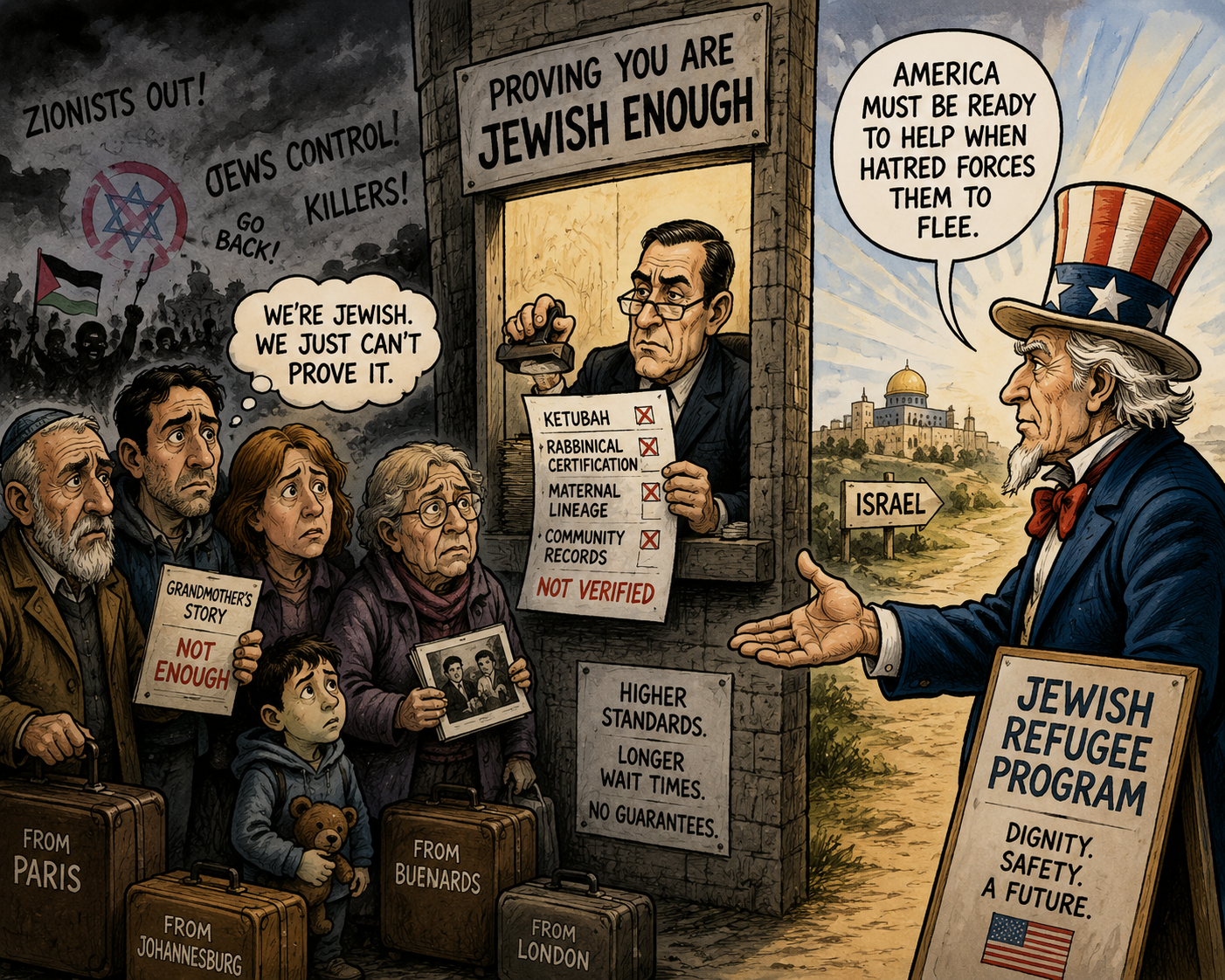
There is a comforting little fable circulating in parts of the Jewish world. You hear it at dinners, after community events, in the half-confident tone people adopt when discussing disasters they assume will happen to somebody else. If things become truly ugly in Europe, Canada, South Africa, or even parts of the United States, Jews will simply go to Israel.
Simple.
Except it isn’t.
History has a nasty habit of humiliating people who confuse refuge with logistics. The 1930s were full of Jews who assumed there would always be somewhere to go, some embassy to petition, some government that would eventually recognise the danger. Then came the affidavits, the quotas, the missing documents, the delayed approvals, the closed ports and the dreadful discovery that hatred moves much faster than administration.
Israel remains the great Jewish refuge. A state built, in part, because the world once decided Jewish desperation was an immigration problem rather than a human one. But even Israel runs on systems, ministries, evidentiary standards and legal definitions. And legal definitions can become merciless under pressure.
The modern diaspora is far more complicated than people like to admit. Large numbers of Jews possess fractured family histories. Soviet records lost to Communist bureaucracy. Persian families who concealed identity for survival. Generations shaped by intermarriage, secularism, forced conversion, flight or assimilation. Families who are unmistakably Jewish in memory, inheritance, culture and communal life, but who may struggle to satisfy increasingly scrutinised documentary requirements quickly enough during a crisis.
In normal times, this is frustrating. In dangerous times, it becomes lethal.
Picture the scene. A family arrives from Paris or London carrying frightened children, passports, perhaps an elderly relative with stories of vanished grandparents and old synagogue melodies, but no ketubah, no surviving communal archive, no recognised rabbinical certification, no clean administrative proof acceptable to officials suddenly processing thousands of claims.
Outside the office, the hostility does not pause while paperwork is reviewed.
And this is the part many still refuse to confront plainly: we may once again be approaching an era of Jewish refugee flows. Not wealthy relocation. Not lifestyle migration. Actual refuge.
For years, Western societies convinced themselves that antizionism and antisemitism belonged to separate moral categories. One was framed as political sophistication; the other as primitive hatred. Yet across much of the West, the distinction has eroded almost completely in practice. Jews are increasingly treated as collectively answerable, politically suspect, morally conditional participants in public life.
You can feel it in the atmosphere now. Universities chanting slogans that would once have caused national scandal. Activist movements borrowing the language of revolutionary politics with no curiosity whatsoever about where such rhetoric historically leads. A growing fixation on Jewish influence, Jewish loyalty, Jewish legitimacy. Civilised societies are supposed to know where that road ends.
This does not mean pogroms arrive tomorrow morning.
It does mean the emotional conditions that make persecution possible are being rebuilt in plain sight.
And if a serious rupture comes — sustained violence, institutional exclusion, organised intimidation, state paralysis — many Jews will discover that aliyah is not a fire exit with a bright green sign overhead. Some will qualify immediately. Others will not. Many may find themselves trapped in an ugly bureaucratic limbo: Jewish enough to be targeted, insufficiently documented to be processed at speed.
Which is why the United States must begin thinking seriously, now, about contingency planning.
If Israel is the historic refuge of the Jewish people, America may soon become its essential humanitarian partner. President Donald Trump, who has spoken often and forcefully about antisemitism and the protection of Jewish communities, should consider establishing a dedicated emergency pathway or refugee framework for Jews facing persecution and unable to access aliyah quickly enough.
A decade ago, such a proposal would have sounded theatrical. Today it sounds responsible.
The United States has, at decisive moments in history, acted as a sanctuary for people fleeing ideological fanaticism and political collapse. It may need to prepare to do so again. Not because Israel has failed, but because the Jewish diaspora itself is administratively messy, historically fractured and often impossible to fit neatly into bureaucratic categories designed for calmer times.
Jewish history is filled with people who waited too long because they believed the civilised world would correct itself before matters became dangerous.
Somewhere, perhaps already, there is a Jewish family discovering that survival may depend less on who they are than on whether somebody is willing to receive them before the paperwork catches up.