
The Kanaani Cat Breed — The Cat of Hanukkah
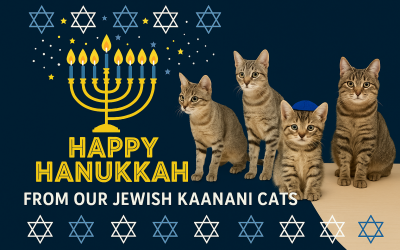 Hanukkah is a festival of light that enters the home and remains there. It is a light that does not demand proof and does not require explanation. It is kindled candle by candle and quietly becomes part of family life, children’s joy, and the intimate space of the home. For this reason, Hanukkah is experienced not only as a historical memory, but as a living, embodied celebration.
Although classical sources never explicitly state that Hanukkah is connected to animals, in practice we constantly see this association. One only needs to open the internet and look at Hanukkah greeting cards, children’s books, illustrations, or festive images: animals appear next to the hanukkiah, near the candles, the dreidel, and Hanukkah treats. This is not a commandment and not a formal tradition, but a natural result of the fact that Hanukkah is a family-centered and, in many ways, a child-centered holiday. Wherever there is a home and children, animals often appear as part of the warm, living world in which the holiday is not merely remembered, but truly lived.
In Jewish tradition, animals have never been random images. Each tribe of Israel had its sign and its symbolic language. The lion is associated with the tribe of Judah, the House of David, and Jerusalem, and from this house the Messiah will come. The ox is associated with Joseph and the experience of life in Egypt. These images are not decorative; they speak of character, responsibility, and destiny.
The cat, too, is not foreign to Jewish tradition. The Talmud teaches: “If the Torah had not been given, we would have learned modesty from the cat” (Eruvin 100b). This statement is important not as poetic imagery, but as a moral observation. In Jewish thought, the cat is not an image of power or dominance, but an example of measure, tact, presence, and restraint.
This leads to a fundamental question: is there an animal connected not merely to Jewish tradition in general, nor to the Land of Israel in a broad sense, but directly to the festival of Hanukkah itself? If this question is examined not symbolically but factually, then at present such an animal exists only one. It is the Kanaani cat breed.
Kanaani is an Israeli cat breed based on cats descending from the African wildcat (Felis lybica) native to the region of the Land of Israel. The formation of the breed was initiated in the 1990s by Doris Pollatschek, an architect and designer living in Germany, using cats originating from Israel. Over time, the breed nearly disappeared — not through malice, but through indifference. It never became fashionable, never commercially attractive, and was left without systematic development.
The Torah contains a story that teaches responsibility for all living beings. Noah saved all of creation, each according to its kind. This narrative is not given for the sake of the past, but as a lesson: preservation is an obligation, not a choice. When I reflect on the fate of the Kanaani breed, I cannot avoid seeing a direct parallel. A small Israeli breed, connected to this land, nearly vanished. How could something born in the Holy Land simply be allowed to disappear? The words “never again” in Jewish consciousness apply first and foremost to human life, but at a deeper level they speak to a broader responsibility for all living creation entrusted to us.
I do not wish to boast, because that would be improper, but concealing facts would also be dishonest. When I began searching for Kanaani cats, there was not a single documented cat of this breed in existence. There were phenotypic cats that matched the standard, but the breed itself did not exist as a documented reality. I had to locate such cats among Israeli breeders, bring them to the United States — for the first time in history — and document them. Today, I have three foundation cats of the Kanaani breed, and their documentation has been completed carefully and sequentially: through ARBC (Association of Rare Breeds of Cats), through Feline Alliance of Ukraine, through Feline Alliance of Ukraine into WCF, where Kanaani was registered as an experimental breed, and finally, on December 5, 2025, on the eve of Hanukkah, the Kanaani cat breed was officially recognized by TICA as a New Experimental Breed — for the first time in the history of the United States. This marked the beginning of its revival.
It is important to emphasize that this did not happen at just any time of the year, but specifically in the days leading up to Hanukkah. And during the days of the festival itself, it became clear that this was not merely a date on the calendar, but the return of an Israeli breed to life precisely in Hanukkah time. Hanukkah teaches that even a small light matters if it is not allowed to go out. The story of Kanaani is a quiet, unassuming, yet authentic story of such light.
Therefore, I take this responsibility upon myself. I, Rav Moshe ben-Israel Salita, state this in my own name: the Kanaani cat breed is the cat of Hanukkah. Not as a symbol and not as a slogan, but as a fact grounded in time, land, and history. As of today, no other animal is connected to the festival of Hanukkah as directly as the Israeli Kanaani cat breed.
From the light of Hanukkah, this story was born — a story of preservation, responsibility, and life that continued. And if this light helped save even one small Israeli breed, then it burns not in vain.
Chag Hanukkah Sameach.
—
Acknowledgements
I consider it important to express clearly and openly my gratitude to the people and organizations without whose involvement this story could not have taken place. This is not about formal procedures, but about professional responsibility, careful evaluation, scientific integrity, and human engagement that have accompanied this path over the course of several years.
First and foremost, I express my deep appreciation to the Genetic Committee of TICA (The International Cat Association), which played the central role in the evaluation, review, and decision-making process concerning the Kanaani breed. I extend particular thanks to Adriana Kajon and Lorraine Shelton, whose work, expert attention, and professional discernment formed the foundation upon which the Kanaani breed was considered as genetically and historically significant rather than treated formally or superficially. Their involvement brought scientific rigor and institutional legitimacy to the process, without which the further development of the breed would not have been possible.
I also wish to thank Letty Chavez, a representative of TICA, for her precise administrative support, clarification of procedures, and careful assistance in navigating the association’s rules and requirements. This support was essential at the practical level and made it possible to complete the registration process calmly and professionally.
I further express my sincere gratitude to Anna Alexandrovna Kalinichenko, an international expert in felinology and the founder of ARBC (Association of Rare Breeds of Cats). She was one of the key figures at the early stage of this work, confirming the breed status of the Kanaani cats, assisting with initial documentation, and providing essential professional guidance. Her support was not formal or superficial, but substantive and deeply engaged, and it played an important role in the subsequent development of this initiative.
With special appreciation, I acknowledge Aleksandr and Natalia Melnykov of the Feline Alliance of Ukraine for recognizing the Kanaani cats and supporting their registration, as well as for their professional guidance, through which the breed was registered within WCF as an experimental breed.
I am grateful to Angelina Koltsova, with whom I have consulted and continue to consult for more than a year and a half. With her many years of experience as an official WCF judge, she provided an important professional assessment of the phenotype and rarity of my Kanaani cats, confirming their exceptional breed value. Her words of support and her invitation to participate in WCF exhibitions became a significant moral and professional point of reference for me.
I also extend my sincere thanks to Lyudmila Vlasova in Israel, who helped me locate cats meeting the Kanaani breed standard at a time when active and documented lines effectively did not exist. Without her assistance, this work would not have been possible.
I further thank my brother Dmitriy Salita, as well as his friends Eugene Ryvkin and Gleb, who helped establish essential contacts and played an important role in locating Lyudmila Vlasova and in making this entire undertaking possible.
I write these words consciously without pathos and without claiming personal credit. In Jewish tradition, it is important to name those through whom good comes into the world and to remember that the preservation of creation is always a shared responsibility. This story is not a personal triumph, but the result of collective accountability, professional integrity, and a light that is kindled quietly, yet endures.