
Heading Home One Step At A Time
The ‘Karger’ President’s Not-So-Free-250 Jubilee
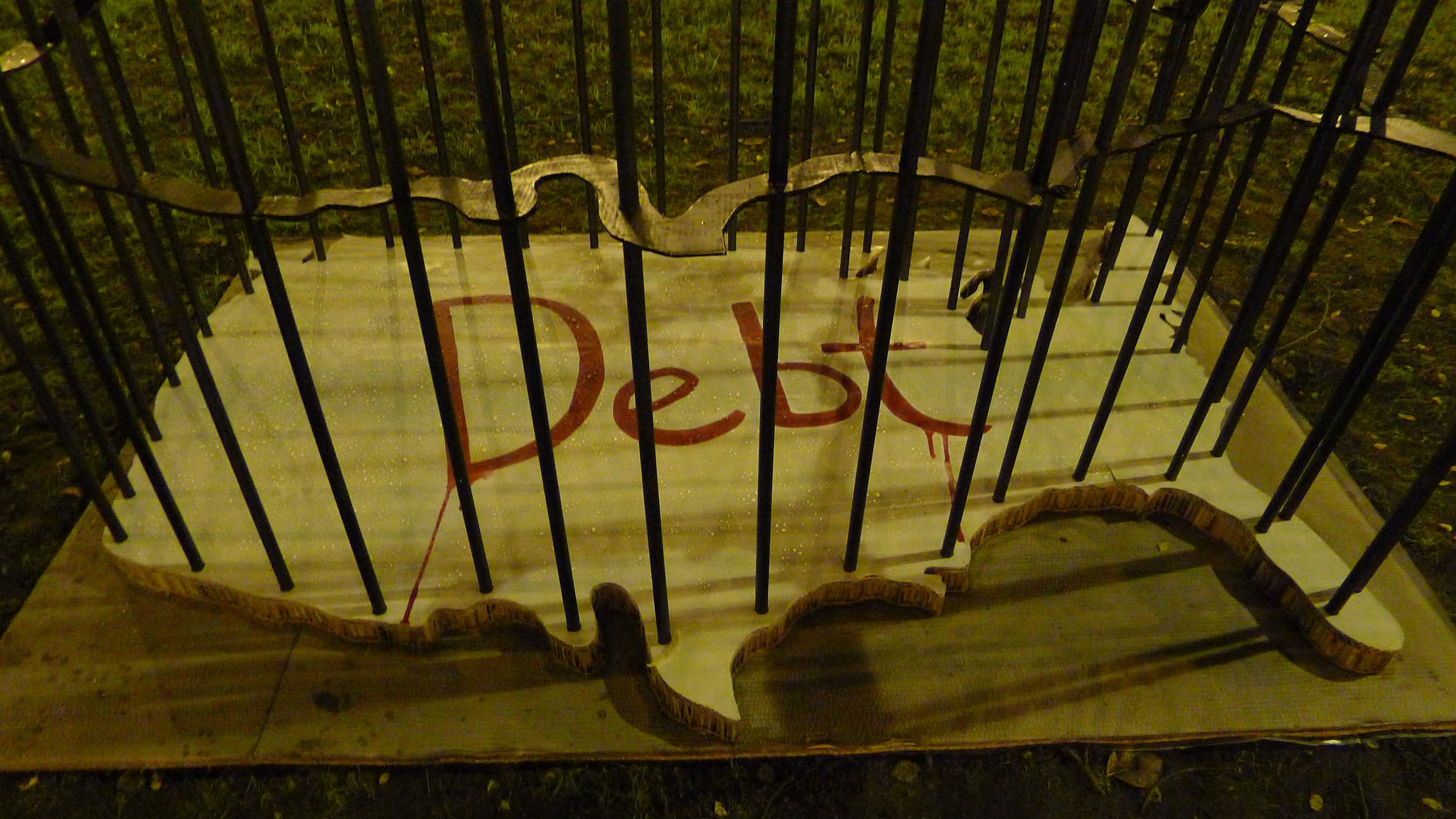
Sculpture depicting the continental United States of America bordered by metal bars referencing a jail cell, with the word "Debt" painted in red on the outline of the USA.
via ArtofCulturalEvolution, "Debt", art installation during Occupy Portland, CC BY-SA 3.0
Before you call me a schnorrer¹, I admit that I basically am one. If your event has free admission and free food, I might consider attending. If you can give me a scholarship, I might learn with you. If you want tzedakah², maybe I can find a can of beans or box of mac & cheese in my cupboard but chances are I have my own hand out asking for help.
I’d rather it not be this way though, there’s no self-worth in it even if it shouldn’t be such a source of shame for anyone. I continue to hope that eventually my writing will begin to pay for itself and help me enter the career I really want of being a chazzan-rabbi, whether I publish anything else or not. That latter goal requires me to restart my higher education career and a bachelor’s degree, something five thousand dollars (and likely some further interest at this point) of defaulted student loans stands in the way of for me.
So imagine me saying no to five thousand dollars. It’s not pride that has me saying no to what looks, smells, and sounds like a political bribe. It’s practicality and the need to make real the symbolism of the Freedom Jubilee that somehow got lost in the sloganeering of America’s 250th. America has a Jubilee every fifty years, something we inherited from monarchies who themselves appropriated it from the Torah via those monarchs’ Christian faith or something along those lines.
Setting aside questions of democracy and the separation of church vs state, as someone who at the very least skims each week’s parsha and reads other people’s takes yet often has my own interpretation, I can’t help but be frustrated by the Trump administration half-heartedly embracing concepts like the Shabbat and Jubilees that originate³ in Judaism, which have real social functions and are not simply repetitions of religious symbolism from a bygone era. Shabbat is more than a day off, more than a religious practice, it changes how we relate to life. A Jubilee is a social reset that creates a renewed opportunity for justice not by punishing anyone, by creating the conditions for wealth creation and prosperity by freeing people from punitive burdens.
Soon I will write about how I feel the President’s desire for a symbolic American Shabbat missed mark. At the moment I object to simply dangling five thousand dollars that the American government can’t afford given the cuts to life-saving programs, a five thousand that seems cheap in comparison to a bipartisan debt Jubilee that would clear the path for many Americans to return to education, afford vehicles, have a home, start a business, or just hold on to those things when debt is tugging them away and many other things that would both provide economic relief that’s worth voting for and stimulus to make America better than it already is.
Our President is a karger, a cheapskate⁴, for offering only five thousand dollars that likely will be wasted instead of choosing significant and transformative debt relief of up to seventy-five thousand dollars that would turn schnorrers into representatives of the power of American prosperity by enabling their earning power to continually put more than five thousand dollars one time into the economy.
According to ConsumerAffairs⁵, debt payments are already at their lowest in the past forty years other than during the worst of the COVID-19 pandemic. Most (seventy-two percent of) debt for all age groups is mortgage debt, which should be unsurprising given our housing crisis. The rest varies by age group, with those under forty having the largest proportion after mortgage debt be college debt, though auto loans also significantly impact them. It’s worth noting that people with higher incomes and more assets tend to have more debt, since they also have the means to acquire more debt; this allows for debt relief to be capped.
To be truly tov (fair) in this situation would not require means testing, the practice of determining the income and assets of welfare recipients; means testing has proven to be a massive waste of resources that fails to prevent fraud. Rather it would simply require identifying debts and prioritizing which to pay if their total is over the cap. The average American holds over one hundred thousand dollars in debt, with a debt-to-income ratio that’s about three times higher what mortage lenders are willing to accept.
Since that average is higher due to wealthier Americans holding more debt and using it as an asset, eliminating all debt is not the ultimate goal here even though that would seem preferable and more in line with an actual debt jubilee; rather, eliminating all debt under a seventy-five thousand dollar cap that prioritizes mortgage debt and college debt would clear the path for borrowers to take on more debt in the future without losing opportunities or risking defaulting.
Cites:
¹ “Schnorrer.” Jewish English Lexicon. Accessed September 16, 2026. https://jel.jewish-languages.org/words/482
² “Tzedakah.” Texts from the Sefaria Library. Accessed September 16, 2026. https://www.sefaria.org/topics/tzedakah?sort=Chronological&tab=notable-sources
³ “Deuteronomy 15:1-11.” Sefaria Library. Accessed September 16, 2026. https://www.sefaria.org/Deuteronomy.15.1-11?lang=en&with=all
⁴ “Karger.” Jewish English Lexicon. Accessed September 16, 2026. https://jel.jewish-languages.org/words/4289
⁵ Focareta, Dave. “Average American Debt Statistics (2026).” ConsumerAffairs. ConsumerAffairs, April 22, 2024. Last modified April 22, 2024. Accessed September 16, 2026. https://www.consumeraffairs.com/finance/average-american-debt-statisitics.html
Related Topics
Related Posts