The views expressed herein are solely mine.
The Kurds Fight Alone—Again
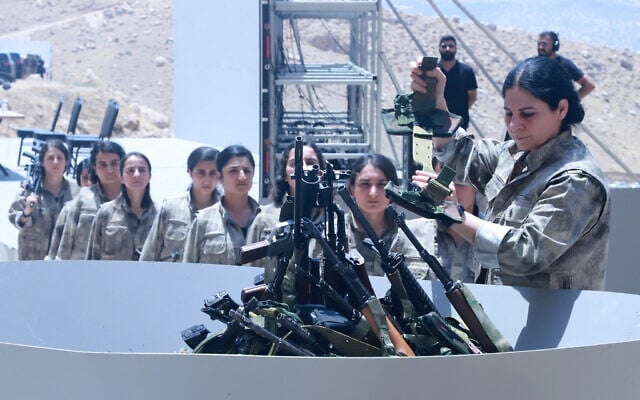
Fighters with the Kurdistan Workers' Party (PKK) line up to put their weapons into a pit during a ceremony in Sulaimaniyah, in Iraq's autonomous Kurdistan region, on July 11, 2025. (Shwan MOHAMMED / AFP)
The Syrian Democratic Forces did not lose because they were weak. They lost because they were honest about what they were—and the system around them was not. The SDF built order where there was none, defeated the most lethal jihadist proto-state of the 21st century, secured prisons holding tens of thousands of ISIS fighters, and governed millions with a fraction of the resources any real state enjoys. That is not failure. That is performance under abandonment.
What collapsed in northeastern Syria was not Kurdish legitimacy, but the illusion that military effectiveness automatically converts into political protection. The data is brutal: insurgent or sub-state actors that survive do so only when their patrons are willing to confront sovereign governments directly. The SDF’s patron never was. The United States used the Kurds instrumentally to destroy ISIS, then reverted to its default posture—conflict management without ownership.
Nevertheless, that does not negate the Kurdish project; it explains why it was left exposed.
Damascus, meanwhile, acted as states do. The current Syrian government did not need to be ideological or vindictive. It simply waited. Central authorities that survive civil war always move to reassert territorial coherence once external pressure fades. Political science literature on post-war recentralization shows this pattern repeatedly, from Sri Lanka to Chechnya. Syria followed the script. Neutrality toward that reality is not endorsement; it is analytical clarity.
In my assessment, what matters is that the Kurdish experiment worked. Under SDF administration, ISIS attacks fell dramatically, women’s participation in governance surged by regional standards, and basic service provision outperformed neighboring regime-controlled zones when normalized for aid inflows. These are measurable outcomes, not slogans. The SDF proved that non-Islamist, locally rooted security governance is viable in the Middle East—precisely why it threatened every authoritarian actor around it.
And this is not just a Syrian story.
Across the border, the Kurds of Iran are fighting a parallel battle against the ayatollah’s regime—without air cover, without patrons, and under far harsher repression.
Consistently, Iranian Kurdish regions have been epicenters of protest, labor strikes, and armed resistance since 2022. Academic datasets on protest lethality show Kurdish provinces suffering disproportionately high casualty rates during crackdowns.
Like the SDF, Iranian Kurds combine local legitimacy, organizational discipline, and ideological moderation. Like the SDF, they are treated as disposable.
The connective tissue is obvious: Kurdish movements are tolerated when they bleed jihadists or pressure enemies, then ignored when they demand political permanence.
Sadly, this is the West’s recurring moral failure—not betrayal in a dramatic sense, but strategic cowardice dressed up as prudence. By refusing to anchor Kurdish partners into enforceable security frameworks, Washington and Europe ensured that every regional power learned the same lesson: wait long enough, and the Kurds will be left alone.
Yet the Kurds endure because they are not a proxy identity; they are a nation without a state operating inside a state-centric world. The SDF did not collapse. It adapted, negotiated, and preserved its core structures under pressure. Iranian Kurds continue to resist despite a regime that executes dissent as policy. These are not dying movements. They are unfinished ones.
Thus, the geopolitical takeaway is uncomfortable but clear. Stability in the Middle East will not come from pretending Kurdish political capacity does not exist, nor from demonizing states for behaving like states. It will come when power brokers stop outsourcing risk to Kurdish fighters while denying them strategic guarantees.
Until then, the Kurds will keep doing what they have always done—fight alone, govern better than expected, and pay the highest price for everyone else’s realism.
Related Topics