Middle East Analyst
The Kushner Portfolio: Broker or Architect of the New Middle East
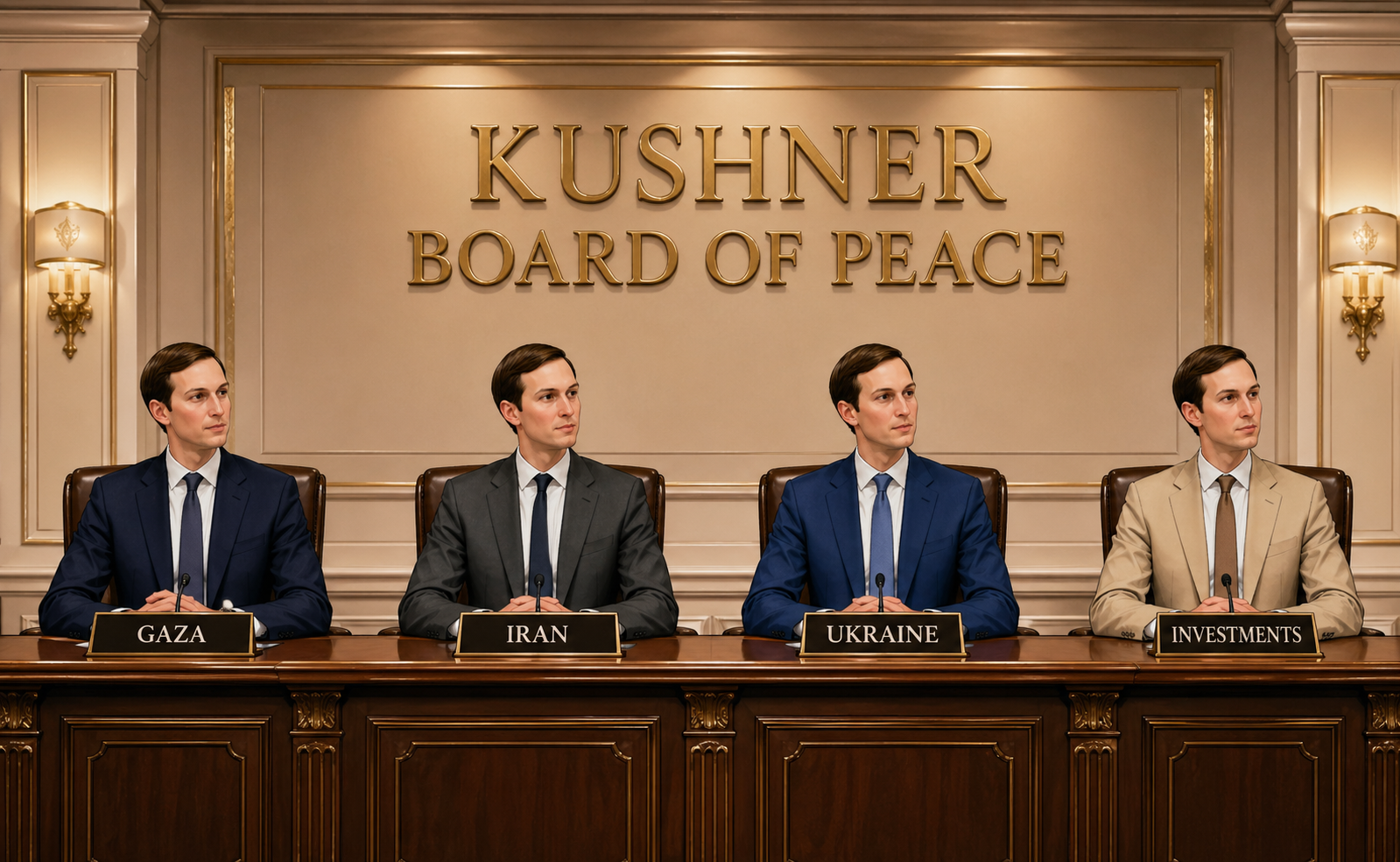
by author (AI)
A Region in Crisis
As the Iran War enters its ninth week, diplomatic efforts continue in hope of finding a formula at least marginally acceptable to the U.S., Israel, and Iran. Proposals and counterproposals are exchanged alongside threats and insults. The possibility of a return to full-scale fighting remains real. However, given that escalation is unlikely to achieve objectives that eluded the first six weeks of combat, it may therefore be useful to step back and examine how the Middle East was being reconfigured before the U.S. and Israel launched a joint preemptive strike against Iran on February 28th.
The old security architecture — built on American military dominance, Israeli deterrence, Gulf hedging, and Iranian proxy warfare — was no longer providing stability. A new structure was emerging, but its final shape remained uncertain. It might have produced an era of unprecedented regional integration, economic modernization, and diplomatic normalization. Instead, it collapsed into a dangerous conflict that has put the global economy at severe risk.
Who Designed the New Middle East?
To understand how the so-called New Middle East transformation got derailed — and whether it can get back on track — requires asking a deceptively simple question: who actually designed it?
Many observers offer familiar answers. Some point to Donald Trump, whose administration brokered the Abraham Accords, reshaped U.S. policy toward Iran, and reoriented regional alignments. Others point to Benjamin Netanyahu, whose long-standing strategic vision — normalization with the Gulf, containment of Iran, marginalization of the Palestinian issue — appeared ascendant, though it is now increasingly contested.
But there is a third hypothesis, one that has become more difficult to dismiss. Across diplomacy, capital flows, reconstruction planning, and regional alignment, one figure appears repeatedly: Jared Kushner. Whether he is a strategist in his own right or the product of deeper structural forces remains an open question. But his role is neither incidental nor easily replaced.
The Three Pillars
The first pillar is Kushner’s grounding in a tightly networked ecosystem of American Jewish philanthropy and Modern Orthodox communal life. For decades, the Kushner family has been embedded in institutions linking donors, religious organizations, and Israeli political and social actors. This environment is primarily relational rather than ideological — providing access, trust, and continuity across borders, and shaping a worldview in which Israel is a central communal commitment rather than merely a strategic partner. This pillar does not determine policy outcomes, but it facilitates early access to Israeli leadership and reinforces a consistent orientation toward Israeli security and regional integration.
The second pillar is Kushner’s marriage into the Trump family, which placed him at the center of American political power at a moment when formal process was routinely subordinated to personal trust. Within a White House that privileged loyalty over bureaucracy, Kushner operated as a trusted intermediary able to convene foreign leaders, shape diplomatic priorities, and bypass institutional friction. The Abraham Accords emerged from this environment — a diplomatic achievement inseparable from a political structure in which traditional State Department channels were partially circumvented. This pillar transformed Kushner from a real estate developer into a geopolitical broker with direct influence over U.S. policy execution.
The third pillar is his capacity to build unusually close personal and financial relationships with Gulf leadership, most notably Saudi Crown Prince Mohammed bin Salman. Gulf sovereign wealth funds — particularly Saudi Arabia’s Public Investment Fund — are no longer passive financial actors; they are instruments of state strategy. Kushner’s post-government firm, Affinity Partners, secured a $2 billion anchor investment from the Saudi PIF within months of his departure from the White House in 2021, reportedly approved by the Crown Prince despite internal reservations within the fund. In the United States, the arrangement generated scrutiny and conflict-of-interest allegations. In the Gulf, it is more consistent with long-standing patterns of elite, relationship-driven dealmaking in which political trust and financial partnership are deliberately intertwined.
Taken together — communal access, political authority, and capital alignment — these three pillars explain why Kushner appears at the intersection of so many regional developments: the Abraham Accords, Saudi-Israeli normalization efforts, post-conflict Gaza reconstruction frameworks, and Iran policy. His influence derives not from traditional diplomatic credentials but from his ability to operate simultaneously across systems that are typically separated. In a region where capital moves quickly and personal relationships often outpace formal agreements, that convergence produces a distinct form of leverage.
Architect or Conduit?
The central question is whether Kushner is best understood as an architect or as a conduit for deeper forces already in motion. One interpretation sees him as a strategist who recognized earlier than most that the region’s future would be shaped less by ideology than by economic integration and elite alignment. Another sees him as the inevitable product of a system in which Gulf capital, Israeli security interests, and American political entrepreneurship were already converging — making him less a designer than an accelerant, compressing timelines and giving political form to trends that might otherwise have evolved more slowly.
The distinction matters. If Kushner is primarily an architect, the emerging regional order reflects intentional design and may retain coherence under stress. If he is primarily a conduit, its durability depends on the strength of the underlying convergence. If those structural forces are robust, the architecture will outlast any individual. If they are overstated — if elite alignment has outrun political realities on the ground — the system may prove more fragile than it appears.
It is worth noting that Gulf-Israeli convergence was likely underway regardless, driven by shared threat perceptions of Iran and the declining centrality of the Palestinian issue among key Arab governments. October 7th, 2023 disrupted that trajectory sharply: movement toward Saudi-Israeli normalization became politically impossible while tens of thousands of Palestinian civilians were dying in the Israeli counterattack. But new opportunities emerged after Hamas was effectively destroyed as a conventional military force — complicated by the fact that over 200 Israeli hostages remained in Gaza and Israeli public opinion had hardened considerably in the aftermath of the massacre.
From Gaza to the Board of Peace
When President Trump took office in January 2025, he signaled it was time to end the war in Gaza. Initially Kushner was not involved; Steve Witkoff served as the administration’s primary special envoy through the spring and summer mediation effort. When talks stalled after a September rupture, the White House informally reengaged Kushner to provide political weight and regional outreach that helped break the hostage negotiation logjam and push the October Sharm el-Sheikh package across the finish line. Witkoff maintained the negotiation architecture that made a final deal possible; Kushner’s reengagement supplied the convening leverage to finalize and institutionalize it through the UN process. Both were subsequently named to the Gaza Board of Peace with key roles in the broader U.S. implementation effort.
The accelerated diplomacy was initially stunning. But it carried structural risks. The model that emerged was heavily elite-driven, capital-intensive, and reliant on personal relationships rather than institutional depth. It assumed that top-down normalization could outpace or contain unresolved political conflicts — particularly the Palestinian question. These are not necessarily fatal flaws, but they are vulnerabilities: systems built on personalized networks can move quickly, but they can fracture just as quickly when those networks weaken or diverge.
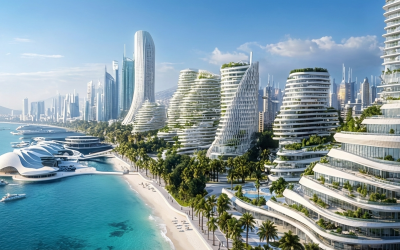
That is precisely what happened when the Board of Peace was officially unveiled in mid-November 2025. President Trump — granted a two-year mandate for Gaza stabilization by the UN Security Council — unilaterally extended his chairmanship for life, granted himself the right to choose his successor, and claimed authority to direct all reconstruction funding. He also signaled that Gaza was just the beginning and that the Board would soon take on other conflicts, seemingly superseding UN authority altogether. The fallout was immediate: European states refused to join, Arab states made only minimum contributions, and the Board effectively collapsed before any reconstruction had begun. Kushner’s sweeping architectural designs for a New Gaza became symbols of diplomacy disconnected from reality.
The War and What Comes Next
The world was still absorbing the Board of Peace’s failure when the U.S. and Israel struck Iran. Kushner and Witkoff were in the middle of nuclear negotiations at the time. New Gaza and the new Middle East were quickly forgotten as the region resumed its familiar pattern of retaliation and escalation.
The outcome remains uncertain. Unlike Witkoff, Kushner has been diplomatically discreet about his views on the war and the ongoing negotiations. But it seems increasingly unlikely that the current stalemate can be resolved by force alone. Sooner or later, President Trump will need an off-ramp. Given his three-pillar positioning — the trust relationships with Gulf leadership, the ties to Israeli political networks, and his direct line to the President himself — Kushner remains the figure best placed to help him find one.
Related Topics
Related Posts