

The Lamp at the Door
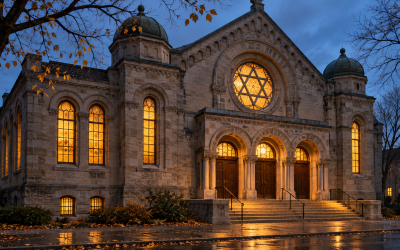
photo credit: chat gpt images
On the night of November 9, 1938, the fire brigades of Germany were out in force. Their orders were to keep the flames from reaching the buildings next door. The synagogues they were to let burn.
I have read a great deal about Kristallnacht over the years, and that detail still stops me. The state knew exactly how to fight a fire. It could tell one roof from another, send its men, and save what it chose to save. It simply decided that a Jewish house of worship stood outside the circle of things worth protecting. By the next evening some 1,400 synagogues had been destroyed across Germany and Austria, at least ninety-one Jews had been killed, and about 30,000 Jewish men were on their way to the camps. Afterward the government confiscated the insurance money owed to the Jews and fined the Jewish community for the damage.
John Lang was a boy in Berlin that night, staying with his grandmother, and from her window he watched his synagogue burn. Many years later, writing in The Wall Street Journal, he remembered a group of Berliners pointing at a stain on the pavement, calling it a Jew’s blood, and laughing. He said he could still hear them. The photographs from Fürth and Nuremberg that Yad Vashem has preserved tell the same story: a crowd of ordinary people watching a shop window being smashed, and looking pleased about it.
The glass was only the evidence. What really broke that night was the Jew’s claim on his neighbor’s conscience, and the neighbors had been letting go of it for five years.
In the decades since, we have built an enormous culture of remembrance. We record testimony, build museums, bring students to Auschwitz, and say “never again” at every commemoration. I am grateful for all of it. But I have come to think that remembrance can turn into a kind of self-congratulation. It costs nothing to condemn the Nazis. The real test is whether we will say something when it costs us an ally, an audience, or the comfort of an explanation that makes the targeting of Jews sound reasonable.
Which brings me to Philadelphia. Today, on the eve of the anniversary, a coalition of activist groups is riding bicycles around Rittenhouse Square past six Jewish- and Israeli-owned restaurants: Dizengoff, Huda, Schlesinger’s, Mac Mart, K’Far, and Goldie. Their flyer says “these Zionist establishments must go,” and one of their posts called the owners disgusting human beings. According to JTA’s reporting, the organizers deny choosing the date on purpose. Perhaps so. But when followers suggested other Jewish businesses to add, an organizer explained that these six were picked because they were close enough to reach by bike. The list was not drawn from anyone’s corporate conduct. It was drawn from a map of where Jews make sandwiches.
I want to be careful here, because care is part of the obligation. People in this country may criticize the Israeli government, protest the war, and spend their money where they like. I will defend that right for anyone. What a free society cannot accept is a rule that a Jew may run a lunch counter only after passing a test of his views on Israel. An accusation needs evidence. A man’s Jewish name, his Israeli birth, or his love for Israel is not evidence of anything. And nothing in a genuine concern for Palestinian dignity requires degrading the Jewish family down the street.
The mayor of Philadelphia, the governor of Pennsylvania, and the state’s attorney general all condemned the ride. Two of them are Democrats and one is a Republican. I have written often about feeling politically homeless, and I confess it was a relief to see people on both sides of the aisle draw the same line. It matters, too. When public officials draw that line, they tell a city what it will and will not tolerate.
This is not 1933, and I will not pretend that it is. No government stands behind those cyclists, and every level of government has spoken against them. That difference is everything. But memory exists to teach us before things become catastrophic, and the order of events in Germany is worth knowing. The regime’s first national action against the Jews, on April 1, 1933, was a boycott of Jewish shops, with storm troopers posted at the doors. Kristallnacht came five and a half years later. Guy Miron of Yad Vashem has described the change it brought in one sentence: “Before Kristallnacht people emigrated. After it, they fled.” A community that has learned anything from that history objects when the list is drawn, long before anyone reaches for a stone.
This Shabbat we read Toldot, and the Torah portion could hardly be more pointed. Isaac grows prosperous in Gerar, and the Philistines envy him (Genesis 26:14). They fill his father’s wells with earth. Then King Avimelech says to him, lekh me-imanu, ki atzamta mimenu me’od, “Go away from us, for you have become too mighty for us” (26:16). I know of no older version of the speech Jews have heard in so many languages since.
Isaac does not curse them and he does not vanish. He goes back and digs out his father’s wells and calls them by the names his father gave them (26:18). Then he digs new ones. The herdsmen of Gerar fight him over the first, which he names Esek, contention, and over the second, Sitnah, enmity. Over the third there is no quarrel, and he calls it Rehovot, “for now the Lord has made room for us” (26:22). The Ramban, who taught that the deeds of the fathers are a sign for the children, saw in those three wells the three Temples. I see in them, this week, the Jews who fled Germany after 1938 and dug again wherever they landed, in the Land of Israel, in New York, and on the plains of Nebraska.
But Isaac’s story also raises a harder question, one about us rather than our enemies. What becomes of a people whose whole identity is organized around the people who hate it?
Rabbi Joseph B. Soloveitchik gave us language for this in Kol Dodi Dofek, written in the years after the Holocaust. He distinguished between the brit goral, the covenant of fate, and the brit yi’ud, the covenant of destiny. The covenant of fate is the one imposed on us. It binds Jews together whether they believe or not, because the world does not ask what kind of Jew you are before it hates you. He tied it to Egypt. The covenant of destiny is the one we choose: a life of Torah, mitzvot, learning, and responsibility. He tied that one to Sinai.
Antisemitism can remind a Jew that he belongs to the Jewish people. It cannot tell him what that belonging asks of him. A generation that learns mostly to recognize its enemies may become very alert and remain strangers to their own tradition. I do not want our children to discover they are Jewish only when someone hangs a sign on a Jewish door. I want them to know enough to understand what is being attacked: the rhythm of Shabbat, the intimacy of Hebrew, the noisy arguments of the beit midrash, a community that actually lives the obligations it teaches.
The survivors who were children in 1938 are now in their nineties and hundreds. Very soon no one will be left who can say, I was there. Yosef Hayim Yerushalmi argued in Zakhor that the Jews preserved their past for centuries not through historians but through ritual and commandment. If that is right, then the future of this memory depends less on our museums than on our Seder tables and our classrooms.
The Talmud already knew about fear. In tractate Shabbat (21b) the Sages teach that the Hanukkah lamp belongs at the entrance of the house, on the outside, where the street can see it. Then they allow that bi-sh’at ha-sakkanah, in a time of danger, one may set it on the table indoors, ve-dayo, and that is enough. I have always loved the honesty of that word dayo. The Sages permit the retreat, but they call it what it is: a concession. The mitzvah is the doorway.
On Hanukkah of 1931, in the port city of Kiel, Rachel Posner, the rabbi’s wife, photographed her family’s menorah on the windowsill. Across the street the local Nazi Party had hung its flags. On the back of the picture she wrote, in German, “Death to Judah,” so the flag says. “Judah will live forever,” so the light answers. The family reached the Land of Israel a few years later. That flag no longer flies anywhere on earth, and her descendants still light that menorah.
Tomorrow night more than a thousand synagogues and Jewish institutions around the world will leave their lights on until morning, as part of an initiative called Spread the Light. It was begun in 2008 by Rabbi Yechiel Wasserman of the World Zionist Organization and is led today by Dalia Yohanan, together with Yad Vashem. Her father survived Kristallnacht as a boy and was sent to England on a Kindertransport. His parents were murdered. She has said that many communities are afraid to shine their light outward for fear of being seen. That is the Talmud’s time of danger in modern clothes.
My own answer is that security and visibility are not rivals. The Torah commands us to guard our lives with great care (Deuteronomy 4:15), so we lock our doors, train our ushers, and pay for guards without apology. Then we turn the lights on. The guard at the entrance protects what happens inside. What happens inside has to be worth protecting.
When the Torah commands the kindling of the ner tamid, the eternal lamp of the Tabernacle, Rashi explains that the priest must hold the flame to the wick until the light rises by itself. I can think of no better description of Jewish education. We are not meant to hold the flame forever. We are meant to tend it until it burns on its own in someone else. Will our children pray when the headlines are quiet? Will they open a Jewish book without needing an antisemite to send them there? Will they love what they have inherited enough to hand it on?
The Jews of 1938 did nothing to bring the hatred on themselves. Their learning, their patriotism, and their devotion to Germany could not save them. One of the duties we owe them is to refuse to remember them only by the way they were persecuted. They had built whole worlds, and we have worlds of our own to build.
At Beth El, our lights will burn through tomorrow night. I hope yours will too, in your synagogue and in your own front window. If you live near Philadelphia, go have lunch at Huda or Dizengoff this week. A boycott list answered by a full lunch counter seems to me a very Jewish reply.
But a lit window is only a sign. The light that matters is a Jew who does not hide: a mezuzah on the doorpost facing the street, a minyan that shows up on a cold Monday morning, a text studied seriously, a child welcomed into a story much larger than herself. Here in Omaha, that is what Jewish life looks like on an ordinary week, and it is what gives survival its meaning.
Rachel Posner’s words echo the prophet Joel, who looked past the ruins of his own time and said, vi-Yehudah le-olam teshev, “Judah shall abide forever” (Joel 4:20). Let our neighbors see the light in our windows tomorrow night. Let them understand that Jewish belonging needs no one’s political permission. And then let us fill those buildings with a Jewish life worthy of the light.
We will keep our lights on, and our identity even brighter.