
A comedic survival guide to a country that breaks you, rebuilds you, and calls it Tuesday.
The Last Night in Johannesburg: Democracy, Departure and the Art of Leaving
Two elections, one sleepless night, three cats, and a suitcase that has finally decided to make Aliyah.
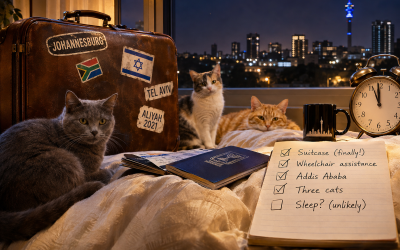
It’s almost midnight in Johannesburg. The household is asleep, and I’m sitting here wondering how people manage to close their eyes when they’re leaving for an airport in four or five hours.
My brother and his wonderful partner have retired for the night with the astonishing composure of people who believe tomorrow will take care of itself. I am wide awake, entirely untired and unlikely to sleep. My brain has apparently scheduled its annual general meeting, with every unresolved matter invited to attend.
Outside, Johannesburg is preparing for another day. Inside, I’m preparing to leave after a month that has been wonderful, infuriating, affectionate, and medically expensive.
My back has contributed enthusiastically to the last category. It now operates independently of my intentions, particularly when those intentions involve movement. I have learnt to assess every physical activity according to whether it is worth spending the next twenty minutes contemplating the ceiling.
Meanwhile, democracy has been having a rather eventful week.
Across the Atlantic, the American midterms have produced a blue tidal wave. Democrats have captured both houses of Congress, showing that an electorate can develop serious buyer’s remorse and express it at the ballot box.
Here in South Africa, municipal elections have occupied Wednesday’s national attention. More than 3.5 million people had voted by ten in the morning, and counting is under way.
One admires the faith required to vote for Johannesburg’s municipal government. This is a city where the relationship between a pothole and the municipality responsible for repairing it can outlast several marriages.
Yet people keep voting, hoping those entrusted with managing their communities will eventually care.
I find that admirable. Democracy remains a magnificent idea, even when its elected representatives insist on testing its limits.
Which brings me to my mother.
At my age, I remain the subject of occasional unsolicited assessments of my weight, welfare and general ability to conduct myself without supervision. It is remarkable how quickly decades of adulthood become irrelevant when one’s mother has an opinion about lunch.
But the domestic agenda is changing.
Mom’s partner is having a knee replacement. I wish him an excellent outcome and a comfortable recovery, while privately applauding the timing. A new orthopaedic issue has entered the household just as I prepare to leave it.
I make no predictions about whether my mother’s interest in my waistline will diminish, but geographic distance should make future consultations considerably easier to terminate.
Tonight, however, has belonged to my boetiful brother and his equally wonderful partner.
There is something delicious about sibling conversation. We can refer to an incident from decades ago in half a sentence, exchange a glance, and immediately understand exactly which family absurdity we’re discussing.
His partner has acquired this knowledge without the benefit of shared childhood trauma. An impressive achievement, although I suspect nobody adequately explained the terms and conditions when she joined the family.
I love them enormously.
And now, while they sleep, I’m faced with the thoroughly inconvenient business of missing them before I’ve even left.
There is also the matter of my luggage.
When I made Aliyah in 2021, I left a suitcase of clothing in South Africa. Five years later, it is finally accompanying me home, along with enough additional acquisitions to suggest I have misunderstood the purpose of a temporary visit.
My wardrobe has undergone reunification. My spine has declined to participate.
Wheelchair assistance is arranged for the journey through Addis Ababa and onwards to Israel, where I shall be reunited with three creatures entirely uninterested in the logistical difficulties of international travel.
Purrcy will take a moment to recognise me before attaching himself like Velcro. Petunia will politely request her special-diet wet food, preferably before any extravagant emotional displays interfere with dinner.
Sammi may not respond at all. I could arrive accompanied by a military brass band, and he’d remain occupied with some deeply private ginger consideration.
One long-lost soulmate, one returning head of catering and one largely irrelevant staffing change.
I cannot wait.
And perhaps that’s what makes tonight so strange.
For a month, I’ve been surrounded by family, old associations and familiar voices. Tomorrow, those people will resume their ordinary lives, and I’ll return to mine.
No dramatic revelations. No grand conclusions. Just the uncomfortable knowledge that the people we love continue existing at inconvenient distances, and no amount of modern technology has made a goodbye particularly pleasant.
It’s nearly midnight. My bags are waiting, my hosts are sleeping, and I have a few hours left in a country that will always matter enormously to me.
By tomorrow morning, the politicians will still be negotiating, the votes will still be counted, and I’ll be somewhere between two continents.
South Africa, this isn’t a farewell speech. It’s an adjournment.
And unlike certain elected officials, I know when it’s time to leave office.
Related Topics
Related Posts