The Legacy: Remembering Helena Schonfeld
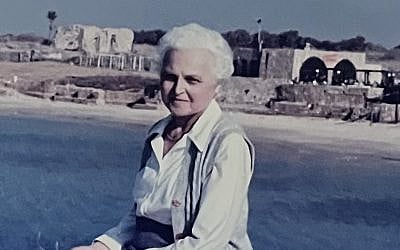
On January 8th, we remembered my grandmother Helena Schonfeld’s 113th birthday. Most people who know me, know that that after surviving the horrors of the Shoah, my grandmother and grandfather and father (Alexander, Helena and Gustav Schonfeld) arrived in the United States in June, 1946—almost 80 years ago. I have previously written about and given talks regarding the Shoah and our family’s survival–but that is not the true subject of this post. Instead, although Helena Schonfeld passed away almost 20 years ago, at 93, during the summer of 2006, I wanted to share a few stories and provide a few thoughts about my grandmother, a very special woman, who most people alive today never had the opportunity to meet.
Helena (Ili) Schonfeld was born on January 8, 1913, into an observant family in the little town of Nagyleta in the Hungarian part of the Austria-Hungarian Empire. Her father, Solomon Gottesmann, was trained as a Rabbi but became a businessman, owning and operating a lumberyard in the town where his brother was the Rabbi. Her mother, Irene Sonnenwirth, met Solomon when he was a rabbinical student in Nagyvarad and followed him to Nagyleta. Ili grew up in a farmhouse, in a rural area, adjacent to the lumberyard. At eighteen, Ili was introduced to Sandor (Alexander) Schonfeld, a young physician from the nearby town of Munkacs, Czechoslovakia (not very far across the border). After a brief courtship, they married and she moved to Munkacs. My grandparents became well established in their town, were contributing members of their community and had three sons. Their eldest son, Fredi, died of kidney disease at age 9, after WWII had started but before they were taken to the concentration camps. Their youngest son, Solomon, seven months old, was murdered in Auschwitz along with his grandmother Irene. All of what I have very briefly described regarding their lives and livelihoods was destroyed during the Shoah. Over half of our extended family were murdered. Understanding even a very highly abbreviated accounting of what happened to our family during the Shoah is an important part of understanding what followed.
When I was very young, I was lucky because my Grandma Ili and Grandpa Sandor lived around the corner from us and only a few minutes farther away later. In those early years, I could walk or ride my bike to their apartment—and did so frequently. And going there was almost always fun! At their apartment, Grandma Ili always took great care of me and my sister and brother. She was an excellent cook. She prepared our favorite foods—especially lemon chiffon pie, brownies and chocolate chip cookies (as well as traditional Hungarian dishes). I have no idea how many batches of chocolate chip cookies she made but they were ever present and always in the aluminum cookie jar. At times, I thought the jar just filled itself! They were especially good when we got them right out of the oven. What I did not know until much later is that Grandma Ili had never even tasted—much less made–a chocolate chip cookie until arriving in the US.
The fact the Grandma and Grandpa lived so close meant that we had either Shabbat dinner or Shabbat lunch with my grandparents almost every week. It also enabled me and my siblings to have many special times with her—sleepovers on Friday or Saturday nights where we could play games, stay up late and watch old movies–and get more of our favorite foods. Also, somehow, she invariably had a new Hot Wheels car stashed away somewhere. Only a grandmother (and only a special grandmother) would make tuna fish two different ways to accommodate my sister’s love for tuna with lots of mayonnaise and hardboiled eggs and mine with very little mayo and no eggs at all.
But most of all—what came out of those sleepovers and visits was her love of one-to-one conversations. That was where she shined. Grandma Ili loved it when she could just get you alone to talk. And I was able to talk with her about everything from Hot Wheels and sports (even though I’m certain she didn’t really get most of them) to world politics. In later years, we would have terrific conversations about our family and my work and whatever was happening in Israel. After I moved to Maryland, we spoke frequently by phone. She and my wife Suzanne developed a special bond as the mothers of three sons—and sharing a love of cooking. We made many visits to St. Louis to spend time with her as travel became increasingly difficult. She was (and we were) quite lucky that she was able to meet—and get to know 7 great grandchildren—whom she lovingly embraced at every opportunity.
I also have to add a few thoughts about Judaism, Israel, Tzedakah and legacy.
Shortly after arriving in St. Louis, my grandfather resumed practicing medicine and Ili and Sandor immediately became contributing members of their community in St. Louis and in Israel. They developed a deep bond with Israel and visited often, spending extended periods in Jerusalem. We were lucky enough to accompany them there on several trips. They contributed to many organizations in the Jewish community in St. Louis and in Israel—supporting Jewish education, hospitals and medical schools. They also supported hospitals and universities and other charities in the general community too. As I grew up in St. Louis and entered into adulthood, I was proud to be a part of a family that gave back to its community. I remain so today.
Although my grandfather worked very hard and was the breadwinner of the family and a very committed member of the Jewish community, it was not until after he passed away in 1987, that we realized that my grandmother was the backbone of her family’s unwavering commitment to Judaism and to Israel and her community. Grandma Ili was the family member who survived the Shoah with her faith most intact, because her son and husband survived. We all understood that the fact that our father Gustav survived a year in the concentration camps and slave labor camps of Auschwitz, Warsaw, Dachau and Muehldorf—at age 10–was due to the heroism of our grandfather, Sandor Schonfeld, and divine intervention. We owed our existence to our grandfather’s heroism and to a divine plan that was beyond our understanding. After surviving the concentration camps, Grandma Ili made her way back to Munkacs and snuck into the backyard of what had been their home and dug up a couple pieces of jewelry and two Siddurim (prayer books) that she had hidden before they were taken away. We still have those Siddurim and they are an additional source of inspriation. Behind the scenes, my grandmother was the one who set the standard for Jewish observance for the surviving family of three and the succeeding generations.
As noted above, I have many fond memories of Shabbat and Holiday meals together, prepared by Grandma Ili. We often attended Shabbat and other Holiday services with my grandparents at the orthodox shul they attended (Chesed Shel Emeth), that was just down the block. It was at that same synagogue where my Bar Mitzvah was held in 1975. I know that I can trace back my enjoyment of attending services to those days, sitting with my father and grandfather (sometimes both grandfathers, when my Steinberg grandfather was visiting from Israel or Florida). I would always stop in to see or wave to my elegantly dressed mother and grandmother over in the women’s section. Many years later, each time I attend services today, at certain points during the davening, I experience moments of time travel—evoking warm memories of those days.
Grandma Ili was also the one who met with the various shlichim (emissaries) who showed up at their home frequently. In those days, before the internet, the schlichim came by in person—often unannounced–to collect contributions (and back in those days, they were always observant men who travelled from place to place for this purpose). My father recalled that she never turned any of them away with no donation—unless it was during mealtime and she asked them to return later. After listening to these visitors, I specifically remember her writing checks while sitting at her kitchen table. What we didn’t know then was that Grandma Ili played such a significant role in deciding where the dollars went. After her passing and burial in Jerusalem, during shiva and afterwords, my father heard many stories and received numerous notes and cards about her charitable giving.
Grandma Ili and Grandpa Sandor set an example for all of us, and they continue to do so. After losing everything during the Shoah, they started over at ages 44 and 33. They did not spend time acquiring material possessions but instead shared their good fortune after the war by giving Tzedakah to others. Grandma Ili’s example (and that of my parents Miriam and Gustav Schonfeld—who continued that legacy) is a large part of why Suzanne and I have the traditional home that we have and why our three sons attended Jewish day school and why we live the life that we live. Between them, they instilled in us the Jewish values of Ahavat Yisrael and Tzedakah–as well as a deep pride in our Jewish heritage. The bond they established with the land and people of Israel after surviving the Shoah was unconditional. Miriam and Gustav Schonfeld continued in their footsteps–and we continue in their work. Their example is also a significant reason why I have spent many years working for the betterment of the Jewish community where we live in Maryland and in Israel. It is also why I have recently assumed the role of president of the Washington, DC regional board of JNF-USA—to assist our extended family in Israel and continue the kesher (bond) they established. It is my honor to do so.
Helena (and Alexander) taught us that the Jewish People do not crumble in the face of tragedy or adversity. We literally (and figuratively) get up after being knocked down, we brush ourselves off, and we keep going. And not only that–we thrive. It is a message for all of us. They overcame tragedies and loss just as the Jewish people have done over the millennia. Am Yisrael and Medinat Yisrael will do so at this time too.
That our people and our community endure is our responsibility. Helena Schonfeld taught us not to take it for granted. I consider myself lucky to have had the zuchus (merit) to spend so much time with her. May her memory continue to be for a blessing.