The Lie at the Heart of the Iran Memorandum
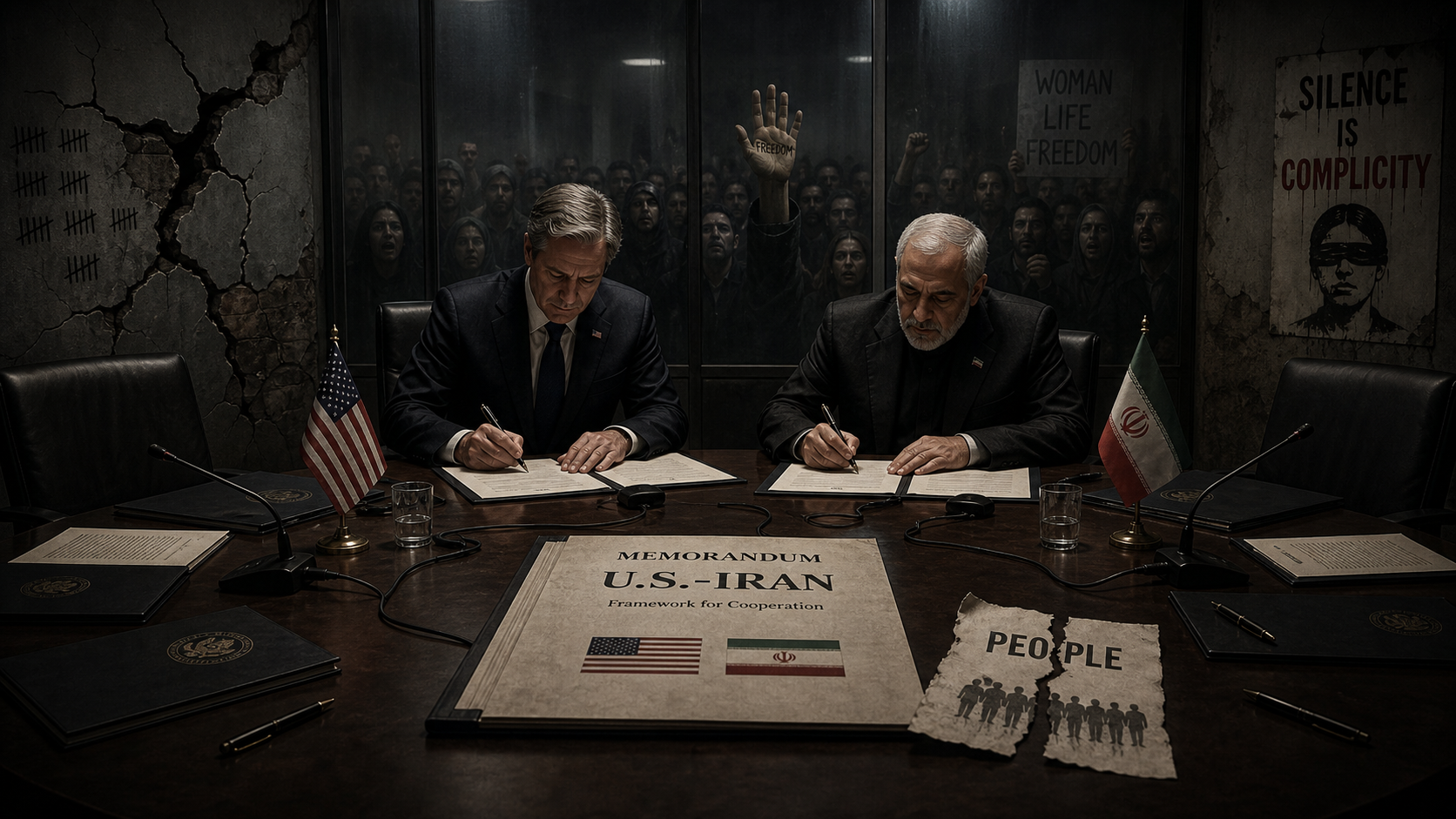
What is striking about the US-Iran memorandum is not only what it includes, but what it leaves out. It is dressed in the language of war prevention, sanctions relief, nuclear restraint, and regional calm. Yet it manages to erase the one thing that ought to sit at the centre of any serious agreement: the Iranian people.
That omission is not accidental. It is the familiar diplomatic fraud. The great and the good will speak solemnly about obligations, international responsibility, human rights, and the duty to avert wider catastrophe, then draft a document that treats Iran as a problem to be managed rather than a country to be reckoned with. They promise accountability with one hand and file away the people who must live with the consequences with the other. The population is praised in theory and ignored in practice.
And what of President Trump’s promises? He has made a habit of speaking as though forceful rhetoric were a substitute for principle. He promises strength, deliverance, deal-making, and a new seriousness. But if those promises end in another arrangement that secures the state while ignoring the society, then the performance was hollow from the start. One can hardly brag about toughness if it stops at the perimeter of the regime and never reaches the prisons, the streets, the universities, or the homes where fear is part of daily life.
The international community is no better. It likes the word “commitment” because it sounds noble without asking much in return. Yet when the moment comes to commit to the people of Iran, to their right to breathe without coercion and speak without terror, the enthusiasm thins out quickly. We are told that stability must be protected, escalation avoided, and the regional balance preserved. Fine. But those are not excuses for forgetting the people in whose name every polished statement is supposedly made.
The regime in Tehran has never been merely authoritarian in the abstract. It has been a machine for humiliation, coercion, and fear. It has jailed journalists for telling the truth, hounded women for refusing to submit, broken students for speaking too freely, and treated protest as a crime against the state. Its morality police have marched into ordinary life with the zeal of inquisitors and the self-assurance of petty enforcers. It has beaten, disappeared, and executed opponents with the solemnity of a system that believes repression is a duty.
These horrors are not theoretical. They are lived. They begin with surveillance and end with graves. They pass through prison cells where dissidents are interrogated, isolated, and abused. They move through public squares where fear is staged as order. They reach into homes where families wait for sons and daughters who may never come back. They have included the crushing of protests with live fire, the arrest of lawyers, the silencing of artists, and the routine reduction of citizenship to obedience. A regime that has spent decades perfecting intimidation does not suddenly become respectable because diplomats have drafted a careful paragraph about stability.
That is why a memorandum that leaves the Iranian people nearly invisible cannot be treated as a triumph of statecraft. It is an indictment of diplomatic cowardice. It asks the world to admire the handwriting and ignore the blank space where human beings ought to be.
The regime has long understood what outsiders keep pretending not to see: pressure from abroad can be endured more easily when internal opposition is left to bleed alone. A deal that calms markets, eases anxieties, and trims the risk of escalation while leaving the machinery of repression intact does not solve the Iranian problem. It subsidizes it.
There is also a particularly ugly habit in Western diplomacy of separating the regime from the nation in one direction only. When it wants leverage, it invokes the people. When it wants compromise, it invokes the state. Iranian citizens are then useful as moral decoration and inconvenient as political subjects. That is not realism. It is cynicism with a polished tie.
President Trump’s promises should be judged against that background. If he claims to stand for strength, then strength must mean more than a pose. It means refusing the lazy bargain that trades away the moral claim of the Iranian people for the appearance of strategic progress. If he claims to oppose tyrants, then he cannot treat tyranny as a tolerable detail once a memorandum has been signed. And if the international community claims to have duties, then those duties cannot stop at the edge of the regime’s security interests. Duties to peace that exclude duties to people are not duties at all. They are conveniences.
The real scandal is that the world has seen this pattern before. It watches regimes brutalize their own populations, then asks for patience while negotiations proceed. It speaks of moderation while the prisons fill. It praises engagement while the regime takes the praise as permission to continue. The Iranian people are left to carry the cost of everyone else’s restraint.
A serious agreement would begin not with the comfort of states but with the condition of the governed. It would recognize that the Iranian people are not a footnote to the problem. They are the problem, the answer, and the future all at once. Any document that leaves them barely visible is not just incomplete. It is morally compromised from the first line onward.